Chapter 5 Equilibra
暂无描述。系统推荐的高质量记忆内容,适合每天坚持背诵学习。
卡片预览 (24 张)
A Brønsted acid
• is a species that can donate a proton • For example, hydrogen chloride (HCl) is a Brønsted acid as it can lose a proton to form a hydrogen (H+) and chloride (Cl-) ion HCl (aq) → H+ (aq) + Cl- (aq)
A Brønsted base
• is a species that can accept a proton • For example, a hydroxide (OH-) ion is a Brønsted base as it can accept a proton to form water OH- (aq) + H+ (aq) → H2O (l)
In an equilibrium reaction, the products are formed at the
• same rate as the reactants are used • This means that at equilibrium, both reactants and products are present in the solution
A conjugate acid-base pair
is two species that are different from each other by an H+ ion • Conjugate here means related • In other words, the acid and base are related to each other by one proton difference
Conjugate acid-base pairs are a pair of reactants and products that are linked to each other by the
transfer of a proton
The pH indicates the
• acidity or basicity of an acid or alkali • The pH scale goes from 0 to 14 • Acids have pH between 0-7 • Pure water is neutral and has a pH of 7 • Bases and alkalis have pH between 7-14
calculation of pH
• The pH can be calculated using: pH = -log10 [H+] where [H+] = concentration of H+ ions (mol dm-3) • The pH can also be used to calculate the concentration of H+ ions in solution by rearranging the equation to: [H+] = 10-pH
The Ka is the
• acidic dissociation constant • It is the equilibrium constant for the dissociation of a weak acid at 298 K • For the partial ionisation of a weak acid HA the equilibrium expression to find Ka is as follows: HA (aq) ⇌ H+ (aq) + A- (aq)

When writing the equilibrium expression for weak acids, the following assumptions are made:
• The concentration of hydrogen ions due to the ionisation of water is negligible • The dissociation of the weak acid is so small that the concentration of HA is approximately the same as the concentration of A-
The value of Ka indicates the extent of
dissociation • A high value of Ka means that: • The equilibrium position lies to the right • The acid is almost completely ionised • The acid is strongly acidic • A low value of Ka means that: • The equilibrium position lies to the left • The acid is only slightly ionised (there are mainly HA and only a few H+ and A- ions) • The acid is weakly acidic
Since Ka values of many weak acids are high/low what values are used to compare
• very low, pKa values are used instead to compare the strengths of weak acids with each other pKa= -log10Ka • The less positive the pKa value the more acidic the acid is
The Kw is the
• ionic product of water • It is the equilibrium constant for the dissociation of water at 298 K • Its value is 1.00 x 10⁻¹⁴ mol2 dm-6 • For the ionisation of water the equilibrium expression to find Kw is as follows: H2O (l) ⇌ H+ (aq) + OH- (aq)

Kw : As the extent of ionisation is
• is very low, only small amounts of H+ and OH- ions are formed • The concentration of H2O can therefore be regarded as constant and removed from the Kw expression • The equilibrium expression therefore becomes: • Kw* = [H+] [OH-] • As the [H+] = [OH+] in pure water, the equilibrium expression can be further simplified to: • Kw* = [H+]2
Calculating [H+] & pH
• If the concentration of H+ of an acid or alkali is known, the pH can be calculated using the equation: pH = -log [H+] • Similarly, the concentration of H+ of a solution can be calculated if the pH is known by rearranging the above equation to: [H+] = 10-pH
Strong acids are completely
• ionised in solution HA (aq) → H+ (aq) + A- (aq) • Therefore, the concentration of hydrogen ions ([H+]) is equal to the concentration of acid ([HA]) • The number of hydrogen ions ([H+]) formed from the ionisation of water is very small relative to the [H+] due to ionisation of the strong acid and can therefore be neglected • The total [H+] is therefore the same as the [HA]
Strong alkalis are
• completely ionised in solution BOH (aq) → B+ (aq) + OH- (aq) • Therefore, the concentration of hydroxide ions ([OH-]) is equal to the concentration of base ([BOH]) • Even strong alkalis have small amounts of H+ in solution which is due to the ionisation of water
• The concentration of OH- in solution can be used to calculate the pH using the ionic product of water
Kw = [H+] [OH-] • Since Kw is 1.00 x 10⁻¹⁴ mol2 dm-6 • Once the [H+] has been determined, the pH of the strong alkali can be founding using pH = -log[H+] • Similarly, the ionic product of water can be used to find the concentration of OH- ions in solution if [H+] is known

A buffer solution is a
solution in which the pH does not change a lot when small amounts of acids or alkalis are added • A buffer solution is used to keep the pH almost constant • A buffer can consists of weak acid - conjugate base or weak base - conjugate acid
A common buffer solution is an
aqueous mixture of ethanoic acid and sodium ethanoate
Ethanoic acid is a …acid
• weak acid and partially ionises in solution to form a relatively low concentration of ethanoate ions

• When H+ ions are added:
• The equilibrium position shifts to the left as H+ ions react with CH3COO- ions to form more CH3COOH until equilibrium is re-established • As there is a large reserve supply of CH3COO- the concentration of CH3COO- in solution doesn’t change much as it reacts with the added H+ ions • As there is a large reserve supply of CH3COOH the concentration of CH3COOH in solution doesn’t change much as CH3COOH is formed from the reaction of CH3COO- with H+ • As a result, the pH remains reasonable constant
• When OH- ions are added:
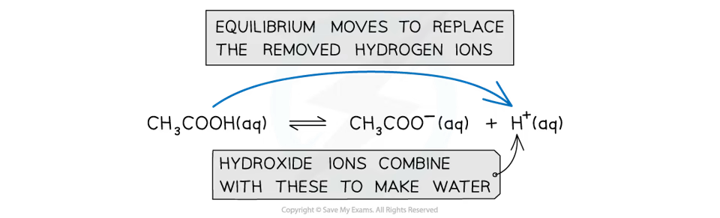
• The OH- reacts with H+ to form water OH- (aq) + H+ (aq) → H2O (l) • The H+ concentration decreases • The equilibrium position shifts to the right and more CH3COOH molecules ionise to form more H+ and CH3COO- until equilibrium is re-established CH3COOH (aq) → H+ (aq) + CH3COO- (aq) • As there is a large reserve supply of CH3COOH the concentration of CH3COOH in solution doesn’t change much when CH3COOH dissociates to form more H+ ions • As there is a large reserve supply of CH3COO- the concentration of CH3COO- in solution doesn’t change much • As a result, the pH remains reasonable constant
When hydroxide ions are added to the solution, the hydrogen ions react with them to form water; The decrease in hydrogen ions would mean that the pH would increase however the equilibrium moves to the right to replace the removed hydrogen ions and keep the pH constant
Uses of buffer solutions in controlling the pH of blood
• In humans, HCO3- ions act as a buffer to keep the blood pH between 7.35 and 7.45 • Body cells produce CO2 during aerobic respiration • This CO2 will combine with water in blood to form a solution containing H+ ions CO2 (g) + H2O (l) ⇌ H+ (aq) + HCO3- (aq)