Module 4a: Pharmaceutically Active Components
No description yet. This curated deck is ready for daily study.
Card preview (21)
The study of interactions btwn drug and organism.
Pharmacology! :D
The study of how a drug affects the organsim.
Pharmacodynamics!
The study of how the organism affects the drug.
Pharmacokinetics!
Pharmacodynamics can be affected by: (3)
• Disease state or disorder • Age • drug-drug interactions (polypharm)
Pharmacodynamics How do drugs bind to receptors? (4)
• Intermolecular forces • Covalent bonds • Hydrophobic interactions • Stereospecific interactions (enantiomers)
What are properties of drugs? (3)
• Affinity (binding) • Efficacy (desired effect) • Potency (compare relative affinity to competing drugs) *drugs act as ligands that bind to the receptors
Categories of drugs include: (4)
• Agonist • Antagonist • Competitive • Non-competitive
Pharmacokinetics
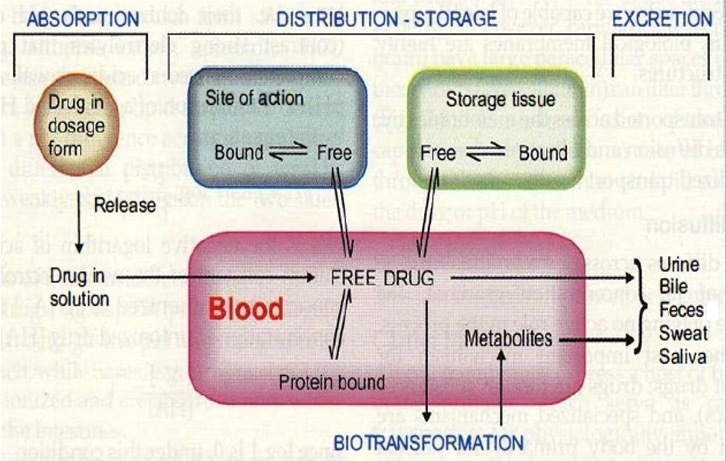
ADME
What determines the time to maximum concentration at the receptor to produce its peak effect?
Absorption rate.
What term describes how much of the drug administered that is actually absorbed?
Bioavailability. *usually talking about oral admin
What are some factors that affect bioavailability?
• MW of drug • drug formation • drug stability (pH) • 1st pass metab • blood flow • gastric emptying (food slows process) • GI motility • Drug interactions (polypharm?)
Distribution What affects distribution of the drug throughout the body?
• blood • TBW • extracellular fluids • lymph fluids • CSF • protein-binding • drug solubility properties
Hydrolysis, REDOX reactions (CYP450s), activating prodrugs are all examples of _____?
Metabolism of drugs. *has potential to form toxic metabolites :(
Kidneys, feces, lungs, sweat glands are all examples of _____?
Excretion of drugs.
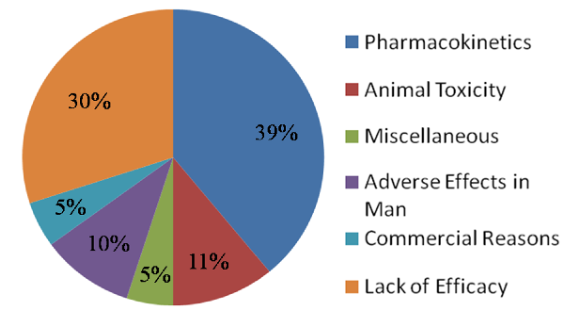
Drug Development What % of drugs make it out of clinical testing?
~10% *90% fail
When do most drugs fail clinical trials? What phase?
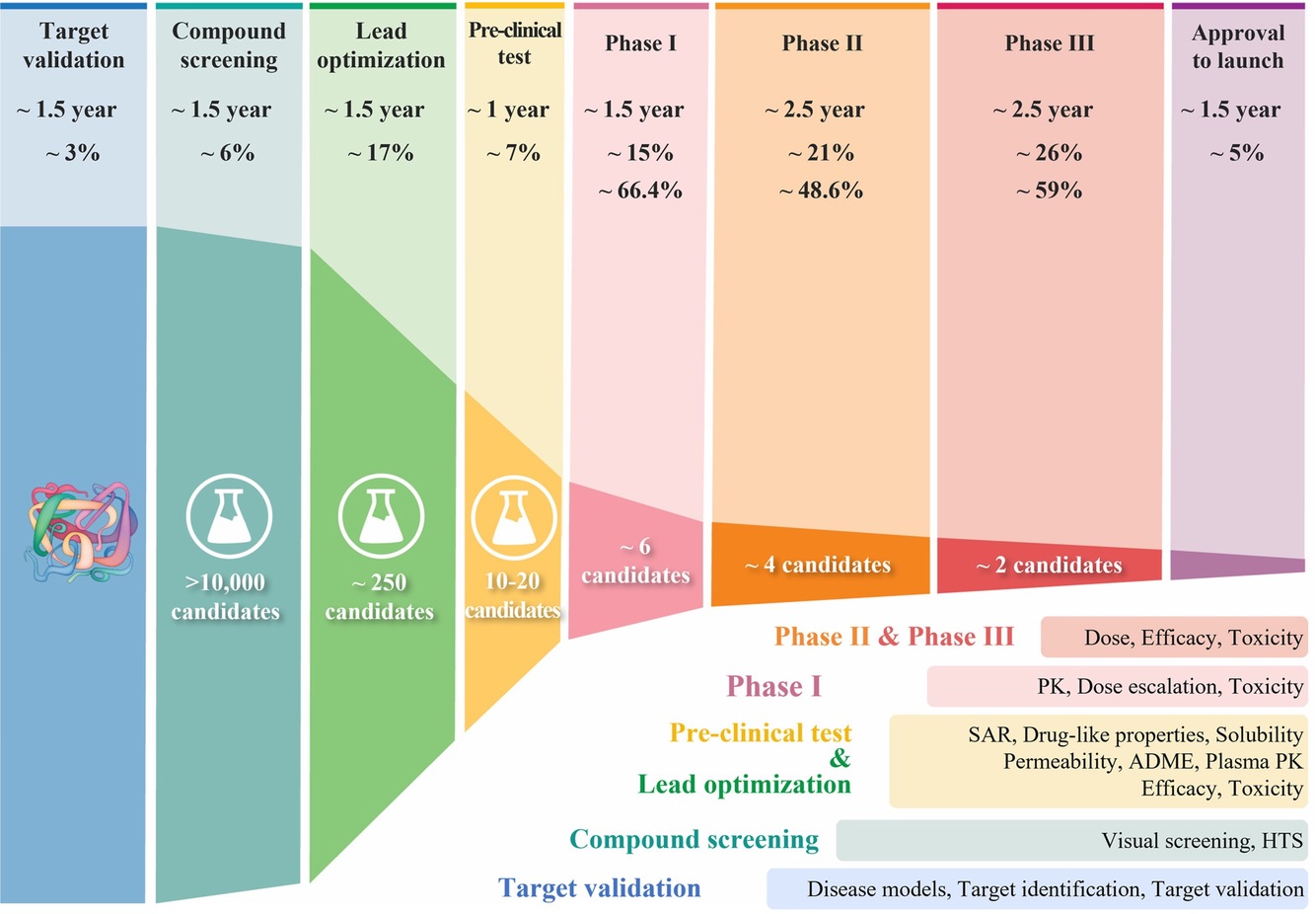
Discovery.
What is the “Lipinski Rule of 5” used for?
Tool to describe drug potential for a new chemical entity (NCE) & its bioavailability.
If you violate only 1 rule of Lipinski Rule of 5, can this drug be deemed orally bioavailable?
NO!
What are Lipinski Rule of 5 based upon?
• H bond donors (amines, alcohols) (no more than 5) • H bond acceptors (F, O, N) (no more than 10) • MW (less than 500g/mol) • Calculated partition coefficient (cLogP 5 or less)
If I develop a drug that is half lipophilic & half hydrophilic, is it safe to say it will move across cell membranes well?
YES! This is ideal. *So is a LMW and low cLogP.
What functional groups have been linked to increases in toxicity d/t their metabolite production? (5) And what is this called?
• Aromatic anilines • nitroaromatics • polycyclic aromatic hydrocarbons • aliphatic halides (group 7) • thiophenes (superman ring) STRUCTURAL ALERTS