3.3.5 Alcohols
No description yet. This curated deck is ready for daily study.
Card preview (24)
Alcohols have _____ melting and boiling points than alkanes of similar relative molecular mass
higher
Why do alcohols have higher melting and boiling points than alkanes?
∵ -OH group in alcohol means hydrogen bonding occurs between molecules
-OH group of alcohols can…
hydrogen bond to water molecules
….cannot bond to water molecules
Non-polar hydrocarbon chain
Why are alcohols with short hydrocarbon chains are soluble in water?
∵ of hydrogen bonding predominates
Why are alcohols with longer hydrocarbon chains are insoluble in water?
Non-polar hydrocarbon chain dominates
What is the benefit of making alkenes from a dehydration reaction?
Allows you to make alkenes from renewable resources i.e. without crude oil
Elimination Reaction Name the condition and product when an alcohol is used as a reactant
Product: Alkene • Al2O3 Catalyst • 450 K • Concentrated, hot H2SO4
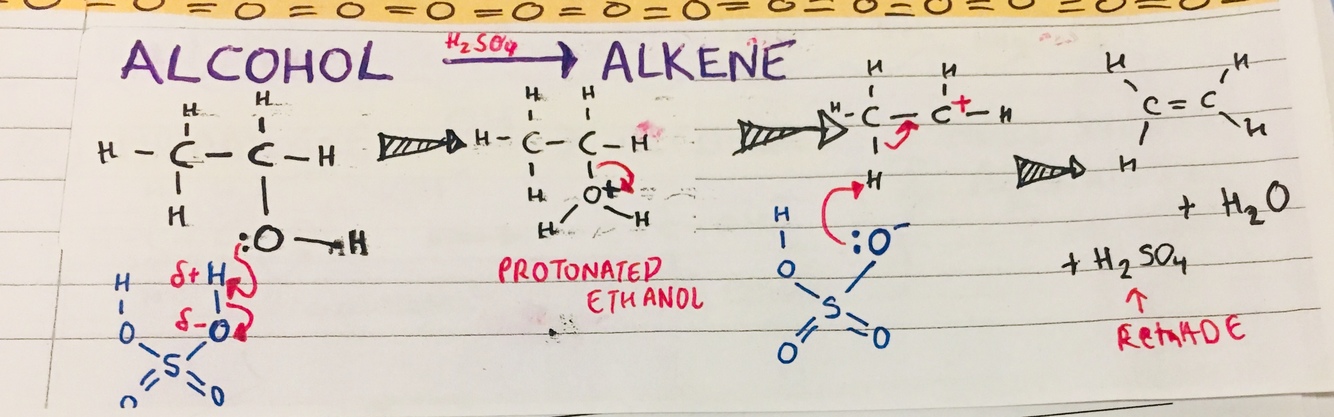
Ethanol + H2SO4 Name the mechanism
Elimination
Ethanol + H2SO4 Mechanism
H2SO4 - acts as a catalyst
How does distillation work?
Uses the fact that chemicals have different boiling points & separates them out to get a single purified substance
Name 2 ways ethanol can be produced
• Hydration • Fermenation
Describe hydration (4)
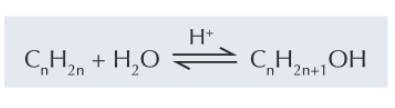
• Hydration of ethene using steam to produce ethanol • Acid catalyst • High temperature + high pressure • H2O added across double bond
Hydration Name 3 conditions for producing ethanol
• 300°C • Pressure of 60 atm • Solid phosphoric(V) acid catalyst • H3PO4
Describe fermenation
• Fermentation (exothermic reaction) is carried out by yeast in anaerobic respiration • Yeast produces an enzyme that converts sugars into ethanol and carbon dioxide • Ethanol formed is separated by fractional distillation
What is an advantage of using fermentation to make alcohol?
Low tech process (uses cheap equipment & renewable resources)
What is a disadvantage of using fermentation to make alcohol?
Fractional distillation is needed for purification = expensive & time consuming
State the equation for the hydration of ethene (include state symbols)
C2H4(g) + H2O(g) ⇌ C2H5OH(g)
State the equation for fermentation (include state symbols)

Name 2 ways alcohols can be oxidised
• Burn them • Use oxidising agent acidified potassium dichromate(VI), K2Cr2O7 to mildly oxidise them
Define Oxidation
• Loss of electrons • Gain of oxygen • (Loss of hydrogen)
Define Reduction
• Gain of electrons • Loss of oxygen • (Gain of hydrogen)
Define oxidising agent
Chemical that accepts electrons and gets reduced (supplies the oxygen or removes the hydrogen)
Define reducing agent
Chemical that donates electrons and gets oxidised (removes the oxygen or supplies the hydrogen)