Week 2 Day 1
No description yet. This curated deck is ready for daily study.
Card preview (24)
solute
thing being dissolved
solvent
thing doing the dissolving (often water)
Solution
result of dissolving solute in solvent
M
Molarity moles of solute / liters of solution *uses volume of solution not solvent
density of water
1 g/ml at 4ºC, less at other temps
m
Molality moles of solute / kg of solvent *molality uses mass of solvent
percent by weight to volume (%w/v)
grams of solute / 100 ml of solution
Percent by weight to weight (%w/w)
grams of solute / 100 g of solution
ppm
(grams of solute/grams of solution) * 1,000,000
1 equivalent (EQ)
1 mole of “reactivity” Ex. Na+ = one equivalent Ca++ = two equivalents
osmolarity
Concentration of a solution expressed as total number of solute particles per liter ex: the osmolarity of a 1 M solution of NaCl is 2 Osm
Solubility
the maximum amount of solute that will dissolve in a solvent usually has units of mass/vol
ÂHsolute
the energy needed to break up solute usually > 0
ÂHsolvent
the energy needed to break up solvent usually > 0
ÂHmix
the energy we get back by the new arrangement usually < 0
ÂHsolution
total energy change during dissolving of solute > 0 needs energy (endothermic) < 0 gives off energy (exothermic)
Effect of pressure on solubility
Increased pressure causes more gas to dissolve into solution S = kH * Pgas kH is specifec for each gas and is temperature dependent
Effect of temperature on solubility
• increased temperature increases solubility of liquids and solids • increased temperature decreases solubility of gases
Colligative properties of solution
• vapor pressure decreases with increasing solute concentration • boiling point increases with increasing solute concentration • freezing point decreases with increasing solute concentration • osmotic pressure increases with increasing solute concentration
Vapor pressure
pressure of the vapor caused by the evaporation of a liquid above the sample of liquid in a closed container.
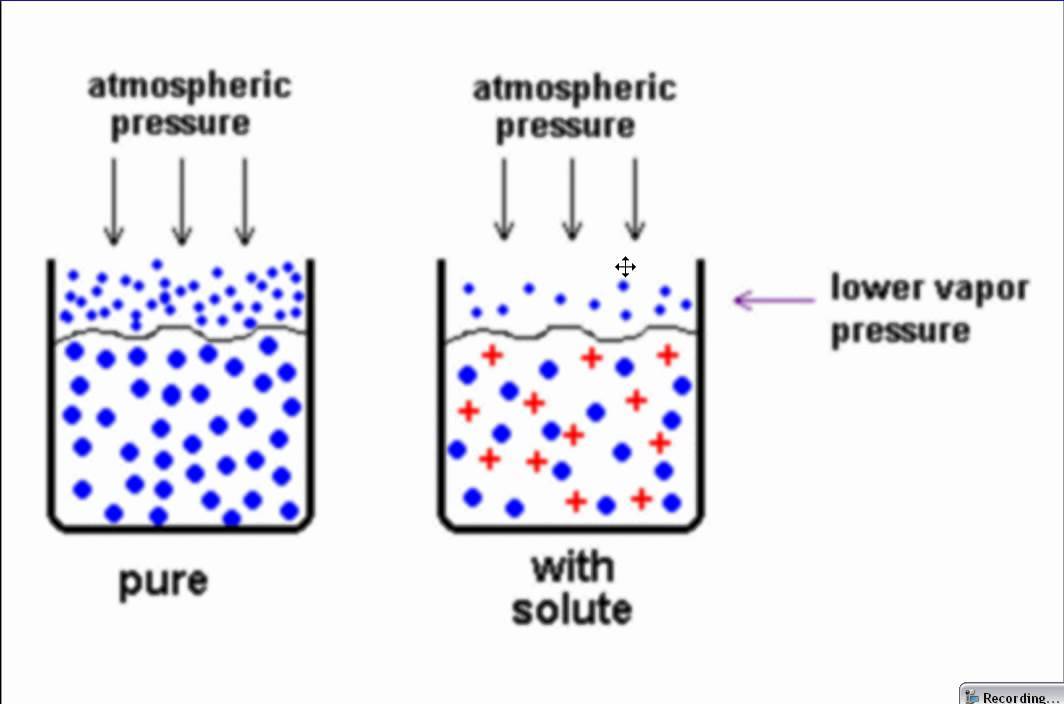
Vapor pressure, Raoult’s law
Ps = Xs * Pºs Ps is vapor pressure exerted by solute Xs is the mole fraction of s in the solution P°s is vapor pressure of pure S
Osmotic pressure
water wants to move from high concentrations to low Π = M * R * T Π is osmotic pressure M is molar concentration R is universal gas constant T is temperature
Colloids
contain particles larger than molecules suspended in a solvent
osmole
number of moles of solute that contribute to osmotic pressure