ChemPath: Hypoglycaemia
No description yet. This curated deck is ready for daily study.
Card preview (24)
Outline the first step in the management of hypoglycaemia patients in the following states: • Alert and orientated • Drowsy/confused but swallow intact • Unconscious or concerned about swallow
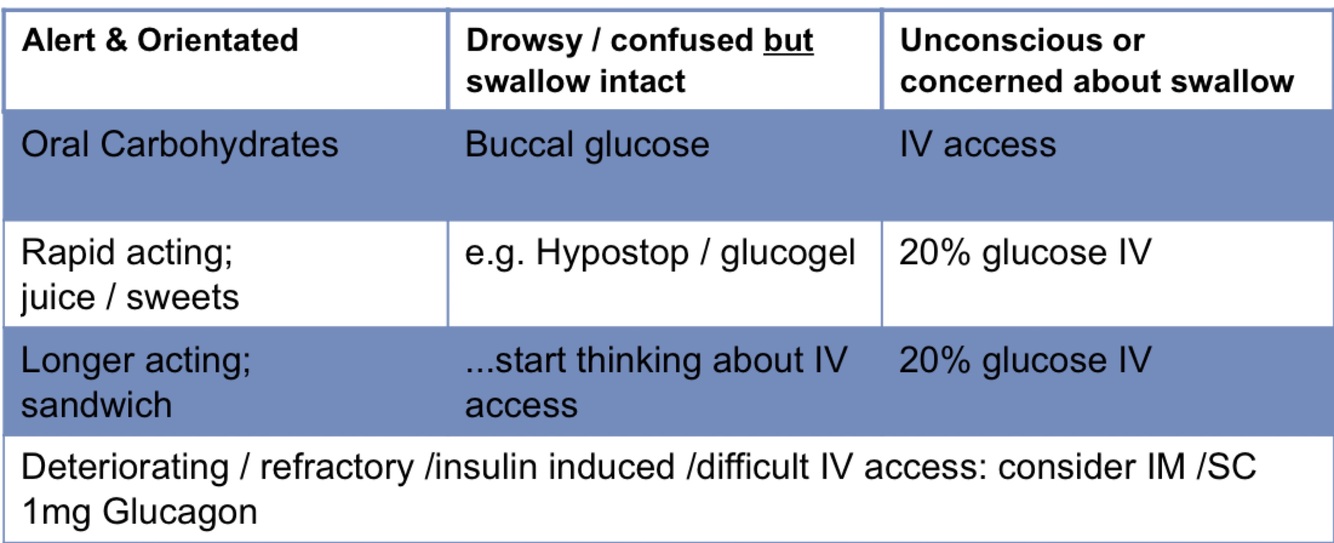
What should be considered if a hypoglycaemic patient is deteriorating or does not appear to be responding to the first step in their management?
IM/SC 1 mg glucagon
What is the benefit of giving glucose sublingually?
Bypasses hepatic first-pass metabolism
How long is it likely to take for IM glucagon to cause an increase in blood glucose?
15-20 mins
Which group of patients may not respond to IM glucagon?
Patients with poor liver glycogen stores • Starving • Anorexic • Hepatic failure
What are some possible consequences of extravasation of IV dextrose?
• Irritation • Phlebitis
Describe the triad of features that is used to define hypoglycaemia.
• Low glucose • Symptoms • Relief of symptoms by administration of glucose
List some symptoms of hypoglycaemia.
Adrenergic: • Tremors • Palpitations • Sweating • Hunger Neuroglycopaenic: • Confusion • Drowsiness • Loss of coordination • Coma • Seizures (Sometimes patients may be asymptomatic)
What is a consequence of recurrent episodes of hypoglycaemia?
Hypoglycaemia unawareness (loss of adrenergic symptoms with hypoglycaemia) Typically affects people on insulin - recurrent hypos
Describe the order in which hormonal compensatory changes in response to hypoglycaemia take place.
• Suppression of insulin • Release of glucagon • Release of catecholamines • Release of cortisol
What are the effects of decreased insulin and increased glucagon?
• Reduce peripheral uptake of glucose • increase gluconeogenesis • increase glycogenolysis • increase lipolysis - FFA and ketone generation
What is the most common cause of hypoglycaemia?
Insulin-induced in diabetics
List some causes of hypoglycaemia in people without diabetes.
• Fasting • Paediatric • Critically unwell • Organ failure • Gluconeogenesis occurs in the kidneys • Liver stores glycogen • Hyperinsulinism • Post-gastric bypass • Drugs • Extreme weight loss • Factitious (artefact)
List some causes of hypoglycaemia in diabetics.
• Medications (inappropriate insulin) • Inadequate carbohydrate intake (missed meal) • Impaired awareness - alcohol • Illness and infection • Strenous exercise • Co-existing autoimmune conditions • eg. Addisons
List some diabetic medications that can causes hypoglycaemia.
• Insulin • Oral hypoglycaemics: sulphonylureas, meglinitides, GLP-1 analogues
List some non-diabetic medications that can cause hypoglycaemia.
• Beta-blockers • Salicylates • Alcohol (inhibits lipolysis) • Atorvostatin - no its not lol
How could co-morbidities in a diabetic patient lead to increased risk of hypoglycaemia?
• Renal/liver failure could lead to impaired drug clearance • Concurrent Addison’s disease could result in hypoglycaemia (polyglandular autoimmune syndrome)
What is continous glucose monitoring?
The device is applied to the abdominal wall with a small cannula that sits in the interstitial space in the subcutaneous fat
Why might continuous blood glucose monitoring be useful?
Can identify patients who suffer from recurrent hypoglycaemia or nocturnal hypoglycaemia
What is the main issue with continoues glucose monitoring?
The sensor does not accurately read blood glucose when < 2.2. mmol/L
What is C-peptide?
Cleavage product of proinsulin - proinsulin is cleaved to form active insulin and C-peptide
List some biochemical tests that may help differentiate between causes of hypoglycaemia.
• Insulin levels (NOTE: exogenous insulin can interfere with assays) • C-peptide (marker of endogenous insulin production) • Drug screen • Autoantibodies • Cortisol/GH • Free fatty acids/ketone bodies • Lactate NOTE: it is important to perform these tests at the time of the hypo (but try not to delay treatment) Thorough history and examination just as important
Which two biochemical tests are used to classify hypoglycaemia? What are these 3 types of hypoglycaemia?
Blood insulin and C-peptide levels • hypoinsulinaemic hypoglycaemia • hyperinsulinaemic hypoglycaemia • exogenous hypoglycaemia
Describe insulin and C-peptide levels in: 1. hypoinsulinaemic hypoglycaemia 2. hyperinsulinaemic hypoglycaemia 3. exogenous hypoglycaemia
• low insulin, low C-peptide • high insulin, high C-peptide • high insulin, low C-peptide