Multiplicity and Coupling
No description yet. This curated deck is ready for daily study.
Card preview (13)
When do you not see spin-active nuclei coupling with another?
When they are magnetically identical
Why does spin-spin coupling occur?
Nearby nuclei in a molecule are affected by other spin orientations (a given nucleus absorbs at different energies depending on the orientations of the chemically distinct atoms in the molecule)
The energy gap between the two energy levels is very small (Boltzmann distribution) What does this means in terms of ratio of molecules in the excited state
• Very nearly as many nuclei in the higher energy levels than in the lower energy level • Thus each nuclei sees approximately equal numbers of neighbours in the two possible environments
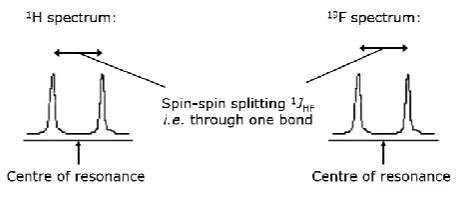
A simple AX system involves H-F, with both atoms have I = 1/2 What doe the respective NMRs of hydrogen and flourine look like?
• Because both nuclei are I = 1/2, each nuclei sees approximately equal numbers of neighbours in the two possible environments (+1/2 and -1/2) • Hence both ¹H and ¹⁹F spectra will comprise doublets with each doublet having an intensity ratio 1:1 • (2x1x0.5) + 1 = 2
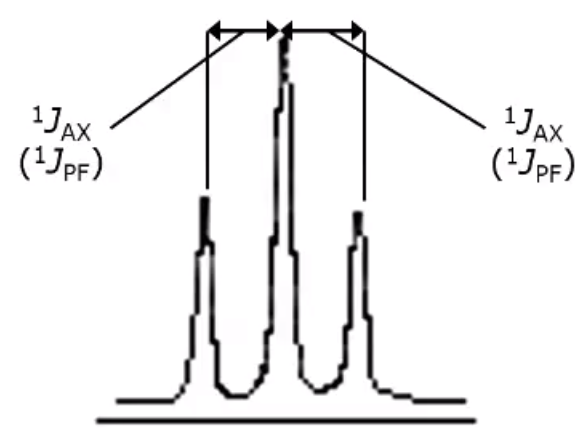
A simple AX₂ system involves PF₂, with both atoms have I = 1/2 What does the respective NMR of phosphorus look like?
• Due to there being 2xF, there are 4 possible ways the Fluorine nuclei can arrange their spins (↑↑ ↑↓ ↓↑ ↓↓) • The two middle arrangements are identical, so there are 3 possible environments phosphorus can be in (1:2:1 triplet) • (2x2x0.5) + 1 = 3
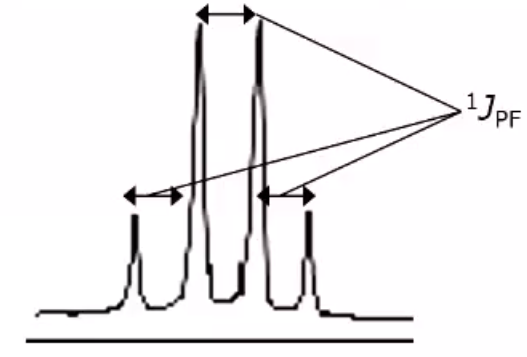
A simple AX₃ system involves PF₃, with both atoms have I = 1/2 What does the respective NMR of phosphorus look like?
• Due to there being 3xF, there are 8 possible ways the fluorine nuclei can arrange their spins (↑↑↑ ↑↑↓ ↓↑↑ ↑↓↑ ↓↓↑ ↑↓↑ ↓↑↓ ↓↓↓) • The 2 of the arrangements in the middle are identical, so there are 4 possible enironments phosphorus can be in (1:3:3:1) • (2x3x0.5) + 1 = 4
The seperation between these peaks is 0.41ppm The following NMR is taken at 200 MHz What is the coupling constant?
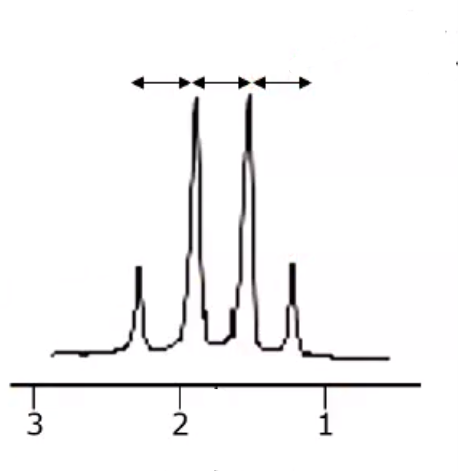
0.41ppm x 200MHz = 82 Hz
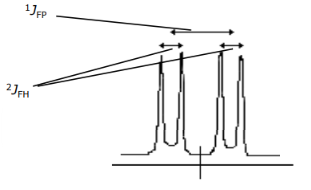
An AMX system is one in which a nucleus is interacting with one of two different nuclei e.g. the F atom in a H-P-F What would the NMR look like?
• 1J F-P: (2x1x0.5) +1 = 2 = doublet • For each possible oritentation of the P nucleus, there will be two different orientations of H (also spin 1/2) • Therefore each original doublet will be split into a doublet, giving a doublet of doublets
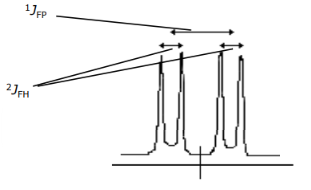
For a AMX system were a doublet of doublets is produced from 2x spin 1/2 nuclei Which produces the original splitting?
• Coupling occurs through intervening electrons, so the bigger atom produces the first doublet, which is then split into a doublet of doublets by the smaller atom
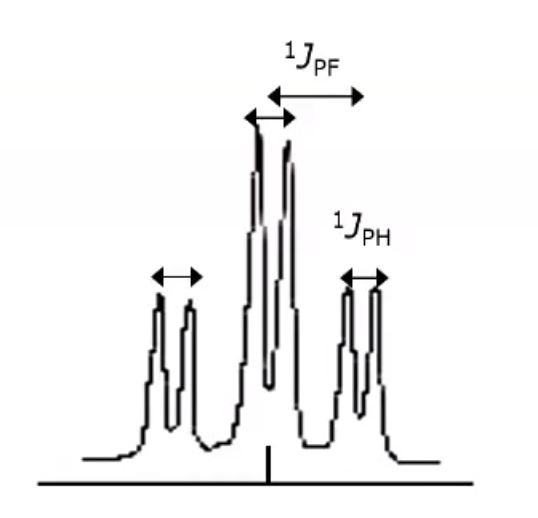
An AMX₂ system is another example of a system which produces further splitting Hence suggest what the ³¹P NMR looks like for HPF₂
• This will be a triplet of doublets • i.e. major splitting by the two flourine to give a triplet (F is biggest atom) • Futher splitting of each resonance by H into a doublet • 1J PF: (2x1x0.5) + 1 = 3 • 1J PH: (1x1x0.5) + 1 = 2
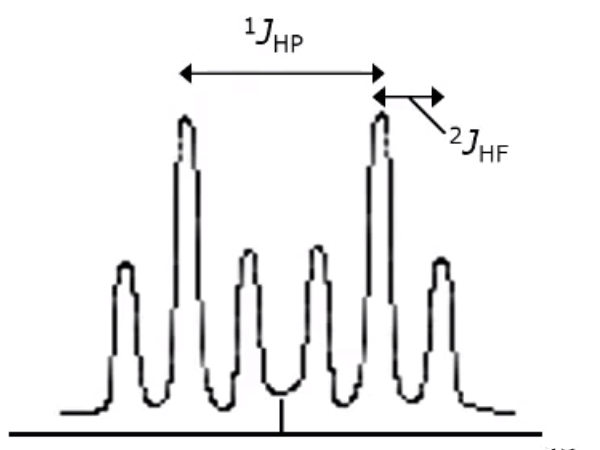
An AMX₂ system is another example of a system which produces further splitting Hence suggest what the ¹H NMR looks like for HPF₂
• This will be a doublet of triplets • Major splitting by the one P to give a doublet (bigger atoms) • Further (smaller) splitting of each resonance by two 2xF into triplets • 1J HP: (2x1x0.5) + 1 = 2 • 2HF: (2x2x0.5) + 1 = 3
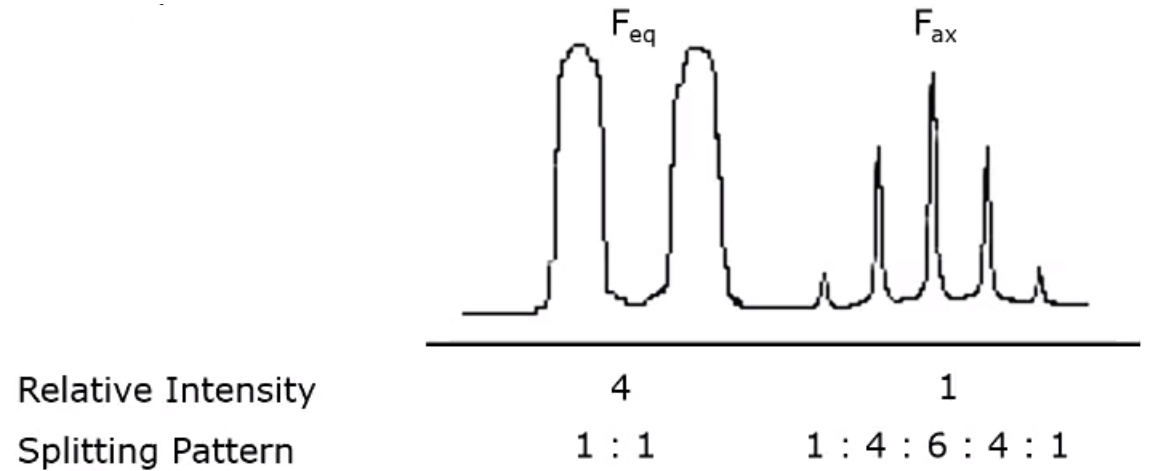
SF₅Cl has C₄v geometry and two distinct sets of fluorine atoms Why? How will this affect the ¹⁹F NMR spectrum
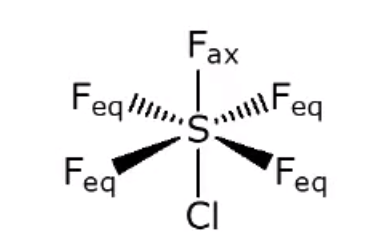
• Through two bonds, the Feq are directly opposite other Feq atoms • Through two bonds, the Fax is directly opposite a chlorine • The ¹⁹F NMR spectrum will therefore contain two resonances, in the intensity ratio 4(Feq):1(Fax) • 2J FF: (2x4x0.5) + 1 = 5 • 2J FF: (2x1x0.5) + 1 = 2
What does ¹³C{¹H} NMR stand for
Coupling on ¹³C spectrum which has been removed by irradiating the coupling nucleus at its resonance frequency (causes rapid transitions between all possible spin states so the carbon cannot tell which one it is in)