Paper 1 Collection ✓
No description yet. This curated deck is ready for daily study.
Card preview (24)
SC1a - What are the arrangements of particles in each of the three states?
• Solid: Regular and close together • Liquid: Random and close together • Gas: Random and far apart
SC1a - What are the movements of particles in each of the three states?
• Solid: Vibrate around a fixed position • Liquid: Move around each other • Gas: Fast in all directions
SC1a - What are the names of the two state changes between solid and liquid?
• S→ L is Melting • L → S is Freezing
SC1a - What are the names of the two state changes between liquid and gas?
• L→ G Evaporating (and Boiling) • G → L Condensing
SC1a - What are the names of the two state changes between Gas and Solid?
• G → S Deposition • S → G Sublimation • During these processes they do not become liquid
SC1a - What is overcome during melting and boiling?
Forces of attraction between particles
SC1a - In a heating curve, at which points will the line be flat?
During Melting and Boiling [phase changes] as the temperature doesn’t increase while the forces of attraction are overcome.
SC2a - What are the two key features of a pure substance?
The composition: • Cannot be changed by physical means • Is the same in all parts of a piece of the substance
SC2a - What is a mixture?
• A mixture contains multiple elements/compounds that aren’t chamically joined together. • The composition cannot be changed and so it isnt a pure substance.
SC2a - How will the heating curve of a mixture look different to a pure substance and why?
• Instead of straight lines there will be curves. • This is because there are multiple different elements which will have different melting points.
SC2b - What is filtration?
Using a filter to trap larger insoluble substances from a mixture.
SC2b - What is cystallisation?
• When a solution is evapourated, meaning that the solvent turns to gas leaving behind the solute which forms crystals. • The size of these crystals depend on the time the crystallisation takes • (Longer time taken = larger crystals)
SC2b - What is a saturated solution and how can this be changed?
• A saturated solution is a solution in which a solvent contains the highest amount of dissolved solute as possible. • This limit can be increased by increasing the temperature.
SC2b - Descirbe what a risk assesment is and how it is used when crystallising in a lab.
• Identifying and evaluating the hazards and considering ways of reducing the risk of harmful effects. • In crystallisation this would be indentifying: • The solution can spit: wearing eye protection and removing from the bunsen burner before the solution is completely evapourated • You can get burnt from the bunsen burner: keep your hands away from the flames at all times
SC2c - What is paper chromotography?
• A method of speration that involves having a piece of paper with dots of ink slightly dipped in the water (so that the water doesnt reach the pencil line that the ink is one). • The solvent is called the mobile phase and the paper contains the stationary phase. • If an ink moves less up the page it is less attracted to the stationary phase. • Different inks have different levels of attraction to the stationary phase and so will get sperated out at different distances.
SC2c - How do you measure the Rƒ value of an ink?
Rƒ = Distance travelled by spot ÷ Total distance travelled by solvent
SC2c - What can paper chromotography be used for?
• Distinguishing between pure/impure substances • Identifying substances by comparing their chromotogram with known substances • Identifying substances by calculating their Rƒ value
SC2d - What is simple distillation?
The separation of a liquid from its dissloved solids, by evapourating it and condensing the gas formed.
SC2d - What conditions do the components of the solution have to meet for simple distillation to work?
They have to have boiling points that are at least 25° C apart.
SC2d - Describe a simple distillation set-up.
• A side-arm flask on a tripod over a bunsen burner. • It contains the solution and anti-bumping granules to help the liquid boil more smoothly. • A thermometer is connected to the top. • A delivery tube, leading to a conical flask, is surrounded with a cooling jacket (condenser) which takes cold water in from the bottom and puts it out at the top. • The conical flask is in a bath of ice water. • The bunsen burner is on a heat resistant mat.
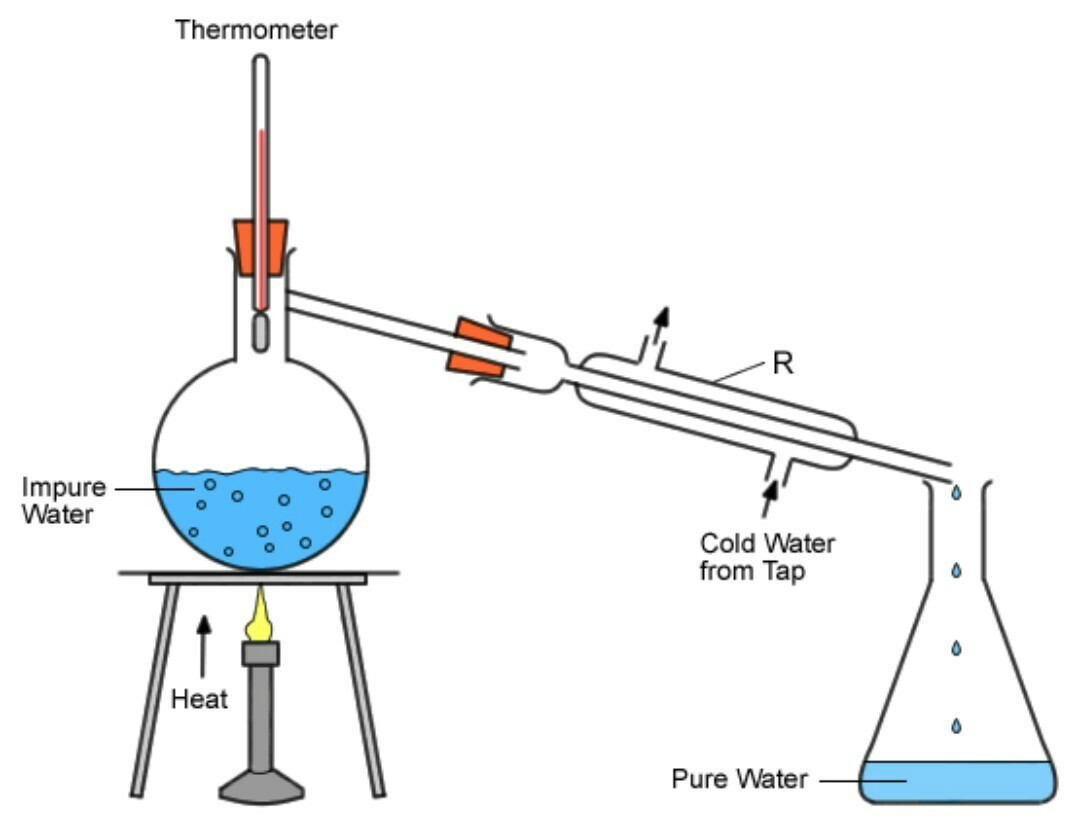
SC2d CP - Which two methods can you use to seperate solvents in an ink?
• Paper chromotography • Simple distillation
SC2e - Why can’t water be purified by distillation on a large scale?
It takes up too much energy.
SC2e - Why can’t tap water be used for chemical analysis?
Tap water contains small amounts of dissolved salts and minerals which may react and alter the resuslts
SC2e - Describe the stages river water goes through before it can be used in homes.
• First, it is screened with a seive to get rid of large objects such as leaves and twigs • It is then sent to a sedimentation tank where small particles will settle out at the bottom • The water is then filtered through layers of sand and gravel • Finally it is treated with chlorine to kill microbes