Conductivity
No description yet. This curated deck is ready for daily study.
Card preview (18)
As the number of atoms in the cluster increases, the spacing between the energy levels of the various orbitals _______. Increases or decreases
Decreases
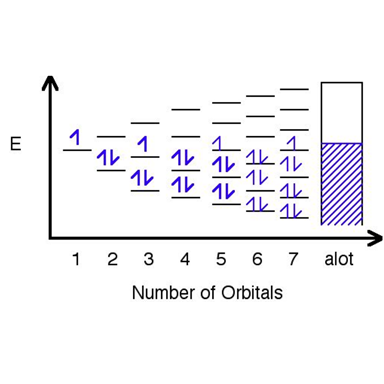
Those materials in which an electric current flows easily in one specific crystal direction while the resistivity is very high in transverse directions
One-dimensional conductors
A completely filled valence band separated from the next energy band, which is empty, by a large, forbidden gap
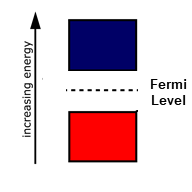
Insulators
The band made up of the occupied molecular orbitals and is lower in energy than conduction band.
Valence Band
The band of orbitals that are high in energy and are generally empty.
Conduction Band
Are materials that are simialr to metals except that they have poorer conductivity and are not malleable like metals.
Semi-Metals
A type of extrinsic semiconductor where the dopant atoms are capable of providing extra holes to the host material.
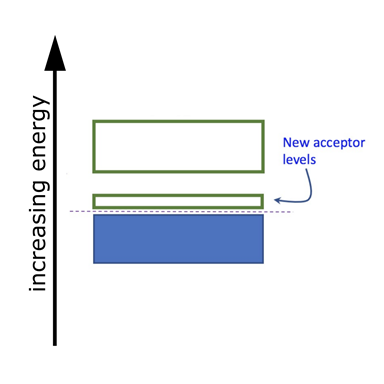
p-type Semiconductors
A type of extrinsic semiconductor where the dopant atoms are capable of providing extra conduction electrons to the host material which creates an excess of negative (n-type) electron charge carriers.
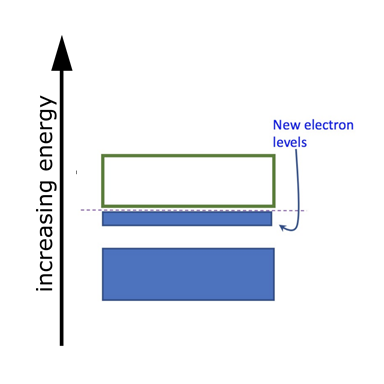
n-type Semiconductors
Are pure materials where the number of electrons in the conduction band is determined only by the size of the band gap and the temperature (more electrons with small band gap and high temperature).
Intrinsic Semiconductors
Are materials where the conductivity is controlled by adding dopants with different numbers of valenece electrons to that of the original material.
Extrinsic Semiconductors (e.g. Germanium doped with Phosphorous [valance of 5])
The band gap is not very large and some electrons have sufficient thermal energy to be promoted up to the empty conduction band.
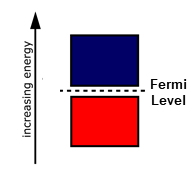
Semiconductors (e.g pure elements, such as silicon or germanium, or compounds such as gallium arsenide or cadmium selenide)
The conductivity of this class of materials is increased, when the temperature is increased.
Insulators There is a large energy gap between the valance and conduction bands, so large that valance electrons barely populate the conduction bands and thefore do not impede electron flow.
Property of complete disappearance of electrical resistance in solids when they are cooled below a characteristic temperature
Superconductivity
The minimum photon energy required to excite an electron up to the conduction band from the valence band.
Band gap
Valence electrons can move through this class of material and are unique as good conductors of electricity.
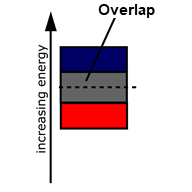
Metals
At absolute zero temperature intrinsic semiconductor acts as perfect insulator. True or False
True
A completely filled level (the valence band) and an empty one (the conduction band) separated by a band gap.
Leads to Non-metallic behavior
A partially filled band, no gap between the top filled level (Fermi level) and the lowest empty one.
Leads to Metallic behavior