Reactions Of Ions In Aqueous Solution
No description yet. This curated deck is ready for daily study.
Card preview (24)
What is the equation for pH
-log10[H+]
When are metal aqua complexes formed
When we add a transition metal compound to water
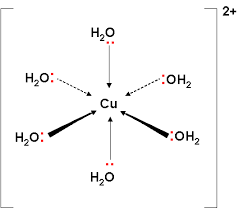
Draw the structure of (Cu(H2O)6)2+
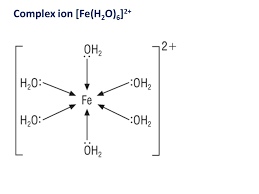
Draw the structure of (Fe(H2O)6)2+
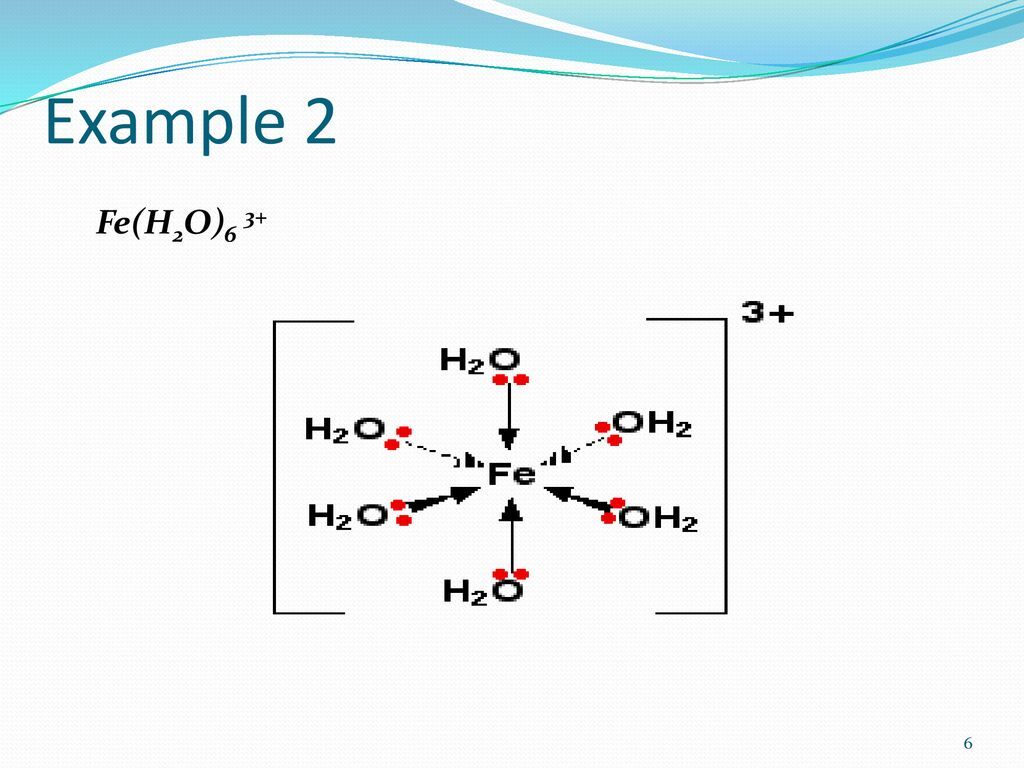
Draw the structure of (Fe(H2O)6)3+
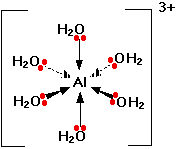
Draw the structure of (Al(H2O)6)3+
What is the pH of metal-aqua ions
Below 7, they are acidic in solution
What affects how acidic a metal aqua ion is in solution
The charge of the ion
What is the equation for when (Fe(H2O)6)2+ reacts with water
(Fe(H2O)6)2+(aq) + H2O(l) ⇌ (Fe(H2O)5(OH))+(aq) + H3O+(aq)
What is H3O+ ion called
Hydroxonium ion
What is the term for using water to break a portion of a complex off using water
Hydrolysis
What is the equation for when (Fe(H2O)6)3+ reacts with water (initial hydrolysis)
(Fe(H2O)6)3+(aq) + H2O(l) ⇌ (Fe(H2O)5(OH))2+(aq) + H3O+(aq)
Why do more positively charged ions form more acidic solutions
More positively charged ions have a greater charger density and are more POLARISING And so attract electrons in the O-H bond in water ligands more strongly, weakening the bond Therefore more likely that H+ will be released
What do we form from further hydrolysis of metal-aqua ions
Insoluble metal hydroxides
What is the state of the neutral complex formed after repeated hydrolysis using OH- of metal aqua ions
Further hydrolysis leads to the formation of a neutral complex that is solid and forms precipitate in solution
Write the equations for the 3 stages for the formation of a solid metal hydroxide precipitate from the hydrolysis of (M(H2O)6)3+(aq) M = Al3+ and Fe3+
(M(H2O)6)3+(aq) + H2O(l) ⇌ (M(H2O)5(OH))2+(aq) + H3O+(aq) (M(H2O)5(OH))2+(aq) + H2O(l) ⇌ (M(H2O)4(OH)2)+(aq) + H3O+(aq) (M(H2O)4(OH)2)+(aq) + H2O(l) ⇌ M(H2O)3(OH)3(s) + H3O+(aq)
Why are there only two steps to form an insoluble solid from metal aqua 2+ ions rather than 3 for metal aqua 3+ ions
Only two water ligands need to be deprotonated to form a neutral complex
Write the equations for the 2 stages for the formation of a solid metal hydroxide precipitate from the hydrolysis of (M(H2O)6)2+(aq) M = Cu2+ and Fe2+
(M(H2O)6)2+(aq) + H2O(l) ⇌ (M(H2O)5(OH))+(aq) + H3O+(aq) (M(H2O)5(OH))+(aq) + H2O(l) ⇌ M(H2O)4(OH)2(s) + H3O+(aq)
Which way does equilibrium shift when we add OH- ions to the reaction between a metal aqua ion and water
Equilibrium shifts right
Metal hydroxides can act as an acid or base meaning they are….
Amphoteric
What is a Bronsted lowry base
H+ acceptor
What is a Bronsted lowry acid
H+ donor
Give an example of an amphoteric metal hydroxide
Al(H2O)3(OH)3
What is the equation for when aluminium hydroxide reacts with a excess base
Al(H2O)3(OH)3(s) + OH-(aq) —> (Al(H2O)2(OH)4)-(aq) + H2O(aq)