6.1 Aromatic Compounds, Carbonyls And Acids
No description yet. This curated deck is ready for daily study.
Card preview (24)
What is a benzene derivative?
-a benzene ring that has undergone a substitution reaction
What is a substitution reaction?
-where a group or atom is exchanged for another group or atom in a chemical reaction
What is an ester?
—esters have the functional group -COO -they are carboxylic acid derivatives where the H from the acid has been replaced with an alkyl chain
How are esters named?
-named after the alcohol and carboxylic acid from which they are formed -the first part of the name comes from the alkyl chain with a carbon atom bonded to only one oxygen atom -the second part comes from the alkyl chain containing the C=O carbon atom -it is followed by the suffix -oate
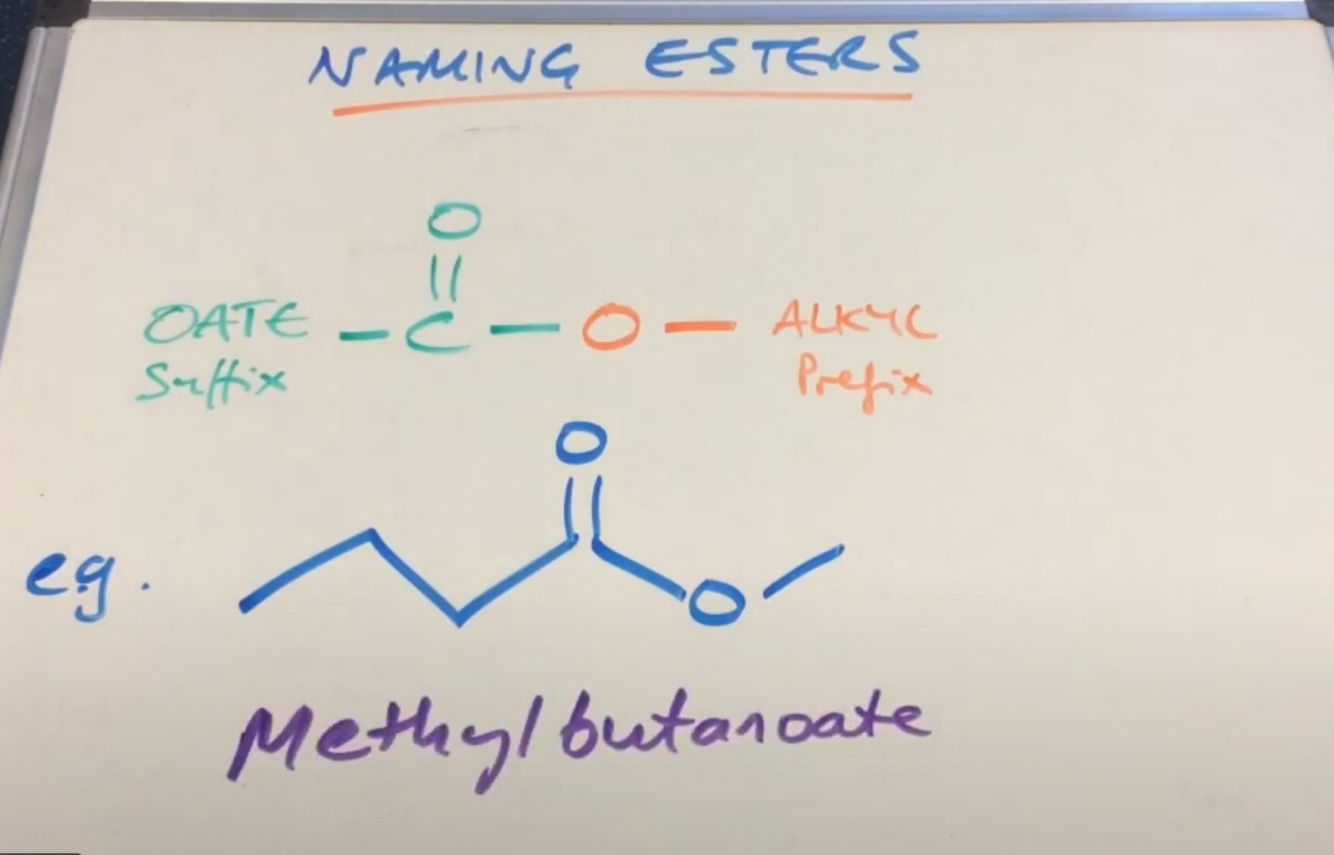
Name this ester
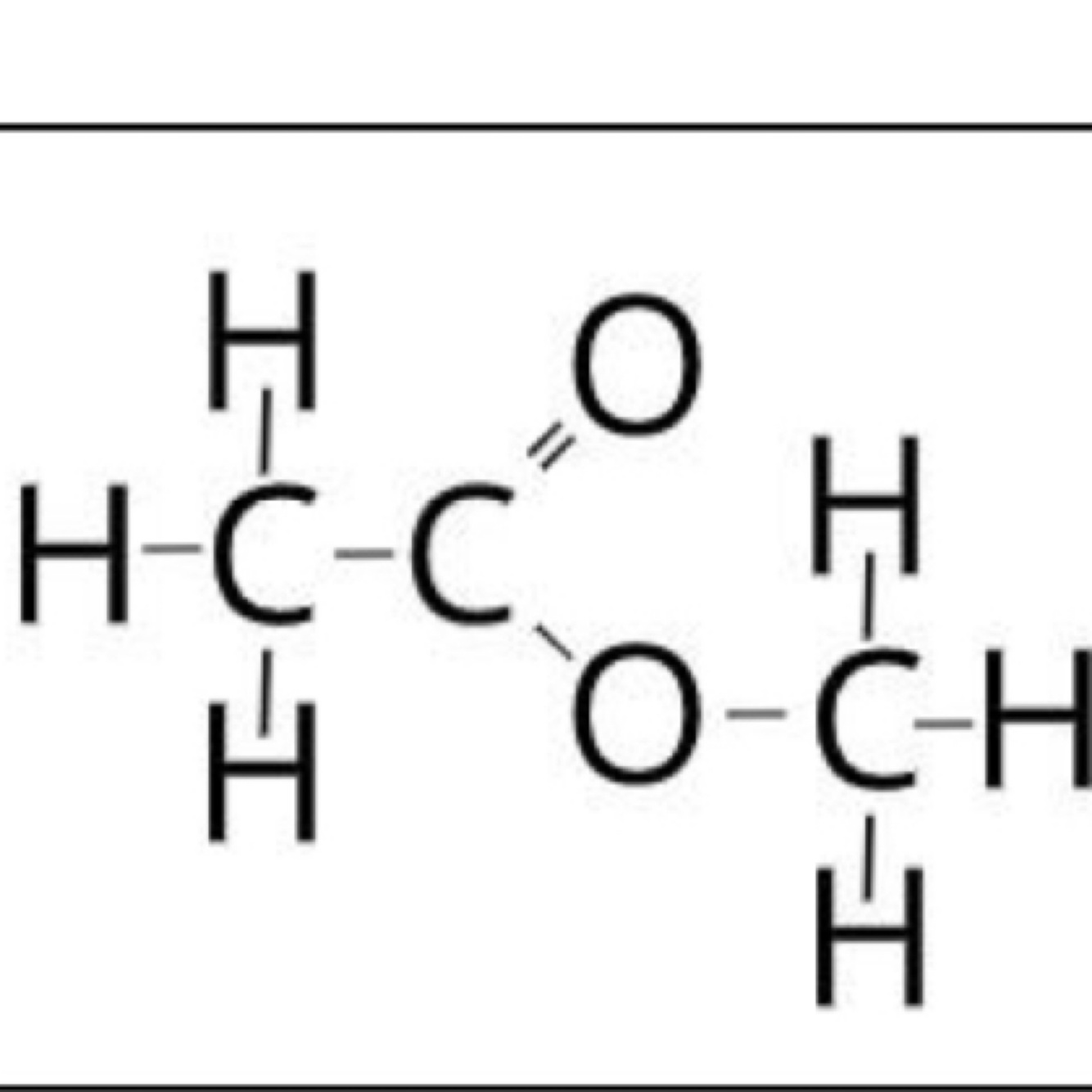
-methyl ethanoate
What is esterification?
-the chemical reaction used to make an ester
Describe the conditions needed for the esterification of a carboxylic acid with an acid catalyst
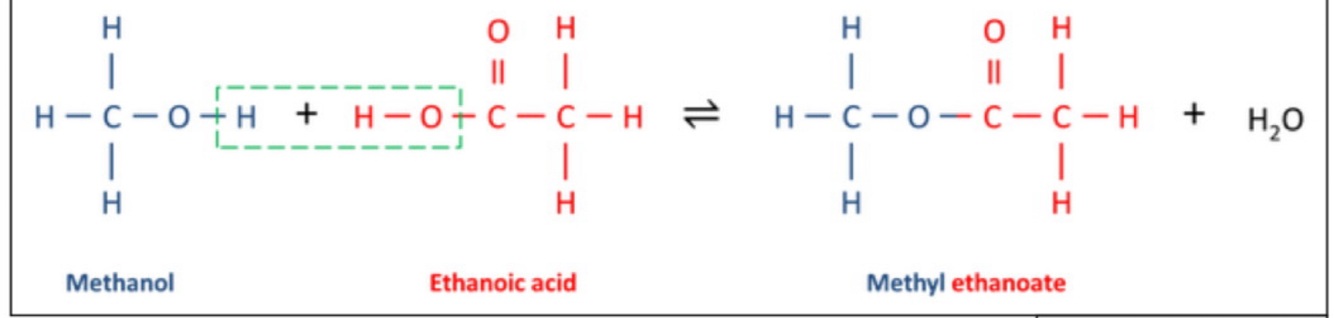
-to prepare a small ester- alcohol and a carboxylic acid are heated gently in the presence of a sulfuric acid (H2SO4) catalyst,this is a reversible reaction and has a slow rate of reaction- separated by distillation as the ester is volatile, distillation needs to be quick to prevent reverse reaction from occurring -to prepare larger esters-alcohol and carboxylic acid with sulfuric acid catalyst heated under reflux until equilibrium has been established-the ester can be separated using fractional distillation ->this method of preparation of an ester is not suitable for phenol or its derivatives as the rate of reaction is too slow
Draw out the reaction of methanol with ethanoic acid using their structural formulas and name the product
What are 3 properties of esters ?
-sweet smelling compounds used in food flavourings and perfumes -low boiling points -good solvents for polar molecule
What is an acid anhydride?
-an acid derivative -more reactive than a similar carboxylic acid -made by the removal of a water molecule from two carboxylic acid molecules
What does anhydride mean?
-without water
Describe esterification of acid anhydrides with alcohols
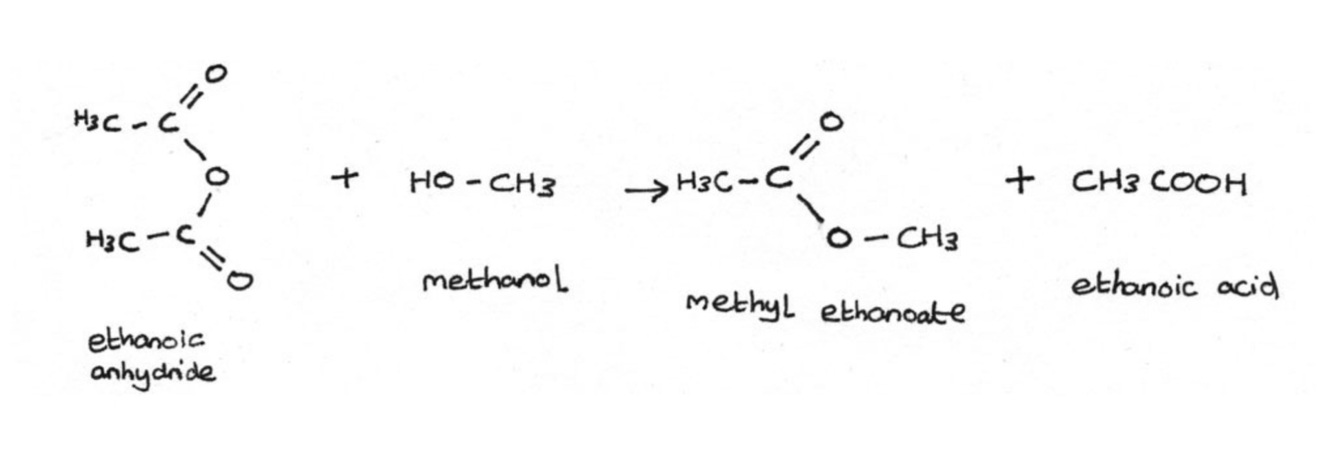
-acid anhydrides will react with alcohols including phenols and its derivatives to make an ester -it is an addition-elimination mechanism -not reversible -therefore has a higher yield than using carboxylic acid -slow rate of reaction that can be increased by gently warming reaction mixture
Draw out the reaction of ethanoic anhydride and methanol and name the products
Define hydrolysis
-a chemical reaction where water causes the breaking of bonds. In a decomposition reaction
What is the name of the reverse reaction of esterification?
-hydrolysis -esters can undergo hydrolysis to form an alcohol
What happens when an ester undergoes hydrolysis in acidic conditions?
-When esters are refluxed with a catalyst of hot aqueous acids, such as dilute sulfuric acid or dilute hydrochloric acid, the ester will decompose reversibly into an alcohol and a carboxylic acid.

What happens when an ester undergoes hydrolysis in alkaline conditions?
-Alkaline chemicals are bases that can dissolve in water: When an ester is refluxed with a hot aqueous alkali, such as potassium hydroxide or sodium hydroxide, it will decompose into an alcohol and a carboxylate salt. This reaction is not reversible. Alkaline hydrolysis of esters is used to make soaps, therefore it is also called saponification
Draw out the hydrolysis reaction between ethyl propanoate and sodium hydroxide name the products

Define a base
A chemical that will react with an acid
What is the carboxylic acid functional group?
-COOH
How do you name a carboxylic acid?
-remove the e from the end of the name of the alkane that has the same number of carbons in its longest carbon chain -add the suffix -anoic acid E.g-a carboxylic acid containing 4 carbon atoms would be called butanoic acid
How are carboxylic acids prepared?
• by the oxidation of primary alcohols or aldehydes under reflux -acidified potassium dichromate (VI) used as the oxidising agent
Are carboxylic acids soluble?
-the -COOH functional group allows carboxylic acid molecules to form hydrogen bonds between each other -they can also form hydrogen bonds with water meaning they are soluble in water
What happens to the solubility of carboxylic acids as their chain length increases?
-as chain length increases their solubility decreases -as CH2 groups do not form hydrogen bonds with water as they are not polar -so as more of the molecule becomes non-polar solubility will decrease