3.1.3 Bonding
No description yet. This curated deck is ready for daily study.
Card preview (24)
Define ionic bonding
Electrostatic force of attraction between oppositely charged ions formed by electron transfer
Ionic Bonding Metal atoms ___ electrons to form ___ ions
Metal atoms lose electrons to form +ve ions
Ionic Bonding Non-metal atoms ____ electrons to form ___ ions
Non-metal atoms gain electrons to form -ve ions
Simplest ions are…
single atoms which have lost/gained electrons to make full outer shell
What are compound ions?
Ions that are made up of groups of atoms with an overall charge
State the formula for a sulfate ion
SO42-
State the formula for a hydroxide ion
OH-
State the formula for a nitrate ion
NO3-
State the formula for a carbonate ion
CO32-
State the formula for an ammonium ion
NH4+
Name the structure of ionic crystals
Giant Ionic Lattice
Sodium nitrate contains Na+ (1+) and NO3- (1-) ions. State the fomula of the sodium nitrate.

Magnesium chloride contains Mg2+ (2+) and Cl- (1-) ions. State the fomula of the magnesium chloride.

Name 3 physical properties of ionic compounds
• Conduct electricity only when they’re molten or dissolved • High melting points • Tend to dissolve in water
Why can ions conduct electricity when they’re molten or dissolved?
∵ ions in liquid are free to move and carry a charge
Why can’t ions conduct electricity when they’re in a solid?
∵ ions are in fixed position by strong ionic bonds
Why do ionic compounds have high melting points?
• Giant ionic lattices • Strong electrostatic forces of attraction between oppositely charged ions • Takes a lot of energy to overcome these forces
Why do ionic compounds tend to dissolve in water?
• Water molecules are polar • Part of molecule has a small negative charge and other bits have small positive charges • Charged parts pull ions away from lattice = causing it dissolve
Ionic bonding is stronger and melting points are higher when ions are… (2x)
smaller and/ or have higher charges
When do molecules form and how are they held together?
• Form when 2 or more atoms bond together • Held together by strong covalent bonds
What do single covalent bonds contain?
Shared pair of electrons
Describe covalent bonding
• Two atoms share electrons so they’ve both got full outer shells • Both postive nuclei are attracted electrostatically to shared electrons

Multiple covalent bonds contain…
multiple shared pairs of electrons
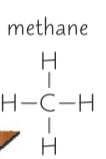
Draw methane, represent the covalent bonds by drawing lines