1.2 - Elements, Compounds and Mixtures
No description yet. This curated deck is ready for daily study.
Card preview (15)
What are the definitions of Elements, Compounds and Mixtures?
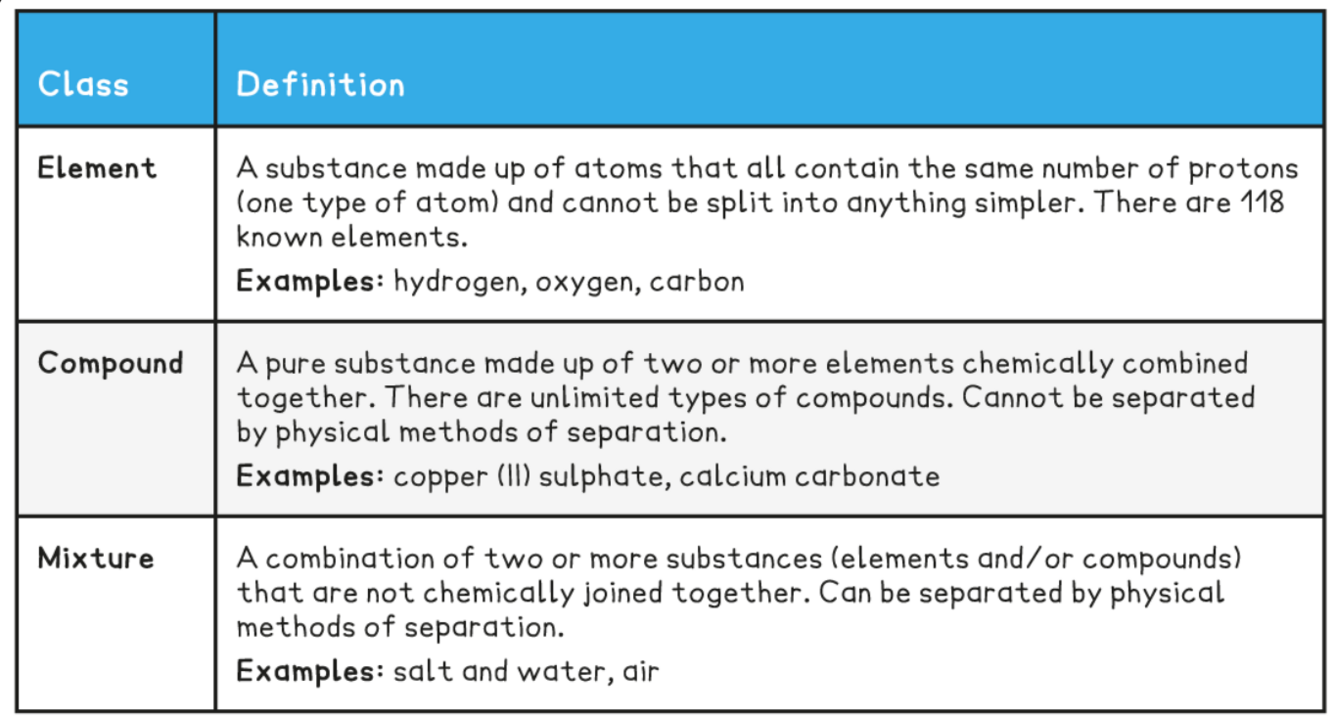
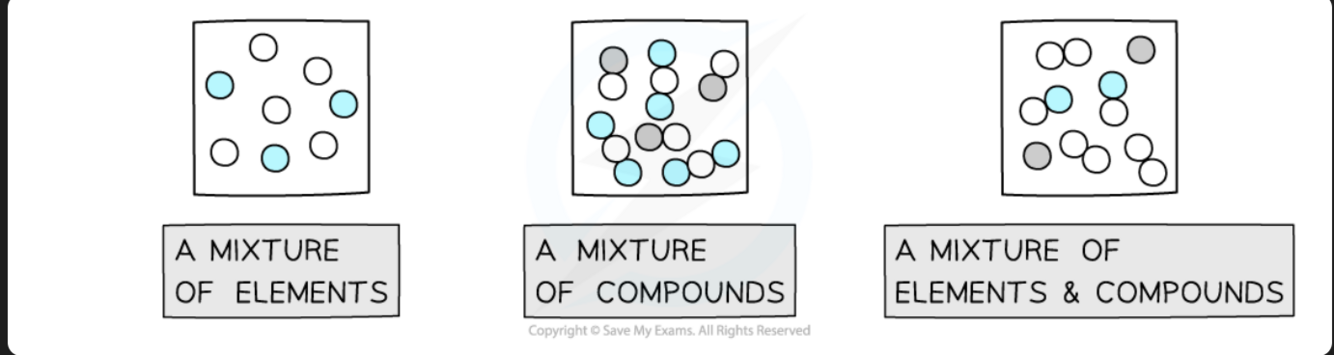
How can Elements, Compounds and Mixtures be represented?
What is a pure substance?
A pure substance may consist of a single element or compound which contains no other substances
What is a mixture?
A mixture consists of two or more elements or compounds that are physically mixed together, they are not chemically combined The chemical properties of the substances in a mixture remain unchanged Substances in mixtures can be separated by physical means Air for example is a mixture of nitrogen, oxygen and some other gases such as carbon dioxide and argon
How can purity be distinguished?
Pure substances melt and boil at specific and sharp temperatures e.g. pure water has a boiling point of 100 °C and a melting point of 0 °C Mixtures have a range of melting and boiling points as they consist of different substances that tend to lower the melting point and broaden the melting point range Melting and boiling points data can therefore be used to distinguish pure substances from mixtures Melting point analysis is routinely used to assess the purity of drugs This is done using a melting point apparatus which allows you to slowly heat up a small amount of the sample, making it easier to observe the exact melting point This is then compared to data tables The closer the measured value is to the actual melting or boiling point then the purer the sample is
How can simple distillation separate mixtures?
This is used to separate a liquid and soluble solid from a solution (e.g., water from a solution of salt water) or a pure liquid from a mixture of liquids The solution is heated, and pure water evaporates producing a vapour which rises through the neck of the round bottomed flask The vapour passes through the condenser, where it cools and condenses, turning into the pure liquid that is collected in a beaker After all the water is evaporated from the solution, only the solid solute will be left behind
How does fractional distillation separate mixtures?
This is used to separate two or more liquids that are miscible with one another (e.g., ethanol and water from a mixture of the two) The solution is heated to the temperature of the substance with the lowest boiling point This substance will rise and evaporate first, and vapours will pass through a condenser, where they cool and condense, turning into a liquid that will be collected in a beaker All of the substance is evaporated and collected, leaving behind the other components(s) of the mixture For water and ethanol Ethanol has a boiling point of 78 ºC and water of 100 ºC The mixture is heated until it reaches 78 ºC, at which point the ethanol boils and distills out of the mixture and condenses into the beaker When the temperature starts to increase to 100 ºC heating should be stopped. Water and ethanol are now separated
What is filtration and how is it used to separate mixtures?
Used to separate an undissolved solid from a mixture of the solid and a liquid / solution ( e.g., sand from a mixture of sand and water) Centrifugation can also be used for this mixture A piece of filter paper is placed in a filter funnel above a beaker A mixture of insoluble solid and liquid is poured into the filter funnel The filter paper will only allow small liquid particles to pass through as filtrate Solid particles are too large to pass through the filter paper so will stay behind as a residue
How is crystallisation used to separate mixtures ?
Used to separate a dissolved solid from a solution, when the solid is much more soluble in hot solvent than in cold (e.g., copper sulphate from a solution of copper (II) sulphate in water) The solution is heated, allowing the solvent to evaporate, leaving a saturated solution behind Test if the solution is saturated by dipping a clean, dry, cold glass rod into the solution If the solution is saturated, crystals will form on the glass rod The saturated solution is allowed to cool slowly Crystals begin to grow as solids will come out of solution due to decreasing solubility The crystals are collected by filtering the solution, they are washed with cold distilled water to remove impurities and are then allowed to dry
How is paper chromatography used to separate mixtures?
This technique is used to separate substances that have different solubilities in a given solvent (e.g., different coloured inks that have been mixed to make black ink) A pencil line is drawn on chromatography paper and spots of the sample are placed on it. Pencil is used for this as ink would run into the chromatogram along with the samples The paper is then lowered into the solvent container, making sure that the pencil line sits above the level of the solvent, so the samples don’t wash into the solvent container The paper is called the stationary phase The solvent travels up the paper by capillary action, taking some of the coloured substances with it; it is called the mobile phase Different substances have different solubilities so will travel at different rates, causing the substances to spread apart Those substances with higher solubility will travel further than the others This will show the different components of the ink / dye If two or more substances are the same, they will produce identical chromatograms If the substance is a mixture, it will separate on the paper to show all the different components as separate spots An impure substance will show up with more than one spot, a pure substance should only show up with one spot.
How can mixtures be identified in chromatography?
Pure substances will produce only one spot on the chromatogram If two or more substances are the same, they will produce identical chromatograms If the substance is a mixture, it will separate on the paper to show all the different components as separate spots An impure substance therefore will produce a chromatogram with more than one spot
What are Rf values?
These values are used to identify the components of mixtures The Rf value of a particular compound is always the same but it is dependent, however, on the solvent used If the solvent is changed then the value changes Calculating the Rf value allows chemists to identify unknown substances because it can be compared with Rf values of known substances under the same conditions These values are known as reference values Calculation The Retention factor is found using the following calculation: Rf = distance travelled by substance ÷ distance travelled by solvent
Explain the practical: Investigate paper chromatography using inks and food colourings
Use a ruler to draw a horizontal pencil line 2 cm from the end of the chromatography paper Use a different capillary tube to put a tiny spot of each colouring A, B, C and D on the line Use the fifth tube to put a small spot of the unknown mixture U on the line Make sure each spot is no more than 2-3 mm in diameter and label each spot in pencil Pour water into the beaker to a depth of no more than 1 cm and clip the top of the chromatography paper to the wooden spill. The top end is the furthest from the spots Carefully rest the wooden spill on the top edge of the beaker. The bottom edge of the paper should dip into the solvent Allow the solvent to travel undisturbed at least three quarters of the way up the paper Remove the paper and draw another pencil line on the dry part of the paper as close to the wet edge as possible. This is called the solvent front line Measure the distance in mm between the two pencil lines. This is the distance travelled by the water solvent For each of food colour A, B, C and D measure the distance in mm from the start line to the middle of the spot
What is the evaluation and conclusion for this?
Evaluation: The Rf values of food colours A, B, C and D should be compared to that for the unknown sample as well as a visual comparison being made Conclusion: The use of chromatography and Rf values is a viable method of identifying unknown mixtures given reference material