ChemPath: Potassium
No description yet. This curated deck is ready for daily study.
Card preview (19)
What is the normal range for serum potassium?
3.5-5.0 mmol/L
What are the two main hormones involved in the regulation of potassium?
• Angiotensin II • Aldosterone
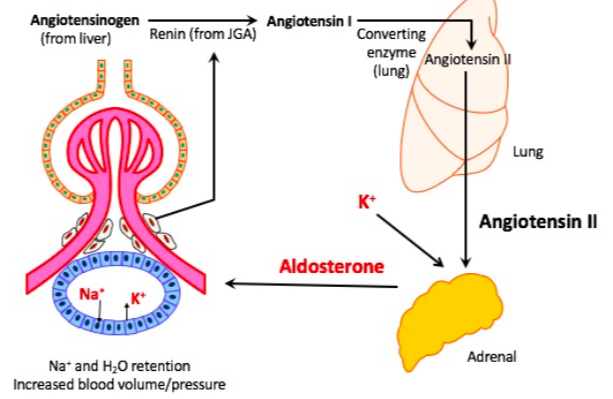
Outline how the renin-angiotensin-aldosterone system works.
• Reduced perfusion or low sodium will stimulate the production of renin from the juxta-glomerular cells • This cleaves angiotensinogen to angiotensin I • This is then converted by ACE in the lungs to angiotensin II → stimulates aldosterone release from the adrenals • Aldosterone stimulates sodium reabsorption and potassium excretion in the principal cells of the cortical collecting tubule NOTE: water will also be drawn in with the sodium so aldosterone should not greatly affect sodium concentration
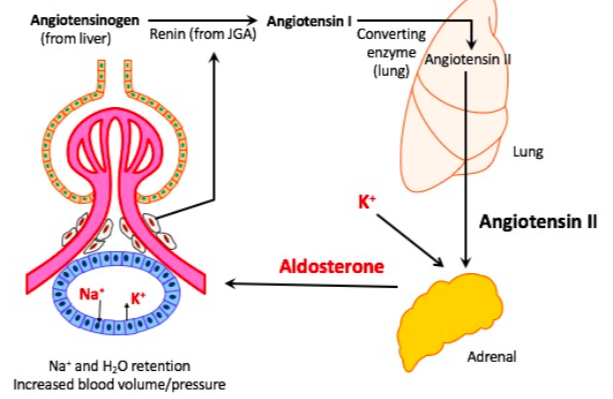
Where aldosterone acts
Principal cortical cells collecting duct
Outline the mechanisms of action of aldosterone.
• Aldosterone binds to MR and stimulates the transcription of ENaC channels • Aldosterone binding to MR also leads to increased Sgk1 which inhibits Nedd4 • Nedd4 usually ubiquitinates sodium channels and degrades them • Inhibition of Nedd4 leads to preservation of sodium channels thereby increasing sodium reabsorption • As you reabsorb more sodium, the lumen becomes more negative and K+ will move down the electrochemical gradient into the lumen via ROMK channels
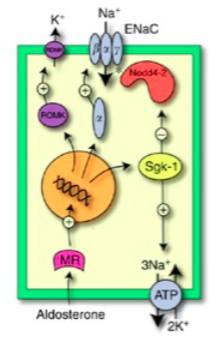
How Na affects K excretion
Sodium resorbed - making the lumen more negative K then excreted along the electrochemical gradient
What are the main stimuli for aldosterone release?
• Angiotensin II • High serum potassium (most potent stimulator)
What are the causes of hyperkalaemia
• Renal failure (low GFR, reduced excretion) • Drugs (ACEi / ARBs / Aldosterone antagonists) • Low Aldosterone • Addisons • Type 4 renal tubular acidosis (low renin, low aldosterone) • Release from cells (Rhabdomyolysis, acidosis)
Explain how acidosis leads to hyperkalaemia.
• When plasma H+ concentration is high, the cells try to take in more H+ from the plasma • To maintain electrochemical neutrality, K+ must leave the cell when H+ enters • This leads to hyperkalaemia
Outline the management of hyperkalaemia.
• 10 ml 10% calcium gluconate • 50 ml 50% dextrose + 10 U insulin • In reality - 100ml 20% dextrose • Nebulised salbutamol - beta agonists drive K into cell • Treat the cause
List some causes of hypokalaemia.
• GI loss (diarrhoea) • Renal loss • Hyperaldosteronism (Conn’s), Cushing’s syndrome (binding to MR) • Increased sodium delivery to distal nephron • Osmotic diuresis • Redistribution into cells • Insulins • Beta-agonists • Alkalosis • Rare causes • Renal tubular acidosis (type 1 and 2) • Hypomagnesaemia
Describe Renal K handling
More Na to distal tubules causes increased exchange of K Block of Na/CL channels by Thiazides and Gitelman’s syndrome
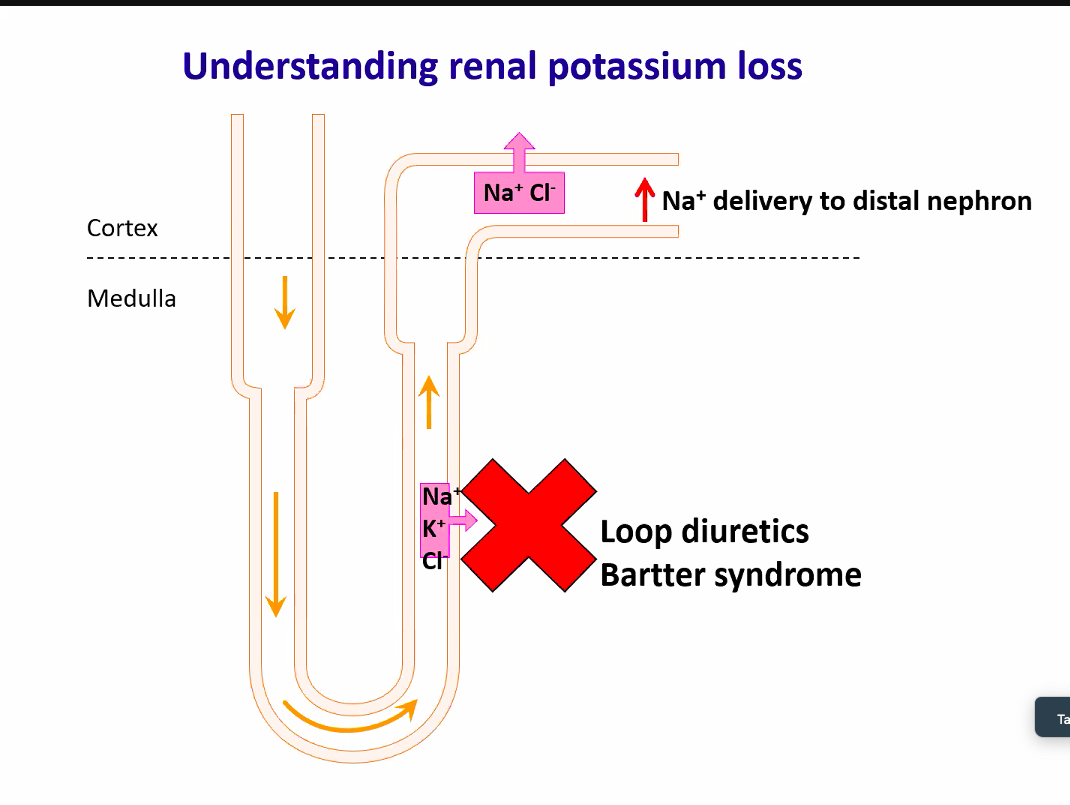
Name two conditions that can block the triple transporter.
• Loop diuretics • Bartter syndrome (mutation in triple transporter)
Name two conditions that can block the Na+/Cl- cotransporter.
• Thiazide diuretics • Gitelman syndrome (mutation in Na+/Cl- cotransporter)
Explain how increased delivery of sodium to the distal nephron can cause hypokalaemia.
• Increased delivery of Na+ to the distal nephron (e.g. because of blocking/ineffective triple transporter or Na+/Cl- cotransporter) leads to increased reabsorption of Na+ in the distal nephron • This leads to the lumen of the distal nephron becoming more negative • This results in the movement of K+ down the electrochemical gradient through ROMK channels into the lumen
Why Distal Na resorption causes reduced K
Increased Na resorption in distal tubule Increased Electronegative gradient Increased K loss
What are the clinical features of hypokalaemia?
• Muscle weakness • Arrythmia • Polyuria and polydipsia (hypokalaemia leads to nephrogenic DI)
What screening test should be done in a patient with hypokalaemia and hypertension?
Aldosterone: renin ratio (primary hyperaldosteronism will show high aldosterone and low renin)
Outline the management of hypokalaemia: • 3-3.5 mmol/L • <3 mmol/L
• 3-3.5 mmol/L • Oral potassium chloride (2x SandoK TDS for 48 hours) • Re-check serum K+ concentration • < 3 mmol/L • IV potassium chloride infusion • Maximum rate: 10 mmol/hr • NOTE: rates > 20 mmol/hr irritate the superficial veins, needs to be given centrally • TREAT THE CAUSE