Waves
No description yet. This curated deck is ready for daily study.
Card preview (24)
What are the two types of waves?
Transverse - at right angles to the direction of energy transfer longitudinal - parallel to the direction of energy transfer
Frequency
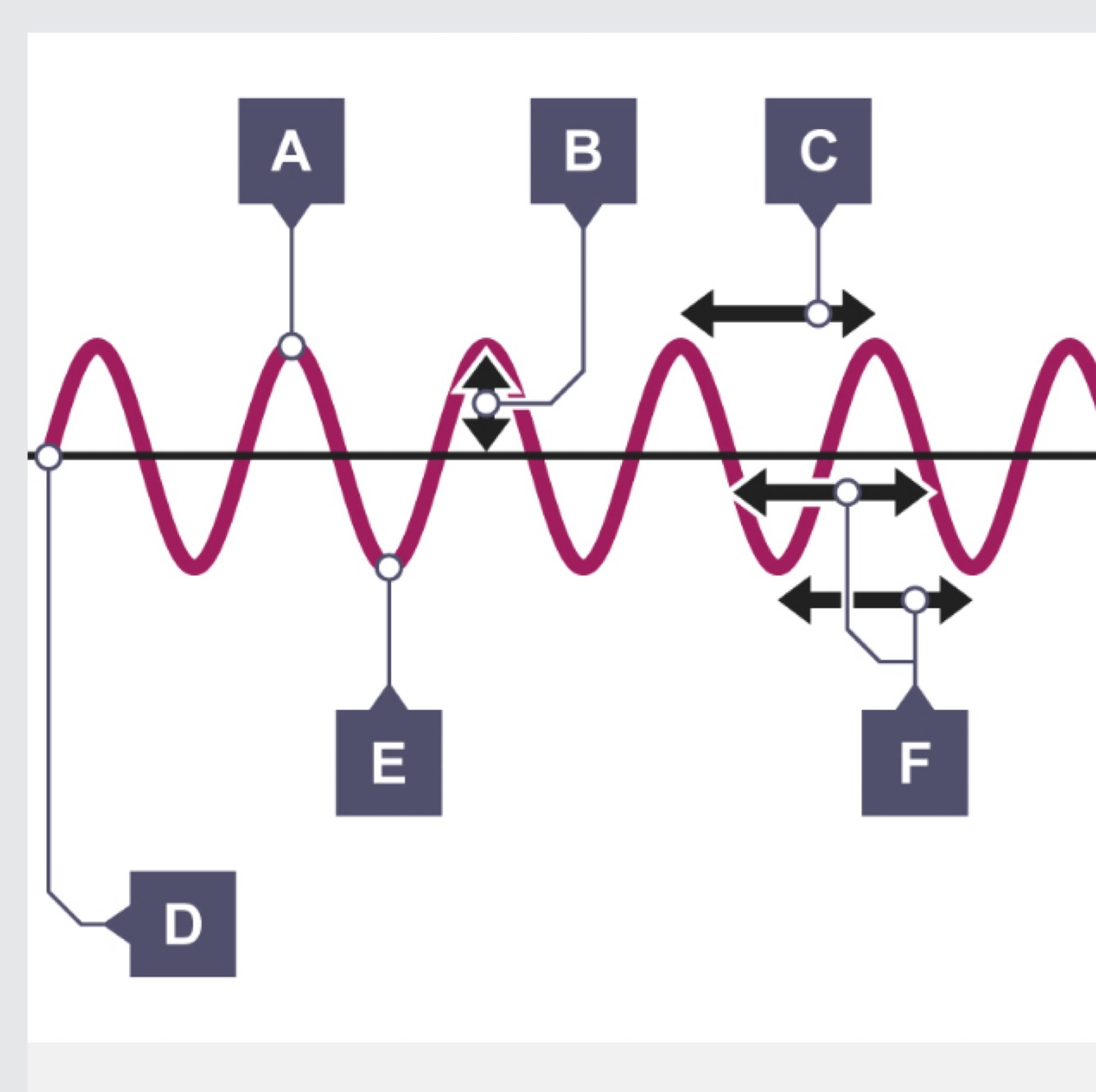
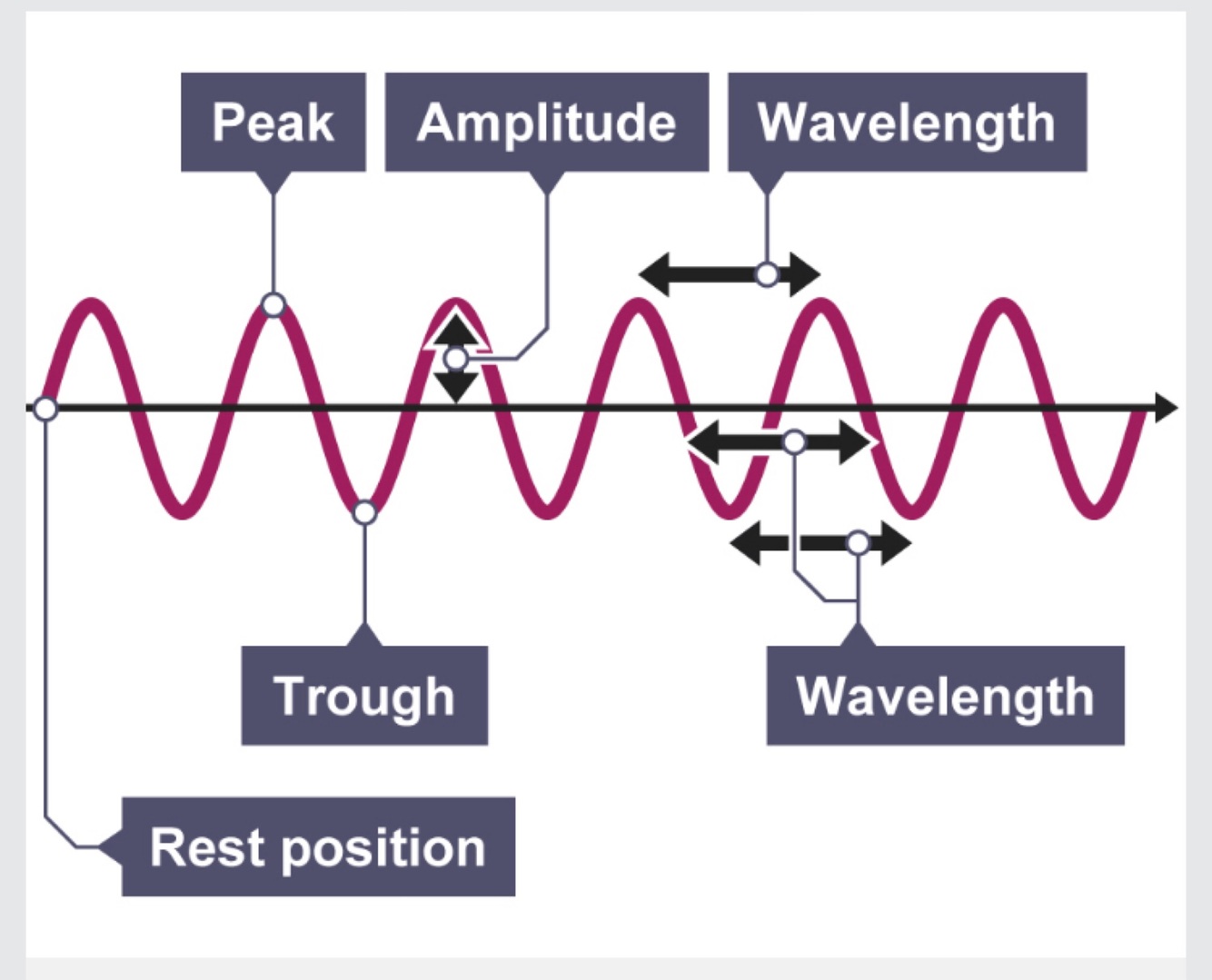
The number of waves passing a fixed point per second measured in hertz
Amplitude
The maximum height of a wave from the middle of a wave to its peak is trough.
Wavelength
The distance from one point on a wave to the equivalent point in the next wave in metres
Period
The time taken for one complete oscillation in seconds
Wave speed
The speed at which the energy is transferred
Ripple tank experiment
• Time how long it takes one wave to travel the length of the tank using speed = distance/time • Count then number of waves passing a fixed point in a second to find the frequency • Use a ruler to measure the peak to peak to estimate the wavelength • Use a stroboscope to make the same measurements and compare the results Control: water depth Errors: stroboscope is more accurate
Speed and wavelength are … proportional
Directly
What changes when waves are transmitted from one medium to another?
Speed and wavelength Frequency doesn’t change as the same number of waves are still being produced by the source per second
Refractive index
The way in which a material affects refraction. The bigger the refractive index, the slower the light travels through the material.
Refraction is due to
The difference in the wave speed in the different media
When a light wave enters at an angle a medium in which it travels slower…
The first part of the light wave to enter the medium slows down The rest of the wave continues at the higher speed This caused the wave to change direction, towards the normal
Investigating reflection and refraction
• Set up the equipment • Draw around the semicircular block • Mark the position of the light at the start, at the end, and where it enters and exits the block • Remove the block and connect the marks to show the light rays • Repeat on a new piece of paper for a range of incident angles • Repeat the experiment with blocks made of different transparent materials
What is the range of human hearing?
20Hz - 20kHz
Why is the range of human hearing limited?
By the frequencies at which the ear drum can vibrate
Waft are examples of sound waves being converted to vibration?
In the ear drum A microphone Glass shattering opera singer
What is a normal?
A line drawn at right-angles to the surface at the point of origin.
A light wave travels from one medium to another and as it crosses the boundary it speeds up. In which direction does the light ray turn?
Away from the normal
Medium
A material through which a wave can be transmitted
Time period
The time for one complete oscillation or the time for one wavelength of a wave to pass
How do radio waves reaching a car aerial produce signals in the electrical circuit of the car radio?
Car aerial absorbs radio waves Electrons are made to vibrate Creating an alternating current
What is a wave?
A vibration about an undisturbed point. They transfer energy from one place to another.
What is a mechanical wave? What is an electromagnetic wave?
Oscillations of particles and transfer energy through a medium Electromagnetic waves are oscillations of electrical and magnetic fields and also transfer energy