Group 17 and group 18
No description yet. This curated deck is ready for daily study.
Card preview (16)
What is the general electronic structure and bonding for group 17
• Electronic structure: s² p⁵ • The element’s behaviour is dominated by high electronegativity F>Cl>Br>I • Diatomic (which can give rise to high volatility for the halogens)
Which is the only halogen which can form chains
Iodine But not through covalent interactions Polyiodides from [I₃]⁻ up to [I₂₉]³⁻
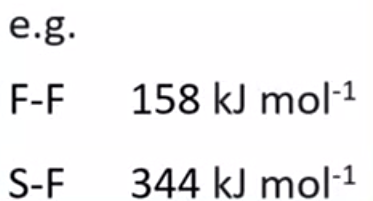
How does F-F react compared to S-F?
• F-F is very reactive (direct combination with most elements) • F-F reactions are very exothermic (violent) • This is due to the low F-F bond energy as it is weak due to high electrostatic repulsion • High S-F bond energy due to large difference in electronegativity, hence electrostatic interactions
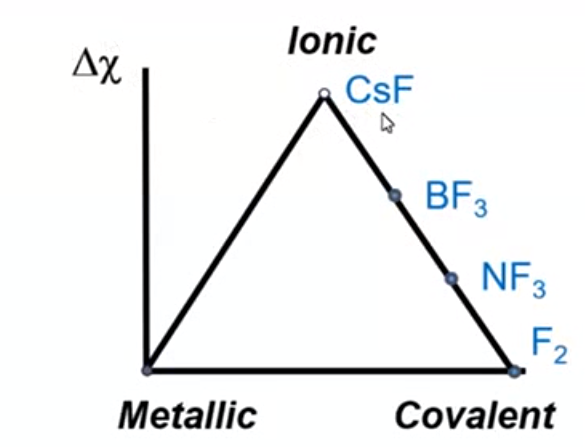
True or false Only ionic compounds can be formed from fluorides
False Both ionic and covalent compounds are formed Will depend on the difference in electronegativity
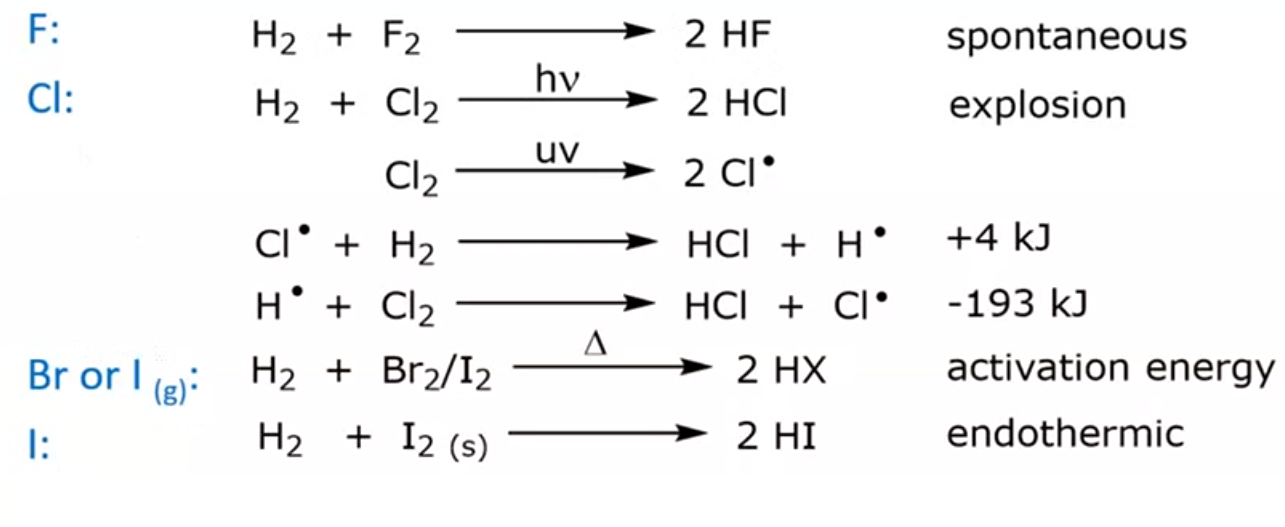
How easily will halogens react with hydrogen
Going down the group, more energy is required for halogens to react with hydrogen
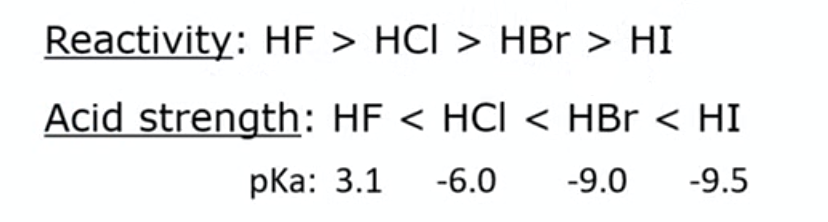
What happens to reactivity and acid strength of hydorgen halides going down group 17 Why?
• Reactivity decreases going down the group • Acidity increases going down the group • Both related to the strength of th H-X bond
A wide range of oxidation states available for heavier halides (i.e. not F) Why?
• Due to how electronegative it is, as the valance shell is very close to the nucleus • We cannot form any high/positive oxidation states
Explain the trend of the following group 18 ionisation energies

• He-Ar are particularly stable and don’t have any d-orbitals • As we go down to larger valence shell the electrons are further away from the nucleus and more easily ionised • As well as d-orbitals from Kr onwards
Xe has the most extensive chemistry Oxidation states ranging from +2 to +8 What does this depend on?
Must have very electronegative substituents (e.g. F, O or Cl) present to stabilise the compounds of the group 18 elements
The graph below shows the formation of different Xenon fluorides What are some key features of these Xenon fluorides?
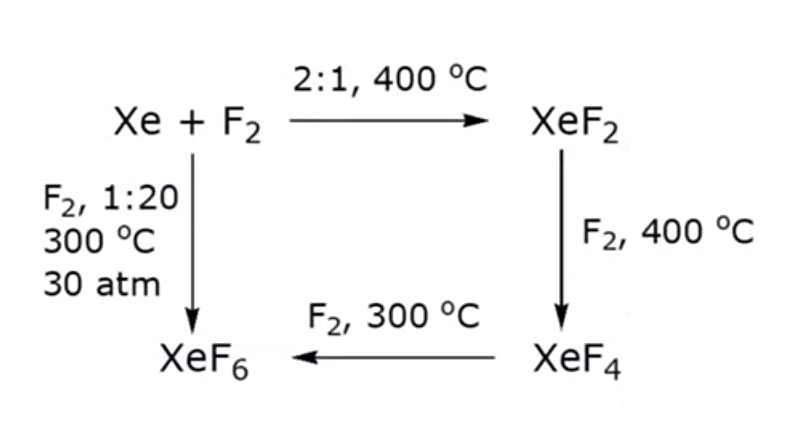
• All colourless, volatile solids • Very powerful oxidising agents and fluorinating agents • Fluorinating ability XeF₂ < XeF₄ < XeF₆
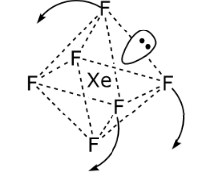
Why is XeF₆ not your typical octahedron?
• 14e-, gaseous structure is a monocapped octahedron i.e. with a lone pair projecting from one face • Lone pair distorts the octahedron by pushing back three of the F⁻ ligands • The structure is fluxional and lone pair shifts from face to face - average of all eight structures
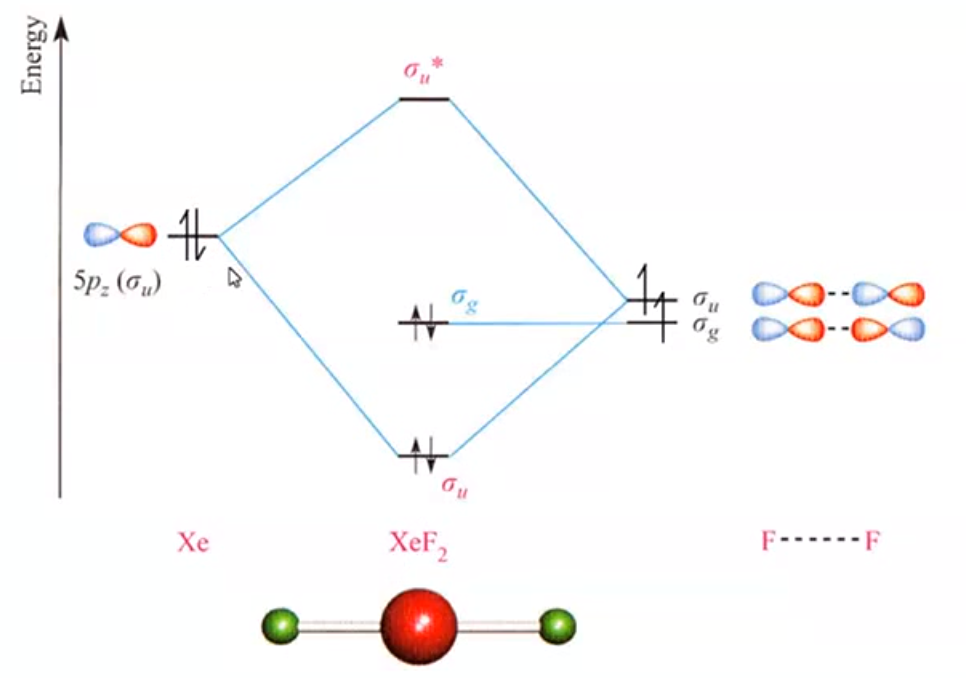
XeF₂ has 10 electrons Hence goes against the ocetet rule Use the Molecular orbital diagram below to rationalise where electrons go within this compound
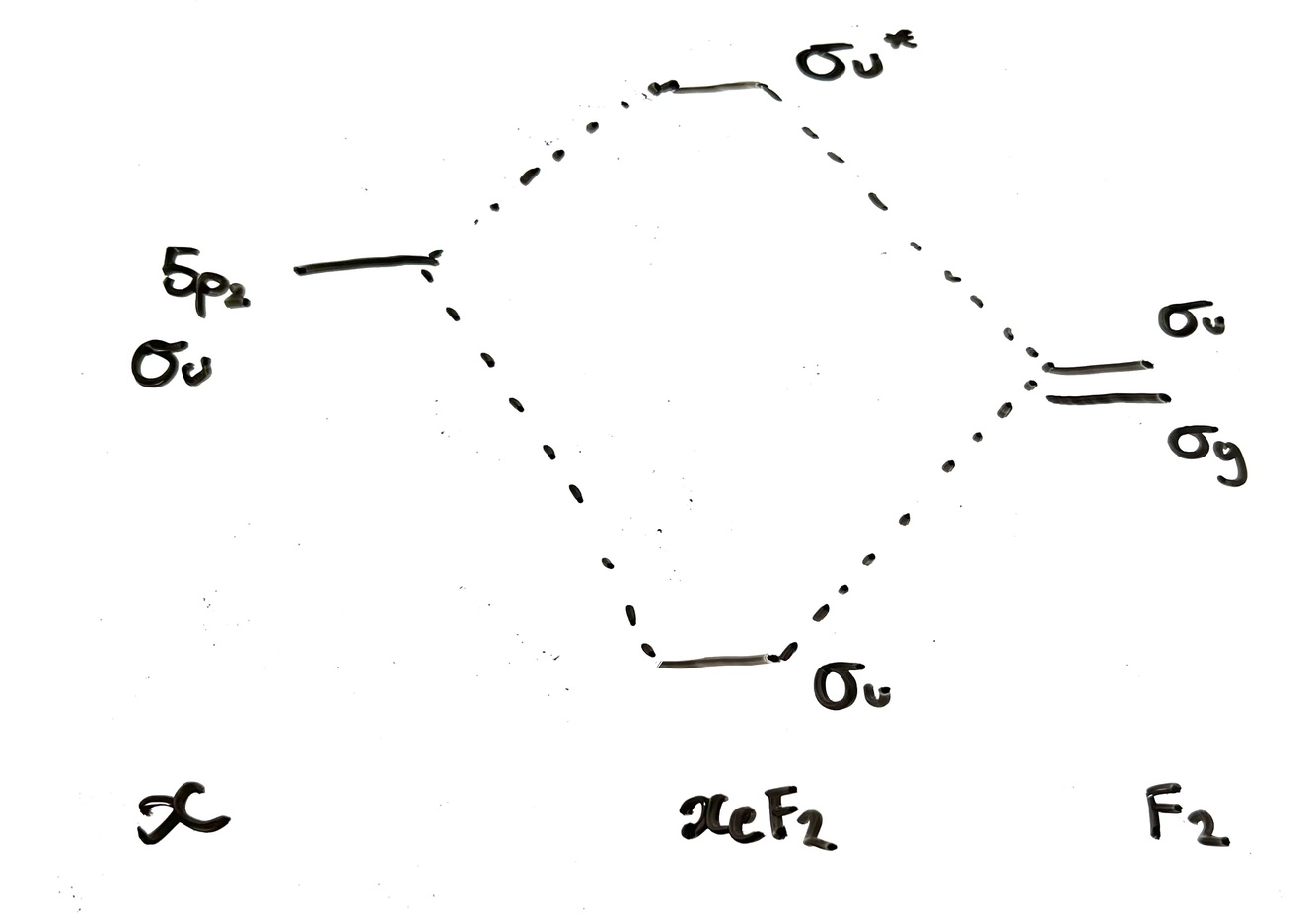
• Three-centre MO’s derived from a p-orbital on each atom • Combination of 3 AO’s gives 3 MO’s: 1x bonding, 1x non-bonding and 1x antibonding orbtial • 2e- from Xe, 2e- from F⁻ gives 4e⁻ to populate • (note: the 2 electrons in this bonding MO are spreadout over the entire molecule (not located entirely in one Xe-F bond) so the two bond are weak)
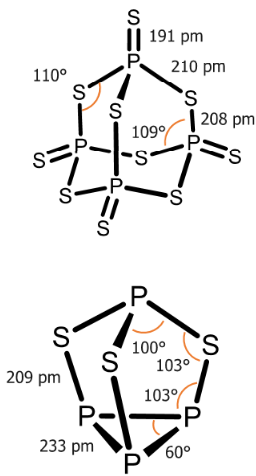
Phosphorus will react with oxygen to form a phosphorus oxide complex e.g. P₄ + 5O₂ → P₄O₁₀ Does S react the same way as O?
• Yes and no • P₄ + ₙS₈ → P₄S₁₀ (isostructual with the oxygen analogue) when n is in excess • But can form P₄ + ₙS₈ → P₄S₃, when n is deficient • This compound does not have a stable oxygen equivalent
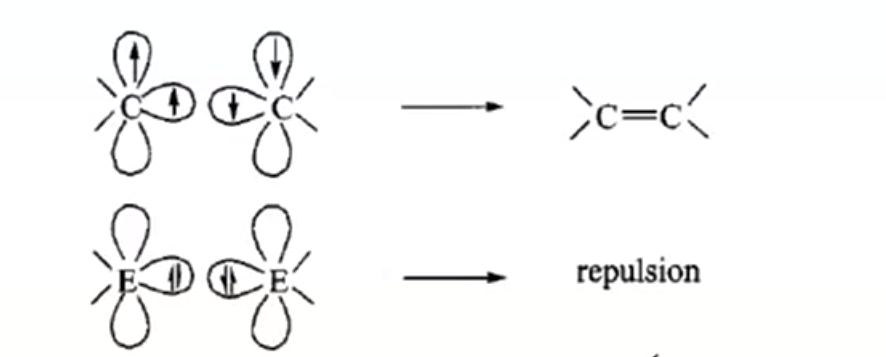
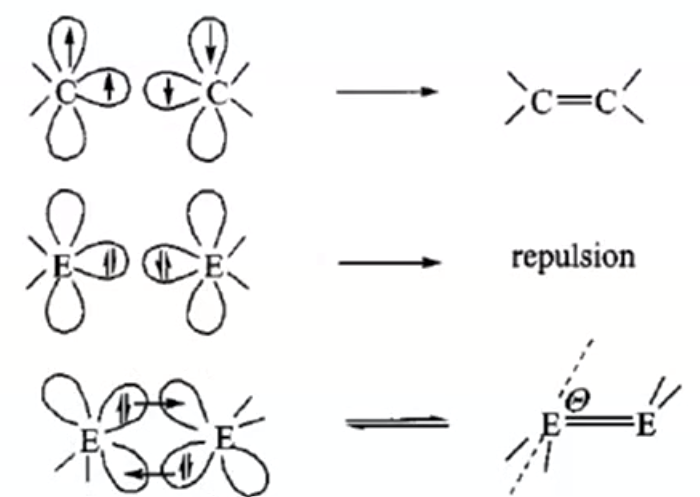
• Carbon can have triplet ground states in carbenes (single unpaired electron) which enables the formation of alkenes - shown below • Silyenes, germylenes, stanylenes and plumbylenes have singlet ground states, how do they form double bonds
• As shown there can’t have an interaction between the two filled orbitals due to repulsion • Instead two fragment tilt at 45° so there is two acid-base interactions • (the larger the element the bigger the tilt)
Germylenes show that electropositive substituents (e.g. Si) can favour great double bond character seen by flatter conformation to carbon germylene equivalents Why?
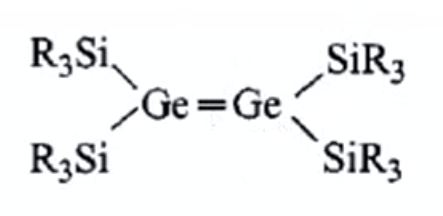
• Due to Si and Ge having a large difference in electronegativity (hence ΔΧ) • Si will release electron density towards germanium • This will affect bond polarity and relative energies of singlet and triplet states AND HOMO and LUMO
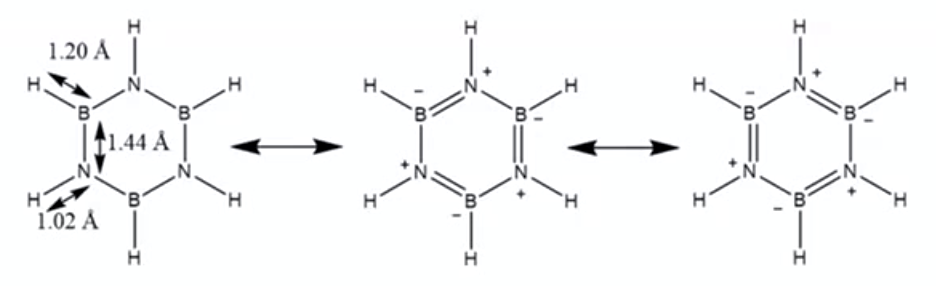
The following compound is Borazine Which is a boron-nitrogen analogue of benzene (isoelectronic and isostructural) What are some differences however been Borazine and Benzene?
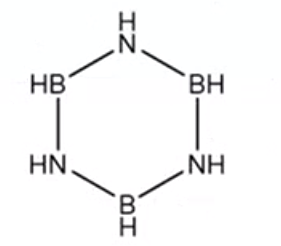
• Nitrogen is a lot more electronegative (3.04) and smaller (0.70Å) than boron (2.04, 0.88Å) • So, more localised charges than benzene (though both formally obey Huckel’s rule) in structures that are in resonance with the neutral representation