Topic 9 Rates of reaction
No description yet. This curated deck is ready for daily study.
Card preview (12)
How to speed up the rate of reaction
-Use a catalyst -Increase concentration -Increase temperature -Increase surface area -Increase pressure
Rate of reaction equation
Change in mass of reactant or product __________________________________________ Time
Maxwell Boltzmann distribution
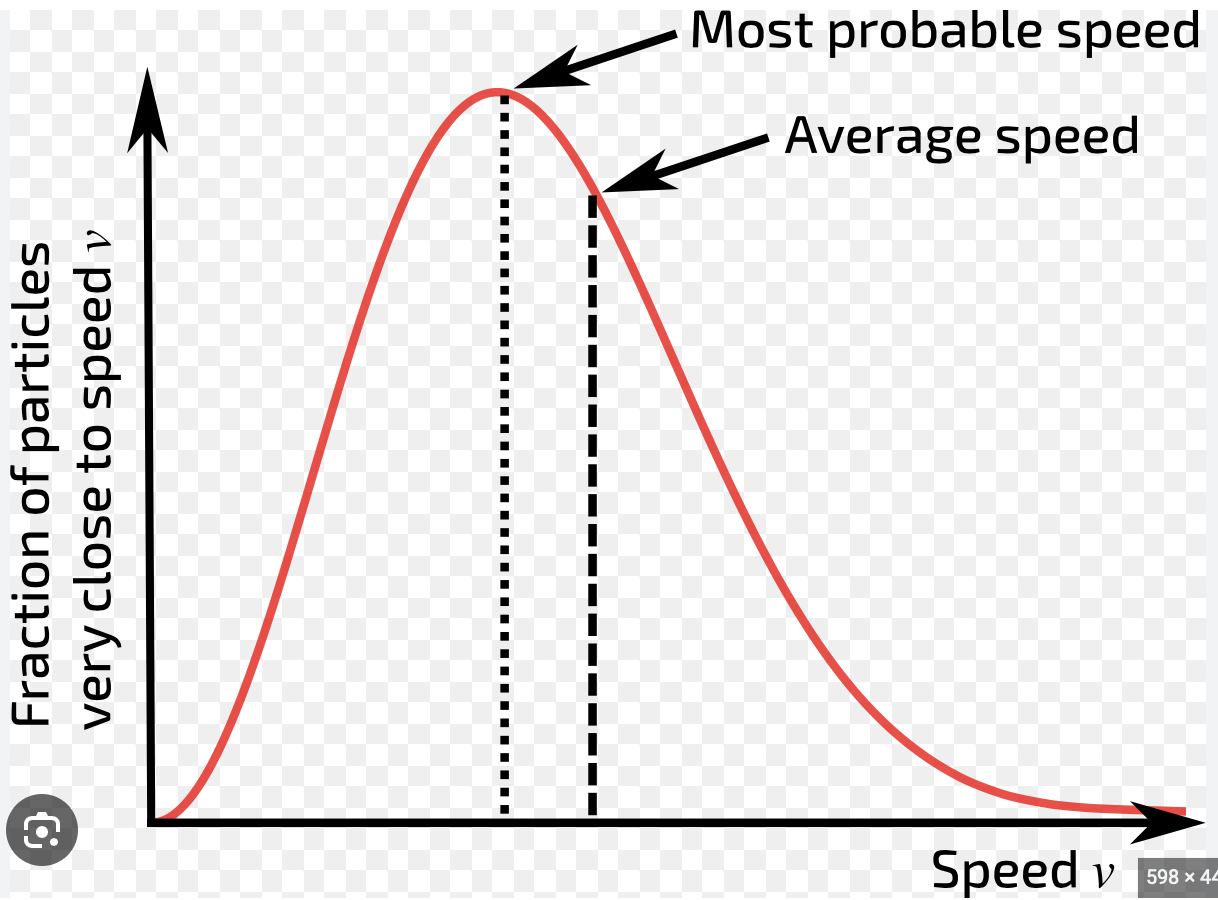
Boltzmann distribution points
1) Shows the distribution of molecular energies 2) Allows us to represent the fraction of molecules in a sample with sufficient energy to react (by marking the activation energy) 3) There are no molecules with zero energy (the curve approaches the x-axis asymptotically) 4) The distribution changes at different temperatures as the distribution of energy of the molecules changes
Effects of changing temperature
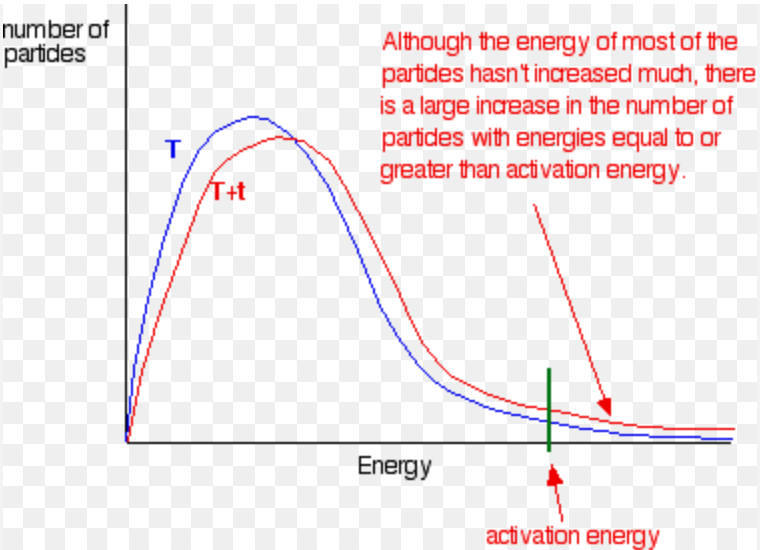
Effects of changing T points
1) The total area under the curve is the same for both temperatures 2) The peak is lower and the distribution is displaced to the right for higher temperatures 3) Ea is the same but a higher fraction of molecules have energy greater than Ea at the higher temperature (the area under the curve is larger)
Reactions in solution
-In the gas phase, molecules move at high speeds and frequently collide with each other -In solute, molecules are more packed together
Low-medium concentrations reactions in a solution
-Most of the solution is solvent so the reacting molecules are surrounded by solvent molecules -They are said to be trapped in a ‘solvent cage’ -This increases the collision rate between solute molecules and, if they have sufficient energy, they may react (this is because sometimes the number of molecules become trapped in the same solvent cage).
Lower activation energy
When a reaction has lower activation energy, a higher fraction of the molecules have energy equal to or greater that activation energy therefore we get more successful collisions.
The most common type of catalyst used in industry
A heterogenous catalyst (that is in a different phase to that of the reactants, eg. in the Haber process reactants are in the gas phase but the catalyst is solid iron)
Steps in catalyst
1) Adsorption (the attraction of molecules onto the surface of a solid) 2) Weakening of the bonds 3) Desorption (the release of an absorbed substance from a surface).
What are the two reasons to use a catalyst?
1) A catalyst increases rate of reaction so more product is made in a given time = more to sell 2) It allows reactions to occur at lower temperatures, this reduces energy costs.