Mechanical Properties of Materials
No description yet. This curated deck is ready for daily study.
Card preview (15)
What is elastic deformation?
Elastic deformation is when there is no permanent deformation after a load is removed from a material, due to bonds being able to return to their normal length. • Strongly bonded materials require a greater force in order to pull apart and deform the bonds.
What is plastic deformation?
Plastic deformation is when there is a permanent deformation after a load is removed from a material, due to bonds being unable to return to their normal length. • Instead of stretching bonds, they are broken or reformed with new neighbours causing a large number of atoms to move relative to each other. • Stress is no longer proportional to strain. • Dislocations cause this plastic deformation. Mainly associated with metals. • Although the crystal structure doesn’t change, the shape of the material does.
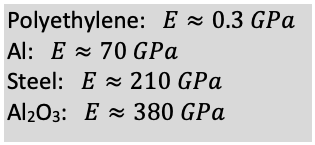
What is Young’s modulus?
A measure of the stiffness and bond strength of a material. • E = σ/ε (during elastic deformation) • N/mm2
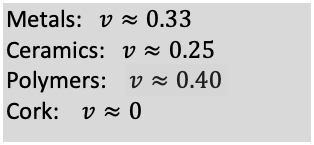
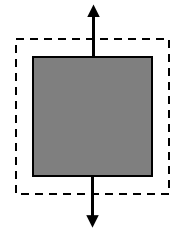
What is Poisson‘s ratio?
The ratio of lateral to axial strains. • v = εL/ε • Dimensionless
What are auxetic materials?
Auxetic materials have a negative Poisson’s ratio, and so expand in all directions when under tension. • They are frequently used in memory foam beds.
What are the features of a stress-strain graph?
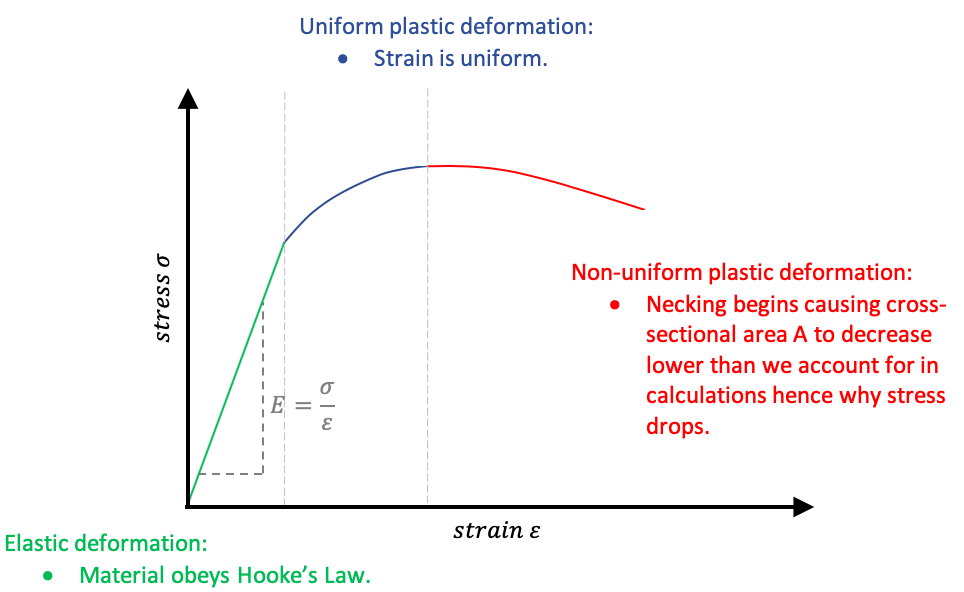
How can you improve the accuracy of a reading for Young’s modulus?
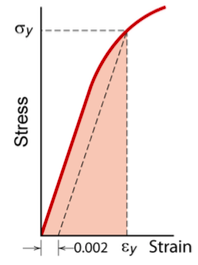
Draw a parallel line through the yield point and measure the gradient of this line.
What is yield strength?
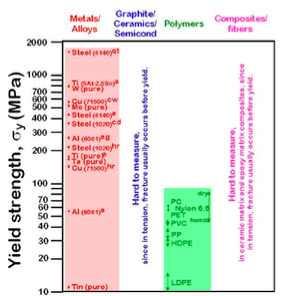
The yield strength is the point at which areas is no longer proportional to strain. • Above this level of stress, plastic deformation occurs. • It is a measure of resistance to plastic deformation. Metals: • Variable yield strength from low to high. Ceramics: • Hard to measure, as fractures usually occur before yield. Polymers: • Low yield strength.
What is tensile strength?
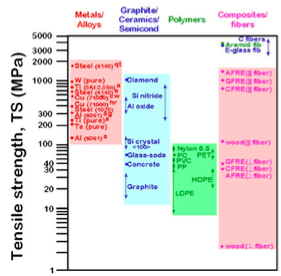
The tensile strength is the maximum stress that a material can sustain. • It is the maximum stress shown on a stress-strain curve. • It occurs in metals once noticeable necking starts, and in polymers when the polymer backbone chains are aligned and about to break. Metals: • High tensile strength. Ceramics: • Medium tensile strength. Polymers: • Low tensile strength.
What is ductility?
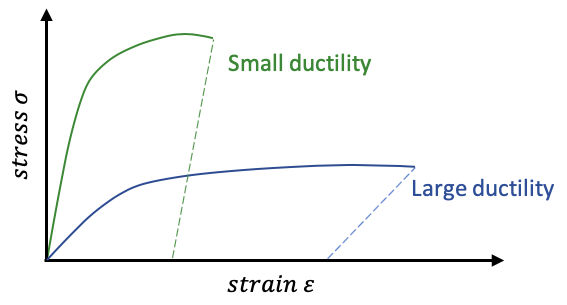
The ductility is the degree of plastic deformation before failure. • It can be found by drawing a line parallel to the Young’s modulus to find the plastic strain at failure of the material.
What is toughness?
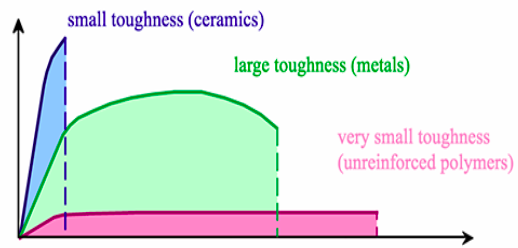
Toughness is the energy required to break a unit volume of a material. • It is a measure of the ability of a material to absorb energy up to fracture, or the resistance to fracture once a crack is present. • It can approximately be found by the area underneath a stress-strain curve. • Generally, ductile materials are tough, and brittle materials are not. • Jm-3 Metals: • Large toughness. Ceramics: • Low toughness. Polymers: • Low toughness.
What is resilience?
Resilience is the capacity of a material to absorb energy during elastic deformation and recover energy during unloading. • It is the materials ability to store energy. • The modulus of resilience (U) is the strain energy per unit volume required to stress a material to the yield point. • Jm-3 • U = 1/2σyεy
What is hardness?
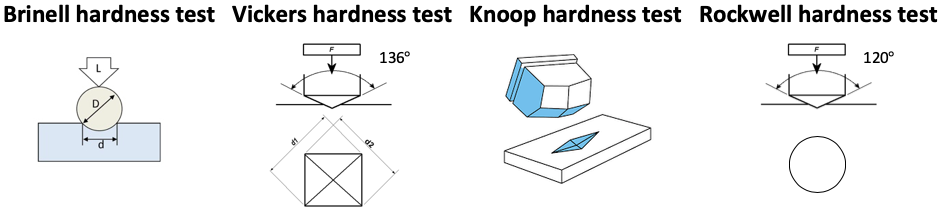
Hardness is the resistance to localised plastic deformation (such as dents/scratches). • Large hardness means resistance to plastic deformation is great and so materials wear better.
What are the different types of hardness test?
What is Mohs hardness scale?
• A scale of hardness devised by arranging 10 minerals so that one material could only scratch those below it. • Intervals of hardness are approximately equal except for between corundum and diamond.