Reflexes
No description yet. This curated deck is ready for daily study.
Card preview (7)
Define a reflex
Rapid automatic response to a change in internal or external environment.
Characteristics of neurons
By a stimulus. Involuntary: Without conscience thought. Rapid: Only a few neurons involved. Stereotyped: Occurs in same way each time.
Spinal reflexes
• Carried out by spinal cord only. • Eventually impulses may be sent to brain, so it is aware of what is occurring. • Person would only become consciously aware of situation, after response has been made.
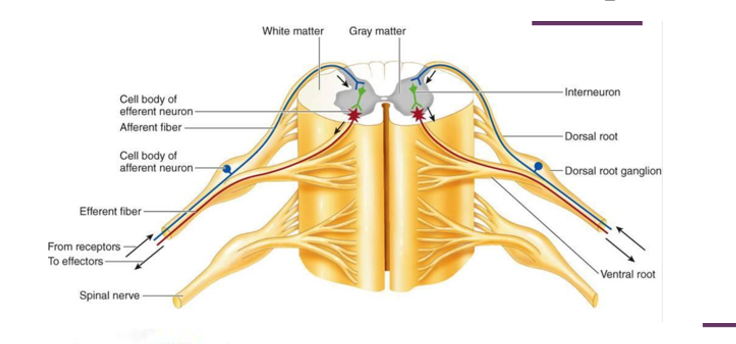
Reflex arc
Purpose is to protect the body from dangerous situations. 1. A receptor in end of a sensory neuron detects a change in environment and reacts to this stimulus by producing a nerve impulse. • Sensory neuron carries impulse to spinal cord. • Information is processed in CNS (S.C). Nerve impulse is passed across a synapse either straight to a motor neuron or via 1 or more interneurons to motor neuron. • Motor neuron carries nerve impulse to an effector. • Effector (muscle or gland) receives nerve Impulse and carries out an appropriate response.
Protective reflexes
Protect body from injury. E.g. Blinking, Sneezing, Coughing, Constriction of pupils.
Learned/acquired reflexes
Complex motor patterns appear during a baby’s development. Other reflexes are learned through constant repetition.
Label a spinal reflex arc