covalent model pt.2 IMF
No description yet. This curated deck is ready for daily study.
Card preview (24)
What are intermolecular forces?
Forces of attraction between molecules (not the covalent bonds within molecules). They explain why covalent substances can be liquids/solids and help predict volatility, melting/boiling points, solubility, and electrical conductivity. (physical properties)
Why is it wrong to call intermolecular forces “bonds” in the same way as covalent bonds?
Covalent bonds are electrostatic attractions within molecules (between nuclei and shared electrons), while intermolecular forces are electrostatic attractions between molecules and are much weaker.
List the four intermolecular forces named in the syllabus.
London (dispersion) forces; dipole-induced dipole; dipole-dipole; hydrogen bonding.
What does the term “van der Waals forces” include?
It is an inclusive term for London (dispersion), dipole-induced dipole, and dipole-dipole forces.
Why do non-polar molecules still experience attractions?
Their electrons are still mobile, so the electron cloud can become uneven momentarily, creating a temporary (instantaneous) dipole.
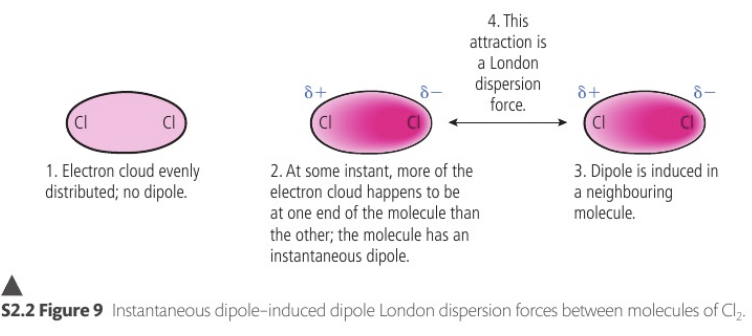
How does a London dispersion force form?
A temporary dipole in one molecule induces a temporary dipole in a neighbouring molecule, creating an attraction between opposite charges.
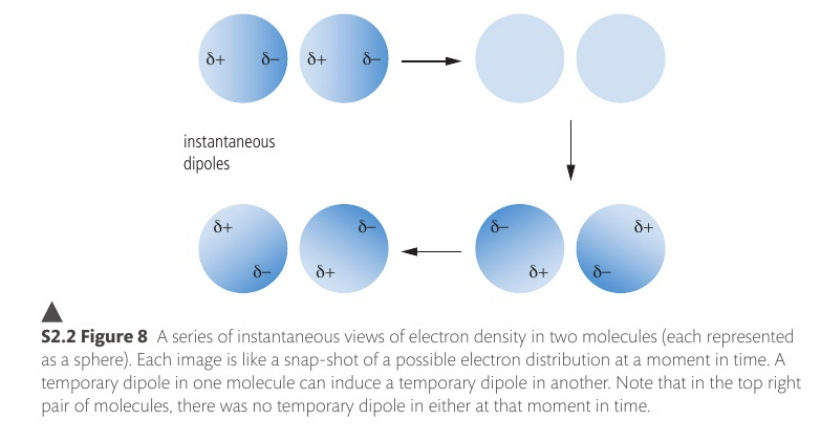
Which molecules have London dispersion forces?
All molecules have London dispersion forces; they are the only intermolecular forces present in non-polar molecules.
How does the strength of London dispersion forces change with molecular size?
London forces increase with increasing molecular size, because more electrons increase the chance and size of temporary dipoles.
When comparing boiling points to see London-force trends, what must be controlled?
Compare substances with similar molar mass so differences are mainly due to polarity rather than size/electron number.
What trend is shown by the halogens in terms of boiling point and state at room temperature?
As you go down Group 17 from F₂ → Cl₂ → Br₂ → I₂, boiling point increases (more electrons → stronger London forces), and their room-temperature states shift from gases to liquid to solid.
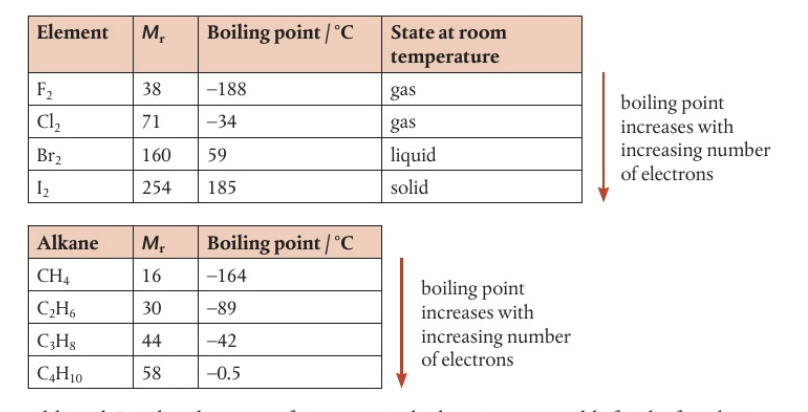
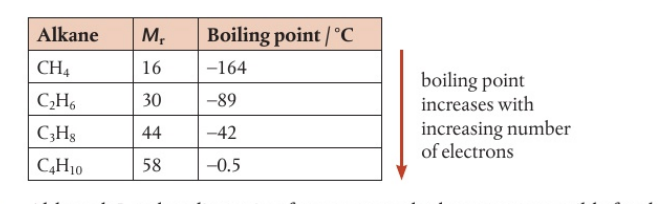
What trend is shown by alkanes in terms of boiling point?
As the number of electrons/molar mass increases (e.g. from smaller to larger alkanes), boiling point increases due to stronger London dispersion forces.
What causes dipole-dipole attraction?
In polar molecules, there is a permanent separation of charge (a permanent dipole) due to electronegativity differences and bond polarity.
Describe dipole-dipole attraction.
The δ⁺ end of one polar molecule is attracted to the δ⁻ end of a neighbouring polar molecule.
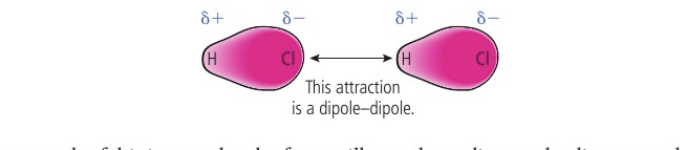
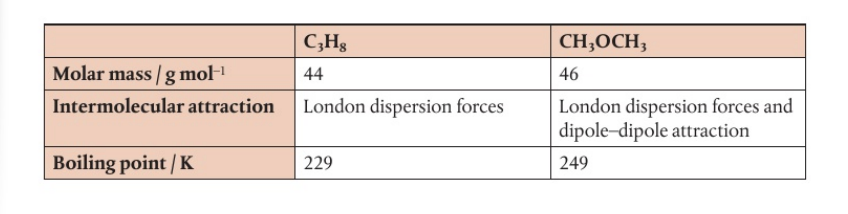
Compared with London forces (at similar molar mass), how does dipole-dipole strength compare?
Dipole-dipole forces are stronger than London dispersion for molecules of similar molar mass, so polar molecules often have higher boiling points than comparable non-polar molecules.
Give the example of a polar molecule showing dipole-dipole attraction.
HCl molecules: the δ⁺ H of one molecule attracts the δ⁻ Cl of another molecule.
When does dipole-induced dipole attraction occur?
When a polar molecule causes a temporary separation of charge in a neighbouring non-polar molecule, inducing a dipole.
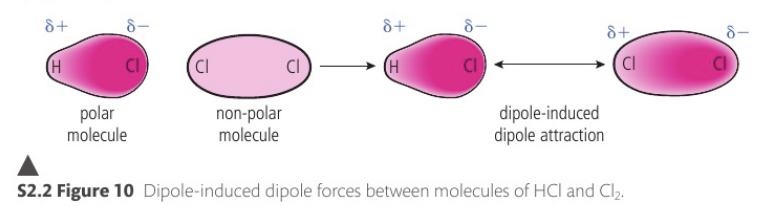
Give the example pairing for dipole-induced dipole.
Interactions between HCl (polar) and Cl₂ (non-polar).
Can dipole-induced dipole forces exist alongside other forces?
Yes, they act in addition to London dispersion forces when polar and non-polar molecules are together.
Define hydrogen bonding
Hydrogen bonds occur when hydrogen, covalently bonded to an electronegative atom, has an attractive interaction with a neighbouring electronegative atom.
Which electronegative atoms are explicitly required for hydrogen bonding
Nitrogen, oxygen, or fluorine (H bonded to N/O/F).
Why are hydrogen bonds stronger than ordinary dipole-dipole forces?
Because the bond is very polar and hydrogen is very small, so the δ⁺ hydrogen is not well shielded and can strongly attract a lone pair on N/O/F in a neighbouring molecule.
What effect do hydrogen bonds have on boiling points compared with similar molecules?
Hydrogen bonding causes much higher boiling points than expected from molar mass alone.
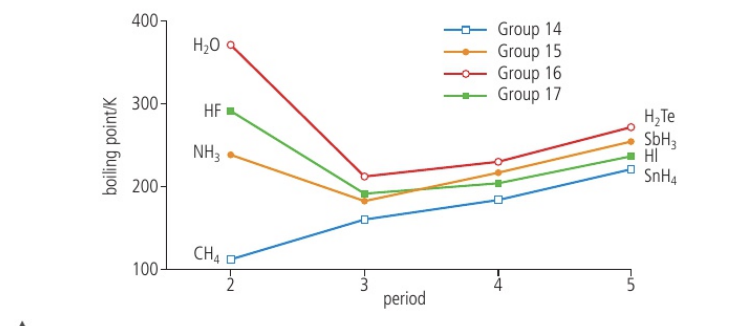
State the syllabus order of relative IMF strengths for comparable molar mass.
London (dispersion) < dipole-dipole < hydrogen bonding.
What is the key condition for applying the relative IMF strengths order effectively?
The substances should have comparable molar masses, so differences reflect polarity and type of IMF, not size.