BUFFERS
No description yet. This curated deck is ready for daily study.
Card preview (9)
• What is a buffer?
• A buffer is a solution which can resist changes in pH when a small amount of acid or base is added • They are designed to keep [H+] almost unchanged, as then the pH remains almost constant
• What is an acidic buffer?
• An acidic buffer is made of a weak acid and a soluble salt of that acid. It maintains a pH below 7.
• How do the acid and salt dissociate in an acidic buffer?
• The weak acid only partially dissociates, so equilibrium lies to the LHS • The salt of that weak acid fully dissociates, so the equilibrium lies to the RHS
• What happens if too much H+ and OH- are added to a buffer?
• Buffers can only cope when a small amount of H+ and OH- are added. If too much is added, the buffer can get saturated
• What is a basic buffer?
• A basic buffer is made of a weak base and a soluble salt of that base. It maintains a pH above 7.
• Why would it be difficult to judge the end point of this reaction using an indicator?
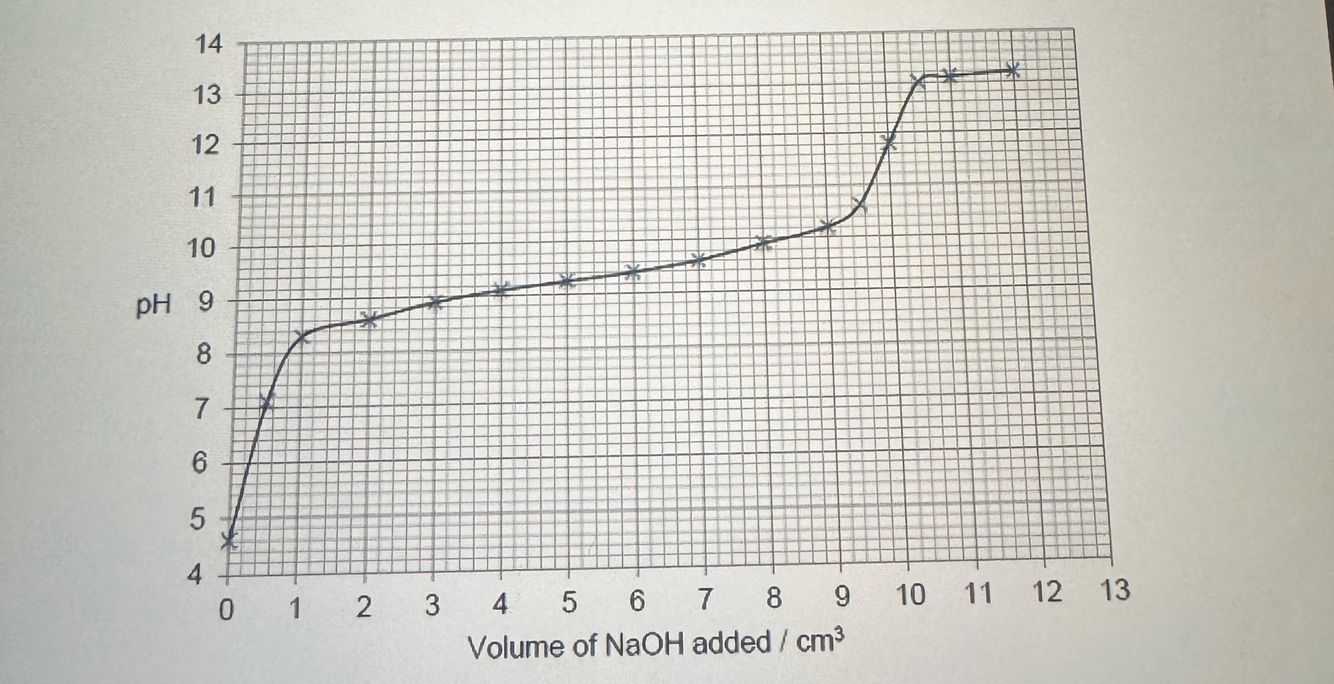
• The change in pH is gradual and not rapid at the end point • An indicator would change colour over a range of volumes of sodium hydroxide
• What is a strong acid?
• Completely ionises to form H+ ions