Periodicity
No description yet. This curated deck is ready for daily study.
Card preview (24)
Periodicity
Periodicity is the repeating pattern of physical or chemical properties going across the periods
Atomic radius
Atomic radii decrease from left to right across a period, because the increased number of protons create more positive charge attraction for electrons which are in the same shell with similar shielding.
1st Ionisation Energy
There is a general trend across to increase. This is due to the increasing number of protons as the electrons are being added to the same shell. There is a small drop between Mg + Al. Mg has its outer electrons in the 3s subshell, whereas Al is starting to fill the 3p subshell. Al’s electron is slightly easier to remove because the 3p electrons are higher in energy. There is a small drop between phosphorous and sulfur. Sulfur’s outer electron is being paired up with another electron in the same 3p orbital. When the second electron is added to an orbital there is a slight repulsion between the two negatively charged electrons which makes the second electron easier to remove
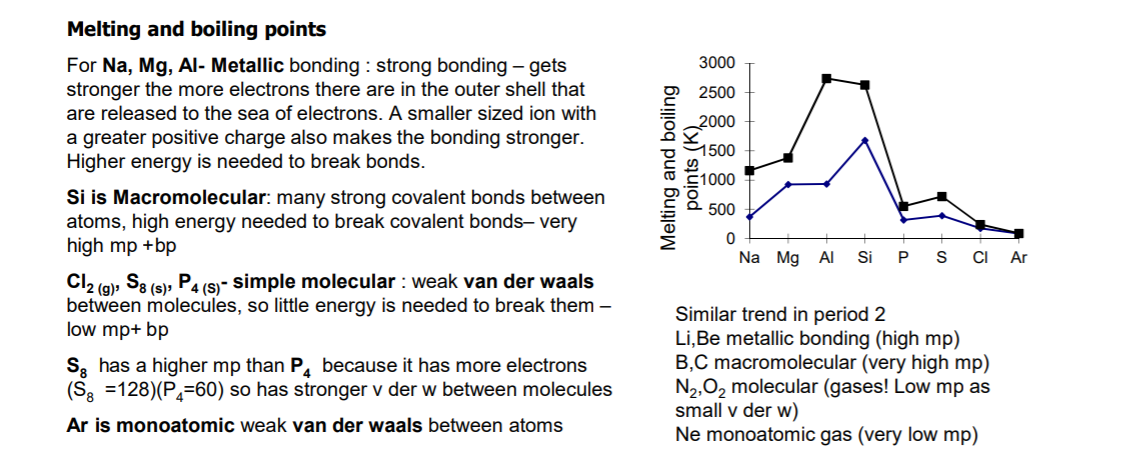
Melting and boiling points Na, Mg, Al, Si, Cl2, S8, P4 , S8, Ar
Group 2 Atomic radius
Atomic radius increases down the group. As one goes down the group, the atoms have more shells of electrons making the atom bigger.
Melting points Group 2
Melting points decrease down the group. The metallic bonding weakens as the atomic size increases. The distance between the positive ions and delocalized electrons increases. Therefore the electrostatic attractive forces between the positive ions and the delocalized electrons weaken
Group 2 1st Ionisation Energy
The outermost electrons are held more weakly because they are successively further from the nucleus in additional shells. In addition, the outer shell electrons become more shielded from the attraction of the nucleus by the repulsive force of inner shell electrons
Group 2 reactions Reactions with oxygen. Mg
The group 2 metals will burn in oxygen. Reactivity of group 2 metals increases down the group Mg burns with a bright white flame. 2Mg + O2 —–2MgO MgO is a white solid with a high melting point due to its ionic bonding. Mg will also react slowly with oxygen without a flame. Mg ribbon will often have a thin layer of magnesium oxide on it formed by reaction with oxygen. 2Mg + O2 —-2MgO This needs to be cleaned off by emery paper before doing reactions with the Mg ribbon. If testing for reaction rates with Mg and acid, an un-cleaned Mg ribbon would give a false result because both the Mg and MgO would react but at different rates. Mg + 2HCl —– MgCl2 + H2 MgO + 2HCl —— MgCl2 + H2O
Group 2 reactions Reactions with water
Magnesium reacts in steam to produce magnesium oxide and hydrogen. The Mg would burn with a bright white flame. Mg (s) + H2O (g) —— MgO (s) + H2 (g) Mg will also react with warm water, giving a different magnesium hydroxide product. Mg + 2 H2O —–Mg(OH)2 + H2 This is a much slower reaction than the reaction with steam and there is no flame
The other group 2 metals will react with cold water with increasing vigor down the group to form hydroxides Ca, Sr, Ba
Ca + 2 H2O (l)—– Ca(OH)2 (aq) + H2 (g) Sr + 2 H2O (l)—–Sr(OH)2 (aq) + H2 (g) Ba + 2 H2O (l)—— Ba(OH)2 (aq) + H2 (g)
One would observe group 2 + water
• fizzing, (more vigorous down group) • the metal dissolving, (faster down group) • the solution heating up (more down group) • with calcium a white precipitate appearing (less precipitate forms down group with other metals)
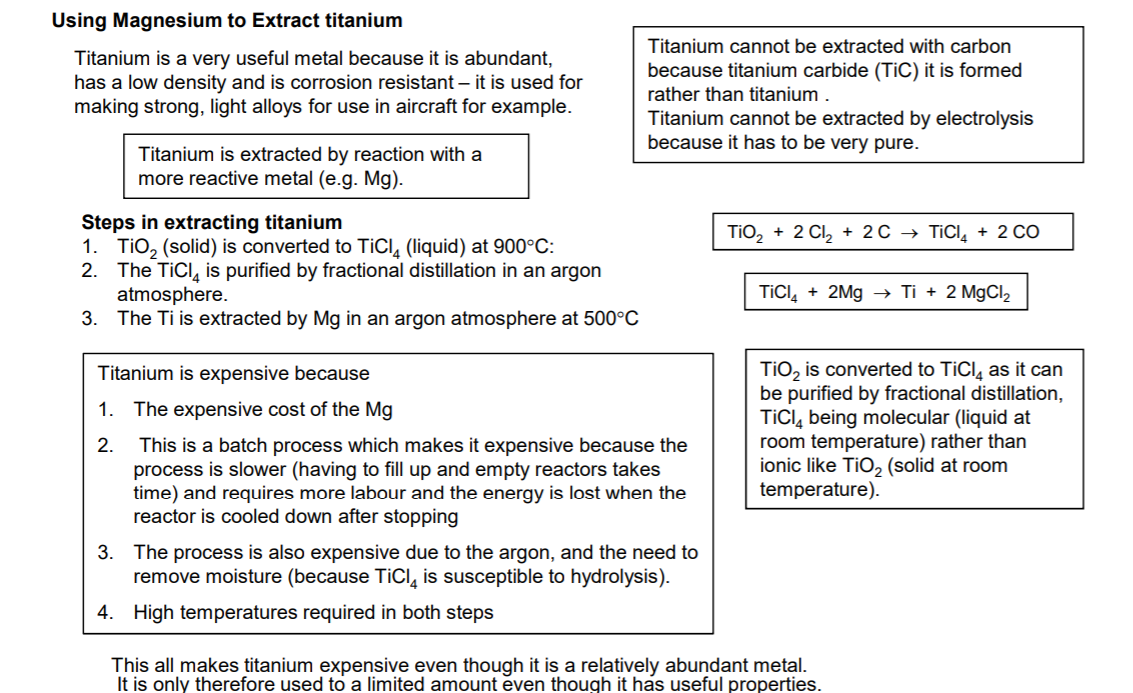
Using Magnesium to Extract titanium
Magnesium hydroxide
Magnesium hydroxide is classed as insoluble in water. Mg2+ (aq) + 2OH-(aq) —- Mg(OH)2 (s) A suspension of magnesium hydroxide in water will appear slightly alkaline (pH 9) so some hydroxide ions must, therefore, have been produced by a very slight dissolving. Magnesium hydroxide is used in medicine (in suspension as milk of magnesia) to neutralize excess acid in the stomach and to treat constipation. Mg(OH)2 + 2HCl—– MgCl2 + 2H2O It is safe to use because it is so weakly alkaline. It is preferable to using calcium carbonate as it will not produce carbon dioxide gas.
Calcium hydroxide
Calcium hydroxide is classed as partially soluble in water and will appear as a white precipitate It is used in agriculture to neutralize acidic soils. A suspension of calcium hydroxide in water will appear more alkaline (pH 11) than magnesium hydroxide as it is more soluble so there will be more hydroxide ions present in solution. An aqueous solution of calcium hydroxide is called lime water and can be used as a test for carbon dioxide. The limewater turns cloudy as white calcium carbonate is produced. Ca(OH)2 (aq) + CO2 (g)—- CaCO3 (s) + H2O(l
Barium hydroxide
Barium hydroxide would easily dissolve in water. The hydroxide ions present would make the solution strongly alkaline. Ba(OH)2 (S) + aq —–Ba2+ (aq) + 2OH-(aq)
BaSO4
BaSO4 is used in medicine as a ‘Barium meal’ given to patients who need x-rays of their intestines. The barium absorbs the x-rays and so the gut shows up on the x-ray image. Even though barium compounds are toxic, it is safe to use here because its low solubility means it is not absorbed into the blood. If barium metal is reacted with sulfuric acid it will only react slowly as the insoluble barium sulfate produced will cover the surface of the metal and act as a barrier to further attack. Ba + H2SO4 ——BaSO4 + H2 The same effect will happen to a lesser extent with metals going up the group as the solubility increases. The same effect does not happen with other acids like hydrochloric or nitric as they form soluble group 2 salts
Testing for Presence of a Sulfate ion
BaCl2 solution acidified with hydrochloric acid is used as a reagent to test for sulphate ions. If acidified barium chloride is added to a solution that contains sulfate ions a white precipitate of barium sulfate forms. Ba2+ (aq) + SO4 2-(aq)——BaSO4 (s). The hydrochloric acid is needed to react with carbonate impurities that are often found in salts which would form a white barium carbonate precipitate and so give a false result. You could not use sulfuric acid because it contains sulfate ions and so would give a false-positive result 2HCl + Na2CO3 —– 2NaCl + H2O + CO2 Fizzing due to CO2 would be observed if a carbonate was present
Soluble salts
All sodium, potassium and ammonium salts All nitrates Most chlorides, bromides, iodides Most sulfates Sodium, potassium and ammonium carbonates Sodium, potassium and ammonium hydroxides
Insoluble salts
Silver, lead chlorides, bromides iodides Lead, strontium and barium sulfates Most other carbonates Most other hydroxides
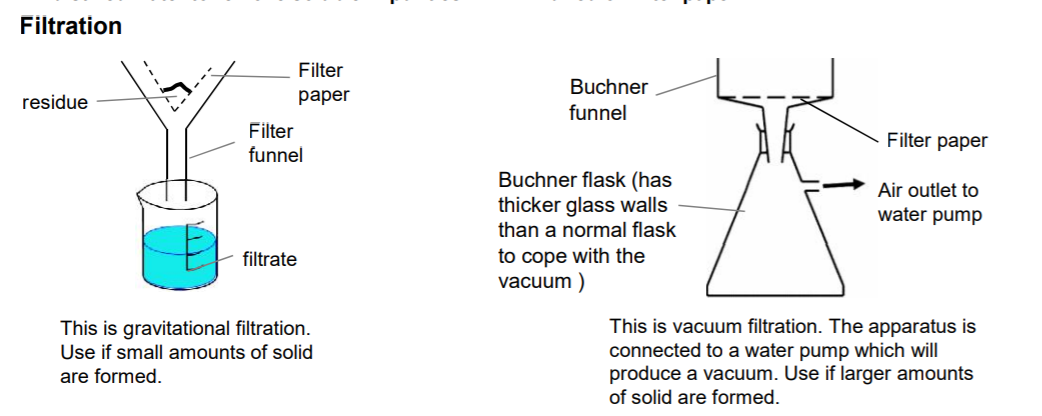
Filtration
Halogens colours
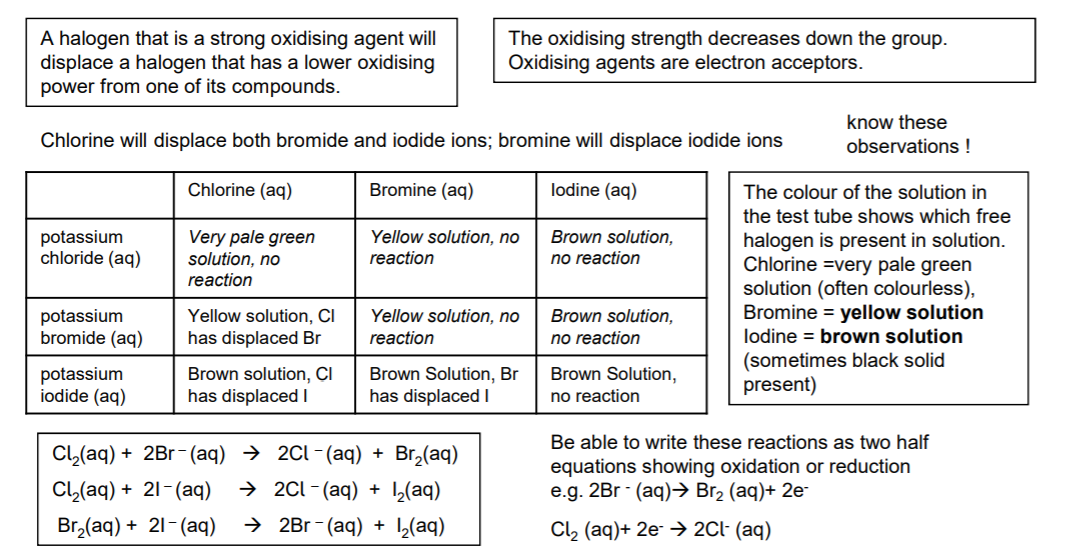
Fluorine (F2 ): very pale yellow gas. It is highly reactive Chlorine : (Cl2 ) greenish, reactive gas, poisonous in high concentrations Bromine (Br2 ) : red liquid, that gives off dense brown/orange poisonous fumes Iodine (I2 ) : shiny grey solid sublimes to purple gas
Trend in melting point and boiling point Halogens
Increase down the group As the molecules become larger they have more electrons and so have larger van der waals forces between the molecules. As the intermolecular forces get larger more energy has to be put into break the forces. This increases the melting and boiling points.
Trend in electronegativity Halogens
Electronegativity is the relative tendency of an atom in a molecule to attract electrons in a covalent bond to itself. As one goes down the group the electronegativity of the elements decreases. As one goes down the group the atomic radii increases due to the increasing number of shells. The nucleus is therefore less able to attract the bonding pair of electrons.
The displacement reactions of halide ions by halogens