Required Practicals
No description yet. This curated deck is ready for daily study.
Card preview (24)
(RP.10) Draw the diagram for suction filtration
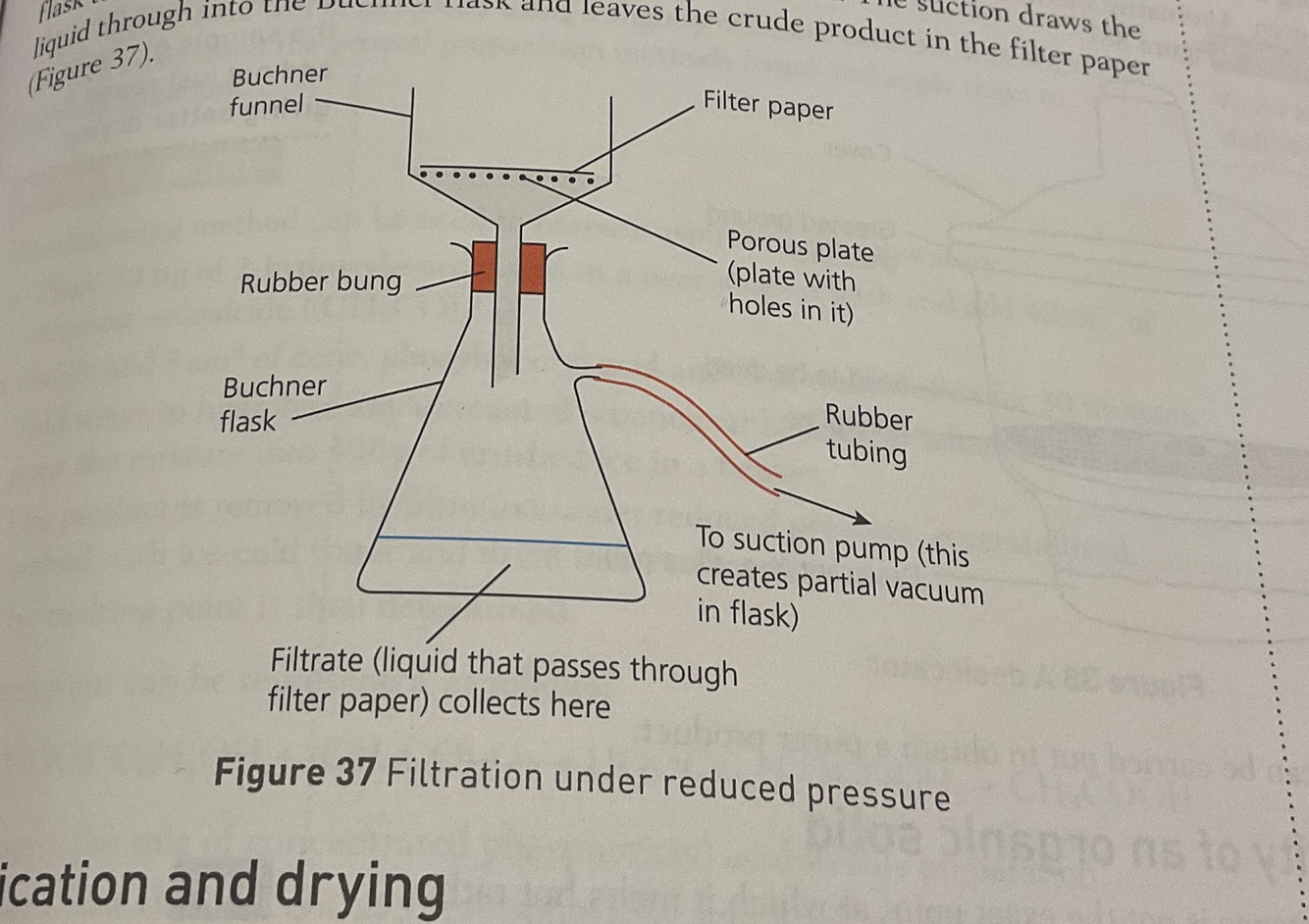
(RP.10) Write down the method for recrystallisation (6 steps)
prep: Filter solution gravity before 1) Dissolve impure crystals in the minimum volume of hot solvent 2) Filter off hot solution by gravity filtration , using a hot funnel and fluted filter paper - prevents precipitation of solid 3) Allow the solution to cool and crystallise - scratch side of flask with a glass rod 4) Filter off crystals formed using suction filtration under reduced pressure 5) Wash by pouring some iced cold solvent too remove aqueous impurities 6)Dry by sucking air over the crystals in the büchner flask then place in a low temperature oven
(RP.10) How do you check the purity of an organic solid (5 Steps) + (1 Explanation)
1)Place some of the solid in a capillary tube sealed at one end 2) Place in melting point apparatus and heat gently 3) Record the temperature at which the solid starts to melt and the temperature at which it finishes melting 4) Repeat steps 1-3 and average the temperatures 5) Compare the melting point with know value as in the data book 6) If the compound melts at a lower melting point and over a range of temperatures, it is impure
(RP.10) When prepping an organic solid why is the percentage yield less then 100%
. Some of the solid is lost in purification steps, some of the solid may still be dissolved in the solvent in recrystallisation .Some of the product is lost ion transferring solids between vessels (solved by rinsing to minimise loss)
(RP.9) Why must your ph meter be calibrated
ensures your readings are accurate and repeatable ph meter can be contaminated, so results tend to drift from their true value with further use
(RP.9) How do you calibrate a ph meter (3)
testing buffer solutions of known ph using that data to form a calibration curve map recorded ph’s to the calibration graph and read off their corrected ph values
(RP.7) How can the rate of the reaction be determined
Continuous monitoring method ie. Loss of reactant over time / Gain of product over time Initial Rates method (Iodine clock)
(RP.7) What is the Initial Rates Method
Plot a graph for each of the experiments at different Conditions Draw a tangent to the curve when x=0 Measure the gradient of this tangent The gradient is the initial rate of reaction, compare values with other graphs at different temperatures
(RP.7) Describe the Iodine Clock Experiment. Include the Equations
The I2 produced reacts with the thiosulphate Excess I2 that remains in solution then reacts with starch to form a blue black solution Time how long it takes for the blue black colour to appear Vary the [I-] to then determine the order of the reaction with respect to iodine ions

(RP.7) What are some issues surrounding the Iodine Clock Experiment
Some [I-] conc may take too long to react Delayed stopwatch reactions makes readings inaccurate Concentrations may not be exact due to measuring apparatus
What is a Continuous monitoring method?
Measuring change in concertation of reactant or product over time Involves measuring a quantity such as volume at set time intervals
(RP.7) Describe the Magnesium ribbon experiment (6)
Continuous monitoring method connect each end of rubber lead to a bung at one end and a gas syringe at the other add 6cm strip of magnesium ribbon into a conical flaks containing HCL quickly place a bung in the top of the flask and start the timer Note down Volume of hydrogen gas collected every 15 seconds Repeat using different Concentrations of HCl
(RP.7) How do you analyse data form the magnesium ribbon experiment
Plot a graph of volume gas produced (Y-axis) against time (x-axis) for each different concentation of HCl Draw a tangent to the curve when x=0 Measure the gradient of this tangent The gradient is the initial rate of reaction, compare values with other graphs at different Concentrations
(RP.7) what are some issues with the magnesium ribbon experiment
Some gas mat escape before the bung is added Density of magnesium ribbon used maybe different for each experiment
(RP.8) What is an Electrochemical Cell? (2)
Two different half cells, connected by a salt bridge. with their electrodes connected by a high resistance voltmeter It’s electric potential energy is generated by chemical redox reactions
(RP.8) What is a salt bridge
A connection between the half cells that allows the movement of ions, to complete the circuit. Consist of a concentrated electrolyte that doesn’t react with wither half cell solution
(RP.8) if a half cell’s reaction consist of two aqueous ions what electrode would be used and why?
Graphite/ Platinum Unreactive with solutions & a good electrical conductor so doesn’t affect voltmeter readings
(RP.8) How do you measure comparative electrode potentials of different metals? (6)
File the surface of a piece of copper & the other metal using emery paper connect the filed copper to the positive voltmeter terminal Cut a piece of filter paper, saturate it with KNO3 solution and place on top of copper covering it completely Connect voltmeter to another piece of metal Hold metal against the filter paper and record the voltmeter value , make sure none of the metals are directly touching Repeat with different metals and record results
(RP.8) Why do you need to file the outer layer of the metal
Removes the oxide layer on the outside of the metal that is largely unreactive
(RP.9) What is a brønsted-lowry acid What is a brønsted-lowry bace What is an Alkali
Proton Donor Proton acceptor A bace that dissolves in water
(RP.9) Why are acid bace indicators used
To detect when a reaction reaches the end point, usually by the presence of a distinct colour change
What is accuracy?
the more accurate the data, the closer it is to the true value
(RP.9) How can you investigate how a weak acids PH changes upon addition of a strong bace
Add 2Cm^3 of NaOH from a burette to ethanoic acid in a conical flask Continue to add 2cm^3 of NaOH measuring the ph each time
(RP.9) why is it important to stir the solution each time bace is added
So all the acid and bace is thoroughly mixed Makes sure ph doesn’t significantly vary at different areas within the solution Gives a more accurate reading