3.2.2 Group 2, The Alkaline Earth Metals
No description yet. This curated deck is ready for daily study.
Card preview (24)
Group 2 elements lose __ electrons when they react
2 (all end s2 & make 2+ ions)
Atomic Radius _____ Down the Group
Increases
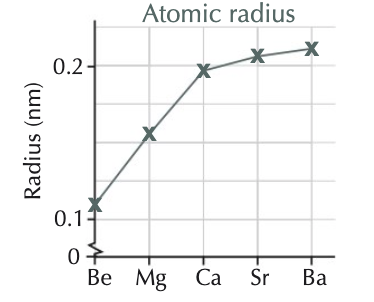
Why does atomic radius increase down the group? (3)
• Number of shells increase • More distance between nucleus and outer electrons • Outer shells more shielded • Less attraction between nucleus and outer electrons
First Ionisation Energy ______ Down the Group
Decreases
Explain why first ionisation energy decreases down the group (4)
• Number of shells increase • Increased distance between nucleus and outer electrons • Outer shells more shielded • Less attraction between nucleus and outer electrons • Easier to remove outer electron = less energy
Reactivity ______ Down the Group
Increases
Explain why reactivity increases down the group
• First ionisation energy decreases down group • Due to increasing atomic radius and shielding effect • When Group 2 elements react = lose electrons & form positive ions • Easier it is to lose electrons (i.e. the lower the 1st and 2nd ionisation energies) = more reactive the element • So reactivity increases down group
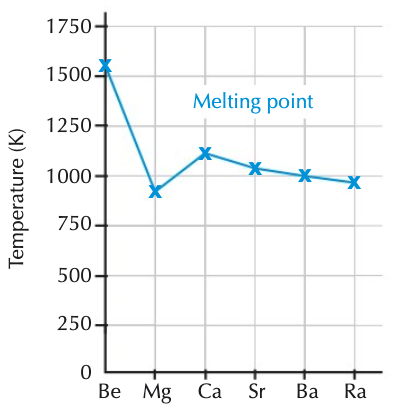
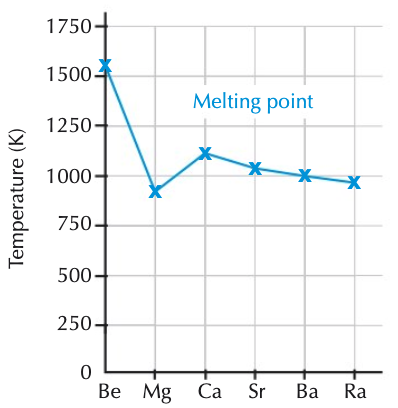
Melting Points _______ _______ Down the Group
Generally Decrease
Describe Group 2 elements’ structure
• Metallic structures • Positive ions in crystal structure surround by delocalised electrons from outer electron shells
Why do melting points generally decrease down the group? (4)
• Size of positive ion increases, but charge remains the same • Delocalised electrons further away from positive ions • Weaker electrostatic forces of attraction between positive ions and delocalised electrons • Weaker metallic bonds = less energy needed to break
Where is there a big ‘blip’ at magnesium?
∵ crystal structure (arrangement of metallic ions) changes
Group 2 Elements React with ____
Water
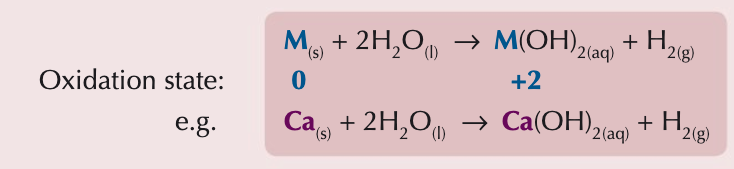
When they react with water, they are oxidised from start of ____ to ____ forming ____ ____
When they react with water, they are oxidised from start of 0 to +2 forming M2+ ions

When Group 2 metal react with water, what 2 products do they give?
Metal hydroxide and hydrogen
Group 2 Elements React with Water State the general symbol equation
Group 2 metals react ___ _____ down the group
more readily
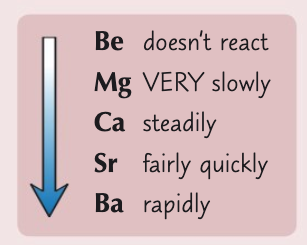
Why do Group 2 metals react more readily down the group?
∵ ionisation energies decrease
Solubility Trends depend on ______ ___
Compound Anion
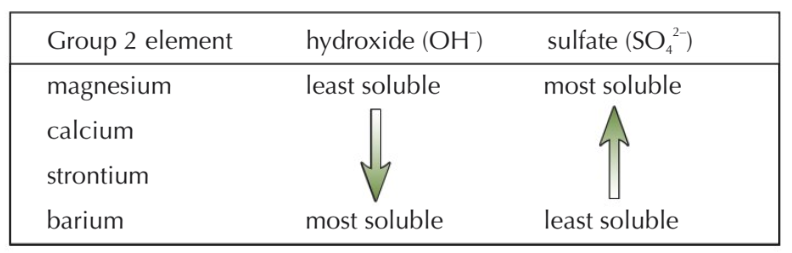
State the 2 general solubility trends of Group 2 elements
• Generally, compounds of Group 2 elements that contain singly charged negative ions (e.g. OH-) ↑ in solubility down group • Compounds that contain doubly charged negative ions (e.g. SO4-2) ↓ in solubility down group
Fill in the gaps
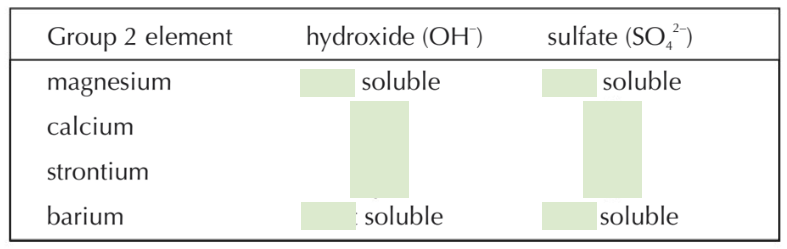
What are compounds like magnesium hydroxide, which have very low solubilities said to be?
Sparingly soluble
Barium sulfate is _____ in water
insoluble
Describe the test for sulfate ions (SO42-)
• Add dilute hydrochloric acid and then barium chloride solution, BaCl2(aq) • If white precipitate of barium sulfate forms = original compound contained sulfate
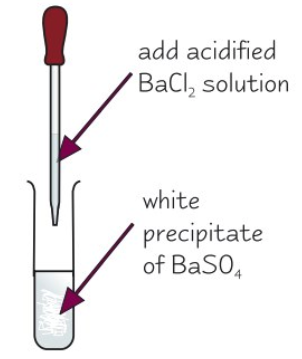
Test for sulfate ions Why should you acidify the solution?
To get rid of any lurking sulfites or carbonates which will also produce a white precipitate