Module 07: Energy in Reactions
暂无描述。系统推荐的高质量记忆内容,适合每天坚持背诵学习。
卡片预览 (24 张)
07.01 Endothermic and Exothermic 07.01 Endothermic and Exothermic
07.01 Endothermic and Exothermic What is thermochemistry?
a branch of chemistry concerned with the quantities of heat released or absorbed during chemical reactions
07.01 Endothermic and Exothermic What are the three energies of a system?
• Temperature • Thermal Energy • Heat
07.01 Endothermic and Exothermic What is “temperature?”
Measure average kinetic energy in particle direct relationship kinetic energy and temperature
07.01 Endothermic and Exothermic What is thermal energy?
Measure total kinetic energy in sample • difference temperature: • Thermal: represents kinetic energy of a sample together • Temperature: average kinetic energy of individual particles
07.01 Endothermic and Exothermic What is heat?
Transfer of thermal energy from one substance to another due to temperature differences
07.01 Endothermic and Exothermic How does heat transfer?
From matter at high temperature to low temperature • depends temperature differences (not in total thermal energy of substances) • continue until both have the same temperature
07.01 Endothermic and Exothermic How is heat and thermal energy measured?
SJ units: joule (J) • unit kilojoules (kJ) → calories
07.01 Endothermic and Exothermic Define enthalpy.
total heat content of a system equal to the internal energy of the system plus the product of pressure and volume • denoted “q”
07.01 Endothermic and Exothermic What is the difference between endothermic & exothermic?
ENDOTHERMIC: reactions absorb energy from surroundings → increase net energy (+q) • absorb kinetic energy > convert potential energy • amount energy absorbed: dependent amount of reactants and difference of potential energy EXOTHERMIC: • reactions releases energy to surroundings → decrease net energy (-q)* • stored potential energy released into kinetic energy
07.01 Endothermic and Exothermic What is a change in enthalpy (△H) ?
Equal heat gained or lost between system and surroundings • gain: +q • lost: -q
07.01 Endothermic and Exothermic What is a potential energy diagram?
• tracks potential energy • y-axis: measure potential energy & x-axis: progress of reaction
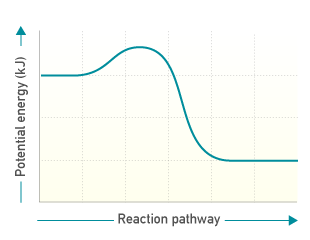
07.01 Endothermic and Exothermic What is th potential energy diagram of an exothermic reaction?
• products less PE than reacts • starts higher and ends lower Law of Conservation of Energy: obeyed extra energy not end up is released into the surroundings
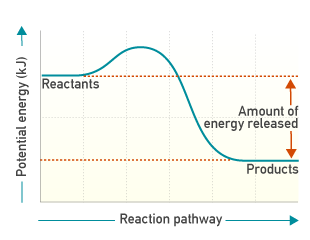
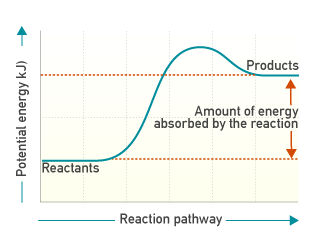
07.01 Endothermic and Exothermic What is the diagram for potential energy of a endothermic reaction?
• products more potential energy than reactants
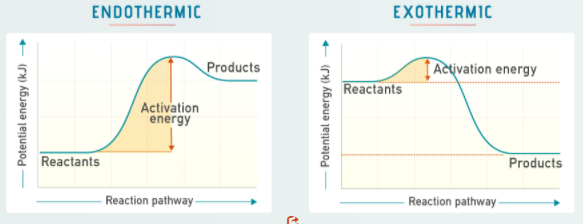
What is activation energy? What is it on a potential energy diagram?
the minimum amount of energy colliding particles must have for a chemical reaction to occur Diagrams: representated positive slope that follows reactatns
07.02 Enthalpy Values 07.02 Enthalpy Values
07.02 Enthalpy Values What is the property of specific heat capacity?
the quantity of heat required to raise the temperature of one gram of a substance by one degree Celsius • intensive property • impacted by mass (how much thermal energy can be absorbed) • J/g °C
07.02 Enthalpy Values What is the specific heat formula?
C = q/m x △T • C: specific heat • q: heat generated by temperature change • m: mass of substance • △T: change in temperature
07.02 Enthalpy Values How can energy transfers be calculated?
q = m x C x △T • q: the heat gained (positive) or lost (negative) by the system, in joules • m: the mass of the sample, in grams • C: the specific heat capacity of the sample, in joules per gram per degree Celsius Jg °C • △T: change in temperature (°C)
07.02 Enthalpy Values How does enthalpy apply to phase change?
• Deposition/Condensation/Freezing: Exothermic (−△H or −q) • Sublimation/Vaporization/Melting: Endothermic (+△H or +q)
07.02 Enthalpy Values How can the overall change of enthalpy be determined?
• comparing the sum of the enthalpies of reactants to sun of products • Heat of Reaction
07.02 Enthalpy Values What is Heat of Reaction?
△H = Hproducts − Hreactants The heat of reaction (overall change in enthalpy) is found by taking the sum of enthalpies of the products and subtracting the sum of enthalpies of the reactants. • Endothermic: • +△H • energy required break bonds is more than amount of energy released • Exothermic: • -△H • energy required break less amount energy released in forming bonds in product
07.02 Enthalpy Values The chemical reaction and enthalpy change for burning methane (CH4) is given below. If 38.5 grams of methane are burned, how many kilojoules of energy are transferred, and is this reaction endothermic or exothermic? CH4 + O2 → CO2 + 2H2O △H = −890.0 kJ/mol
The enthalpy change value of this reaction tells us that for every mole of methane (CH4) burned, 890.0 kilojoules are given off because the enthalpy change is negative. This is an exothermic reaction. Use the enthalpy change as a conversion factor between moles of methane and kilojoules of energy. 38.5 g CH4÷1 × 1 mol CH4 ÷ 16.05 g CH4 × −890.0 kJ ÷ 1 mol CH4 = −2,135 kJ This shows that as 38.5 grams of methane are burned, 2,140 kilojoules of energy are released.
07.02 Enthalpy Values If the amount of energy required to break bonds in the reactants is more than the amount of energy released in forming bonds in the products, then the reaction will have a negative change in enthalpy (−ΔH). (2 points) True False
False