Switching On And Maintaining A Fuel Supply
No description yet. This curated deck is ready for daily study.
Card preview (24)
How much glucose does the fetus near term use?
~ 5 g glucose / kg / day - substrated are principally glucose + amino acids
What is the dominant hormone and its role in the fetus near term?
Insulin - works as an anabolic hormone -> removes glucose from circulation into the fat stores, acts as a growth hormone - ‘baby building hormone’. Beta cells in pancreas undergo hyperplasia in 3rd trimester -> insulin secreted.
What are the actions of insulin?
• Increase glucose uptake in muscle, fat + liver • Decrease lipolysis • Decrease amino acid release from muscle • Decrease gluconeogenesis in liver • Decrease ketogenesis in liver
What is the energy requirement for a newborn?
~ 4-6 g glucose /kg/day
How does the newborn meet its energy demands?
• Little milk available at first - baby gets colostrum + 7mls/feed in first 24 hours • Newborn initially has to meet demand from stores (metabolism) • Later, milk is available as a high fat food • Newborn must manage demand as well as supply
In terms of demand, how is energy partitioned in newborns?
• In babies the brain accounts for a higher proportion of resting energy expenditure • But the cerebral metabolic rate (CMRglucose) is relatively low at birth
In terms of supply and energy stores, describe the weight of the baby
• ~1% glycogen (stored in liver) • ~16% fat
How are stores converted to fuels?
The anabolic actions of insulin are opposed by the counter-regulatory (catabolic) hormones.
Name some counter-regulatory (catabolic) hormones that oppose anabolic actions of insulin
• Glucagon • Adrenaline • (Cortisol) • (Growth hormone)
Describe what happens during a glucagon surge
As plasma glucose levels fall at birth, plasma glucagon levels rise rapidly -> activates gluconeogenesis, opposing insulin.
How does the baby utilise stores to provide glucose as an energy source for the tissues (during a postnatal fast)?
• Gluconeogenesis - process of providing glucose from stores - muscle (amino acids + glycogen) and fat via substrates such as lactate, pyruvate, alanine + glycerol. • Ketogenesis - process of providing ketone bodies (act as fuel) from breakdown of fat. Ketones tend to be higher in the newborn period in comparison to adults.
What are 3 rate-limiting steps within gluconeogenesis?
• G-6-P ase • F1,6 BP ase • PEPCK
Describe the structure of fats
• Glycerol backbone (3 carbon skeleton) • Fatty acids attach (saturated or unsaturated)
Describe the oxidation of fat and in turn formation of ketone bodies
• Terminal two carbon group removed from fatty acid and bound to coenzyme A, as acetyl CoA (beta-oxidation) • Acetyl groups can then be utilised to form ketone bodies (acetone + beta-hydroxybutyrate) • OR Acetyl groups can also then enter the Kreb’s cycle as an energy source
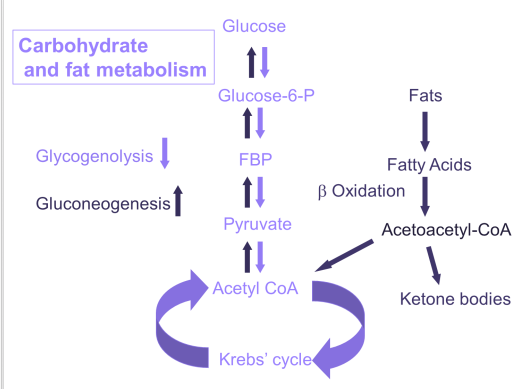
What happens in the fasting (post-absorptive) state?
• Substrates are mobilised peripherally through action of counter-regulatory hormones (catecholamines, cortisol, glucagon) • Insulin is opposed
What happens in the fed (post-prandial) state?
• Infant diet (milk) is 50% fat and 40% carbohydrate • CHO is mainly lactose • Breast milk contains a lipase • Insulin acts to store blood glucose in tissues • In liver, excess glucose made into glycogen
What general kind of problems can babies have?
• Demand exceeds supply • Hyperinsulinism • Counter-regulatory hormone deficiency • Inborn errors of metabolism
What happens to a baby when the demand exceeds the supply?
• Extremely small preterm baby • High demands • Small nutrient stores • Immature intermediary metabolism • Establishment of enteral feeding delayed • Poor fat absorption
What is the difference between being ‘small for gestational age’ and ‘intrauterine growth restriction’?
• Small for gestational age - form lower percentile level but can be normal • Intrauterine growth restriction indicates pathological process that causes growth restriction
Describe the infant of the diabetic mother
• High maternal glucose -> high fetal glucose • Fetal and neonatal hyperinsulinism (producing more insulin) • Insulin acts as a growth hormone • -> Neonatal macrosomia + hypoglycaemia Not all babies will be macrosomic so could look fine but have a problem of hypoglycaemia.
Another cause of hyperinsulinism in the baby is Beckwith Wiedemann syndrome - what features will the baby have?
• Macroglossia (large tongue) • Macrosomia • Midline abdominal wall defects (exomphalos, umbilical hernia, diastasis recti) • Ear creases or ear pits • Hypoglycaemia
What is another cause of hyperinsulinism (that isn’t a diabetic mother or Beckwith Wiedemann Syndrome)?
Islet cell dysregulation: Nesiodioblastosis
How does congenital adrenal hyperplasia cause virilisation, salt-wasting and hypoglycaemia?
• Congenital adrenal hyperplasia -> virilsation in the womb -> enzyme defect (21 OH deficiency) -> don’t produce cortisol or aldosterone • -> pre-cursors build up to cause virilisation (testosterone prod inc). • -> less cortisol (counter-reg hormone) -> hypoglycaemia • -> lack of aldosterone -> salt-wasting crisis
What are other deficiencies of counterregulatory hormones apart from CAH/cortisol?
• Hypothalamic-pituitary-adrenal insufficiency: septo-optic dysplasia • Waterhouse-Friderichsen syndrome: severe adrenal haemorrhage with adrenal gland dysfunction secondary to sepsis or hypoxia