AQA A Level Chemistry - Properties Of The Period 3 Elements
暂无描述。系统推荐的高质量记忆内容,适合每天坚持背诵学习。
卡片预览 (24 张)
• What is the trend in atomic radius across period 3?
• Atomic Radius decreases along the period
• Why does atomic radius decrease across period 3?
• There is an increase in nuclear charge • Same amount of shielding • This means the electron shells are held closer to the nucleus
• What is the trend in electronegativity across period 3?
• Electronegativity increases along the period
• Why does electronegativity increase across period 3?
• There is an increase in nuclear charge • Same amount of shielding • This means the elements are increasingly capable of withdrawing electron density from a covalent bond
• What is the trend in 1st ionisation energy across period 3?
• 1st ionisation energy increases along the period
• Why does 1st ionisation energy increase across period 3?
• There is an increase in nuclear charge • Same amount of shielding • This means the electrons are held increasingly more tightly and so require more energy to be removed
• What are the two slight anomalies concerning 1st ionisation energy of the period 3 elements?
• AI has a lower 1st IE than Mg • S has a lower 1st IE than P
• Why does Al have a lower 1st IE than Mg?
• Mg has a 3s electron removed • Al has a 3p electron removed • 3p is higher in energy than 3s
• Why does S have a lower 1st IE than P?
• P has a 3p electron removed which is unpaired • S has a 3p electron removed which is paired • S has a lower ionisation energy due to electron pair repulsion
• Why does the melting point increase from Na to AI?
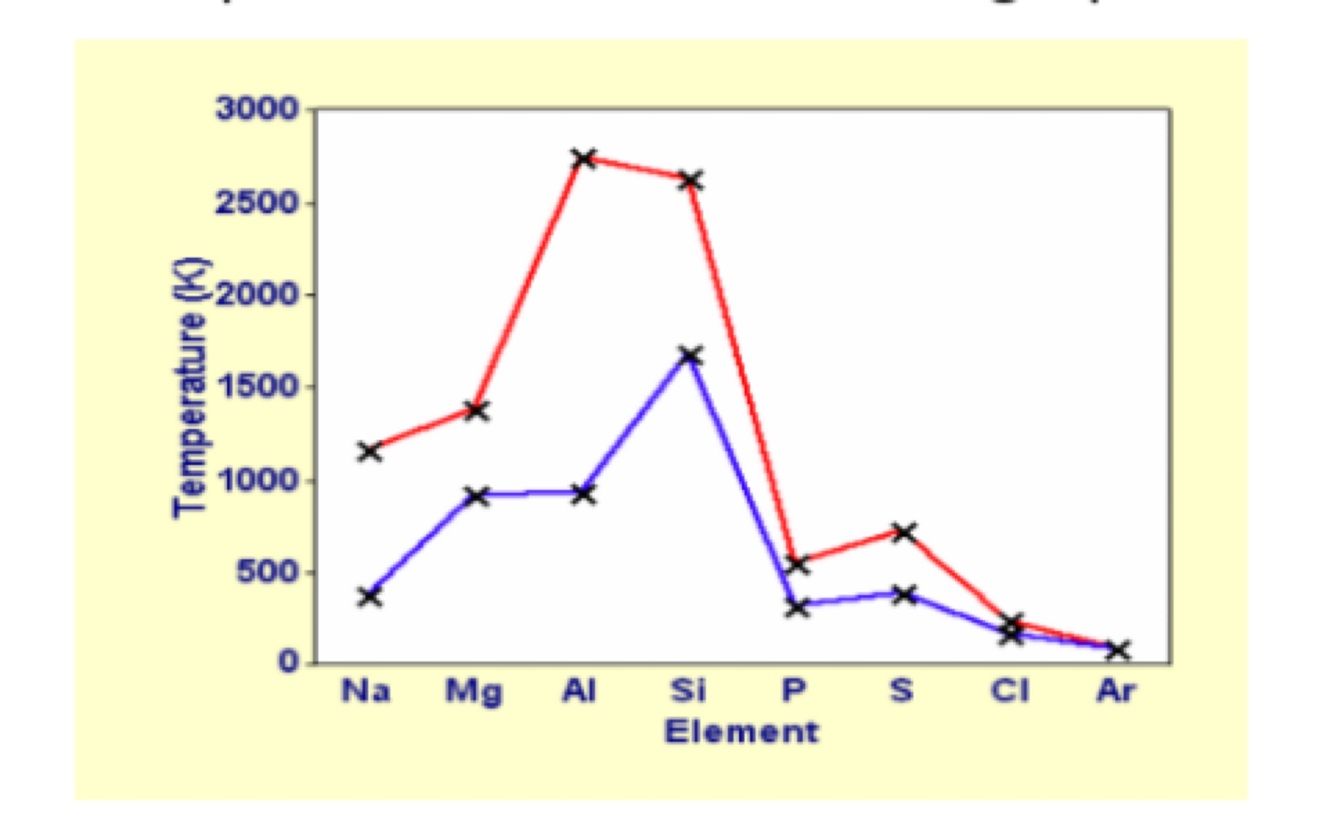
• The charge in the metal ion increases from Na+ to Al3+ • The size of the metal ion decreases across the row • Therefore there is an increase in the strength of attraction between the metal ions and delocalised electrons
• Why does Silicon have the highest melting point?
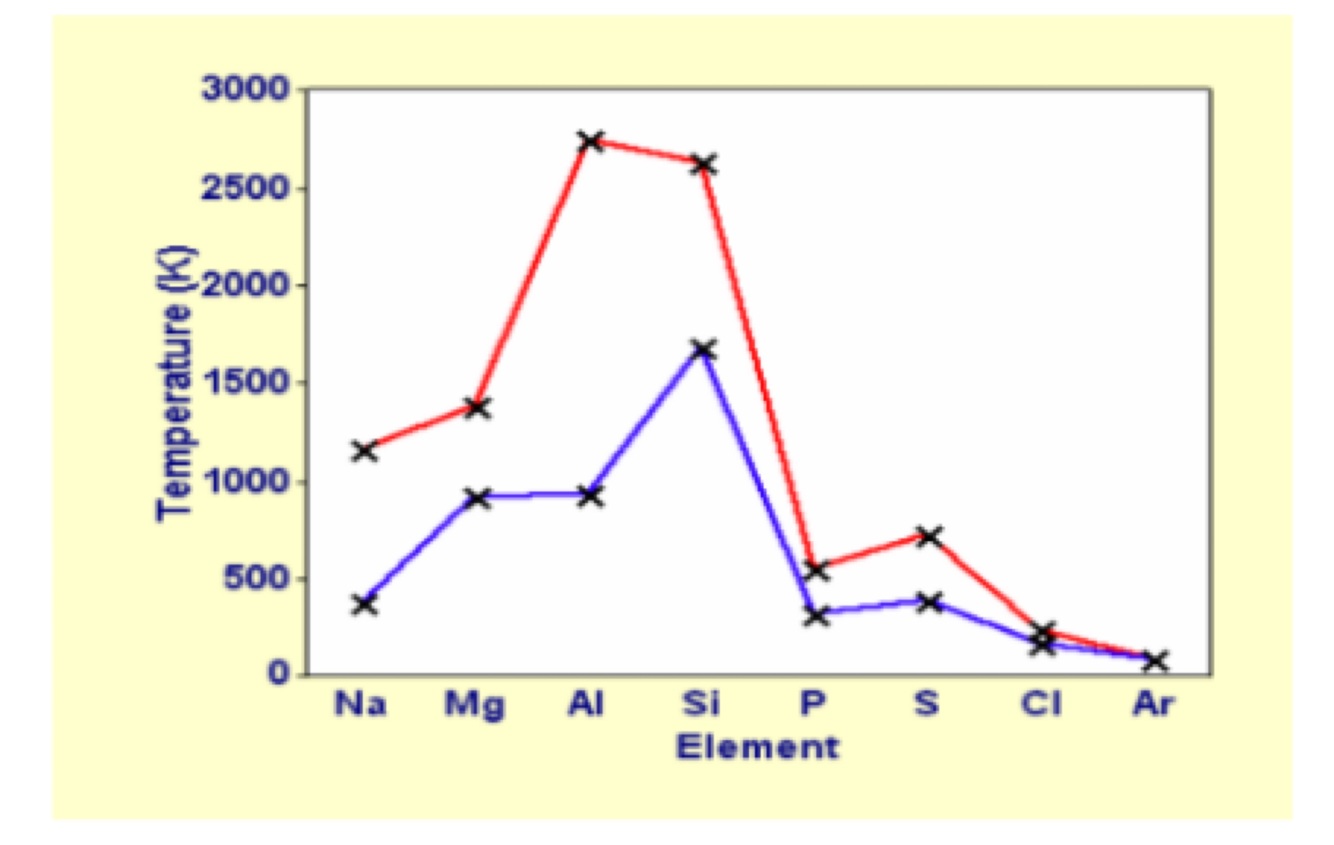
• It has a macromolecular structure • With lots of covalent bonds • Which are very strong
• Describe the trends in the non metals on this graph?
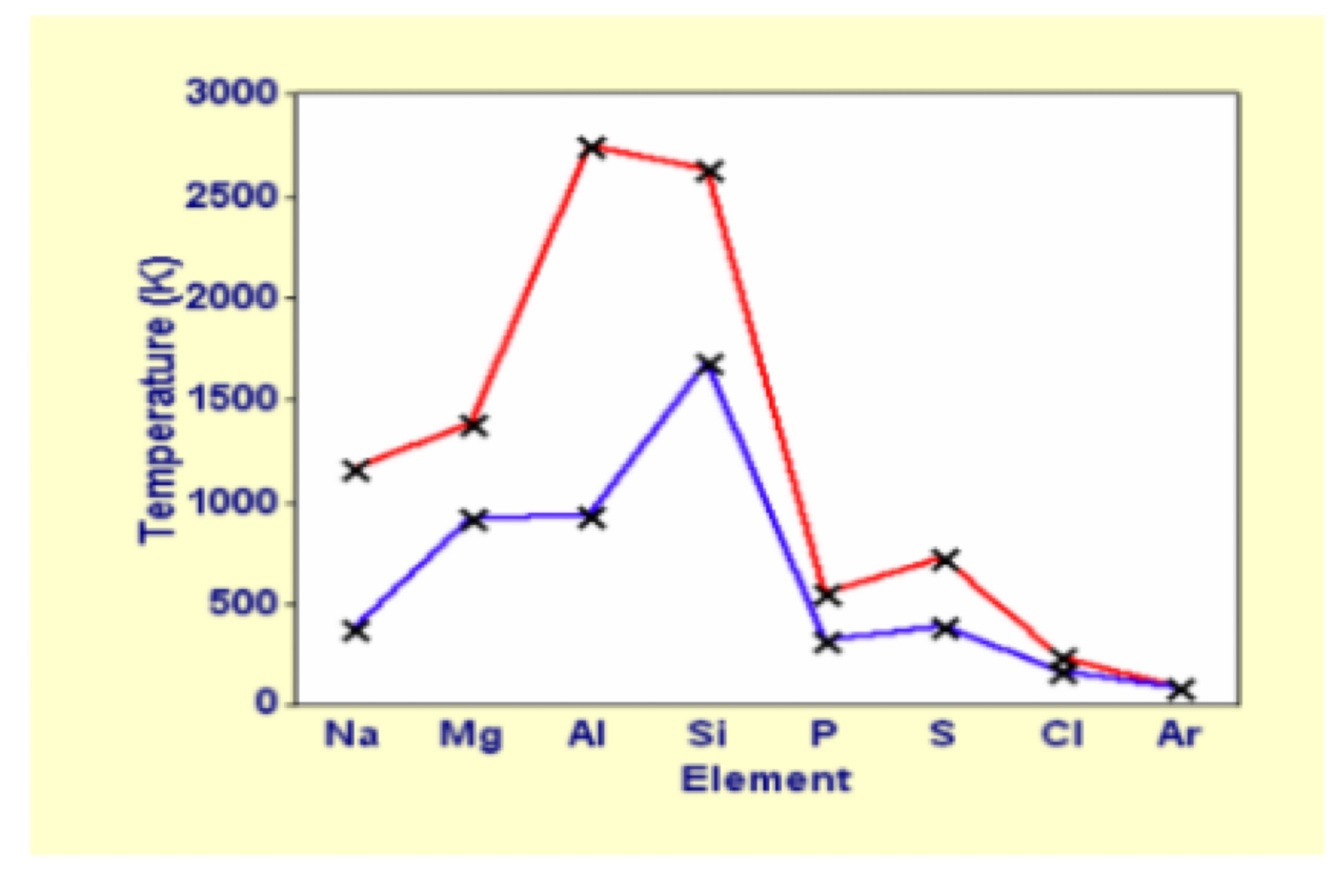
• P4, S8 and Cl2 and all have a simple molecular structure with Van der Waals intermolecular forces • Strength of the Van der Waals depends on the size of the molecule and S8 is largest, followed by P4 then Cl2 • Argon exists as single atoms with the weakest Van der Waals out of all of them
• Why does Al have the highest boiling point?
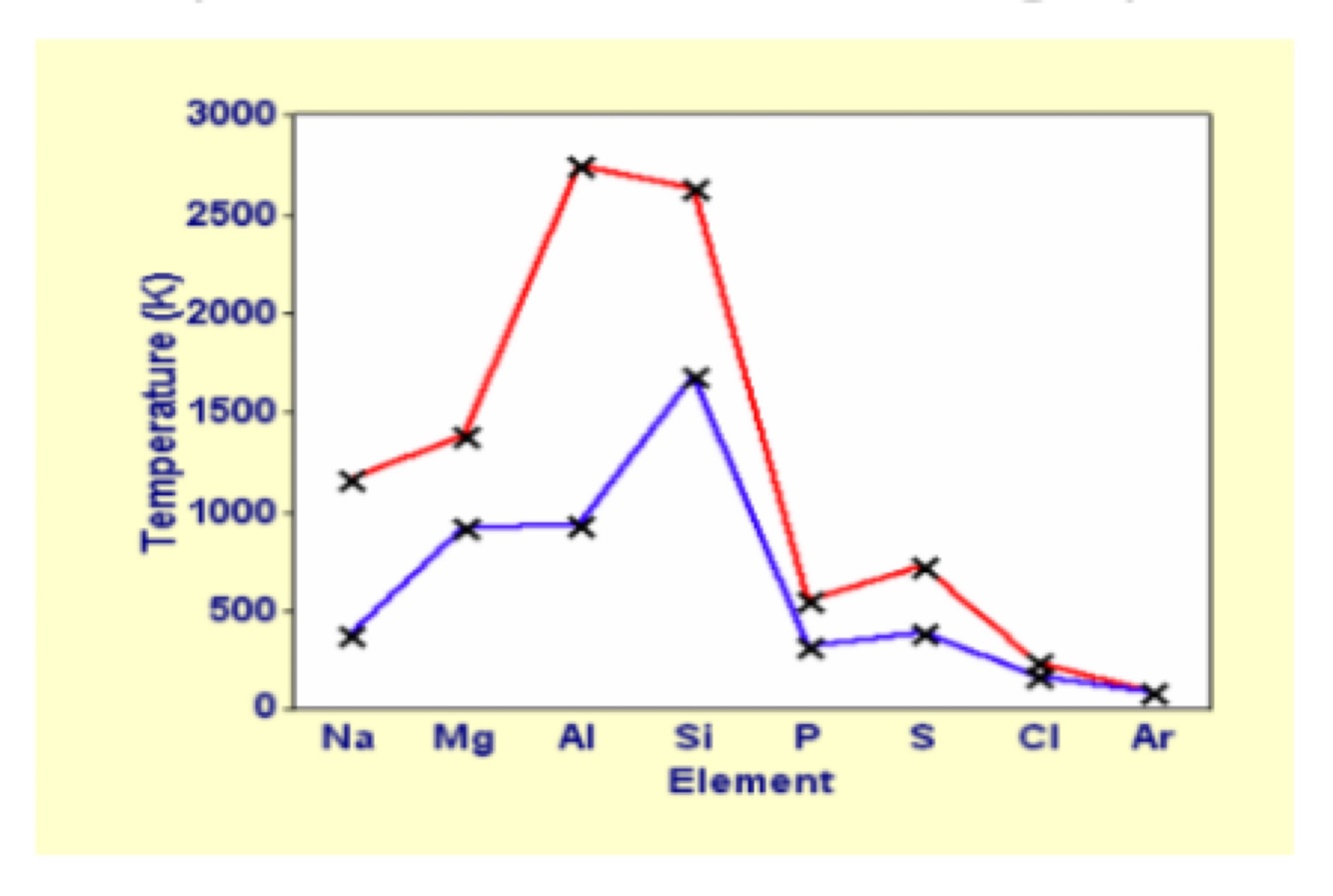
• Once silicon has been melted most of its strong covalent bonds have been broken, so boiling it requires only a little extra energy • In the liquid state Aluminium still has strong electrostatic attraction between ions and delocalised electrons, and so still required a large amount of energy to boil
• What is the equation for the reaction of sodium with cold water?
2Na (s) + 2H2O (l) -> 2NaOH (aq) + H2 (g) • pH = 13-14 • This is a vigorous reaction. The metal fizzed rapidly and melts due to the heat released. A strongly alkaline solution is formed.
• What is the equation for the reaction of magnesium with cold water?
Mg (s) + 2H2O (l) -> Mg(OH)2 (aq) + H2 (g) • pH = 9-10 • This is a very slow reaction at room temperature. Only a few bubbles of gas are produced after a day or two. The resulting solution is only a weak alkali because magnesium hydroxide is only sparingly soluble
• What is the equation for the reaction of magnesium with steam?
Mg (s) + H2O (g) -> MgO (s) + H2 (g) • This reaction is a lot faster due to the higher temperatures needed to generate the steam
• What are the two equations for the reactions of chlorine with water?
Cl2 (g) + H2O (l) ⇌ HClO (aq) + HCl (aq) • pH = 2-3 2Cl2 (g) + 2H2O (l) -> 4HCl (aq) + O2 (g) • pH = 2-3 [ The pH of the resulting solution depends on the concentration of solution
• What are the trends in the reactions of the elements Na, Mg, Al, Si, P and S with oxygen?
• The elements all react with oxygen to form oxides • Sodium burns with a yellow flame to produce a white solid • Mg, Al, Si and P burn with a white flame to give white solid smoke • S burns with a blue flame to form an acidic choking gas (colourless sulfur dioxide)
• What is the equation for the reaction of sodium with oxygen?
2Na (s) + 1/2O2 (g) -> Na2O (s) • This burns brightly in oxygen gas with a characteristic yellow flame to form a white solid
• What is the equation for the reaction of magnesium with oxygen?
2Mg (s) + O2 (g) -> 2MgO (s) • This burns brightly in oxygen gas with a brilliant white flame to form a white solid
• What is the equation for the reaction of aluminium with oxygen?
4Al (s) + 3O2 (g) -> 2Al2O3 (s) • pH = 7 • If aluminium powder is heated and lowered into a jar of oxygen it burns with a bright white flame to produce aluminium oxide. Aluminium also reacts with oxygen from the atmosphere in a much slower version of the reaction. This means most pieces of aluminium are dull and grey, coated with a layer of aluminium oxide
• What is the equation for the reaction of silicon with oxygen?
Si (s) + O2 (g) -> SiO2 (s) • pH = 7 • Silicon forms an oxide when heated strongly in oxygen
• Draw SO2 and SO3
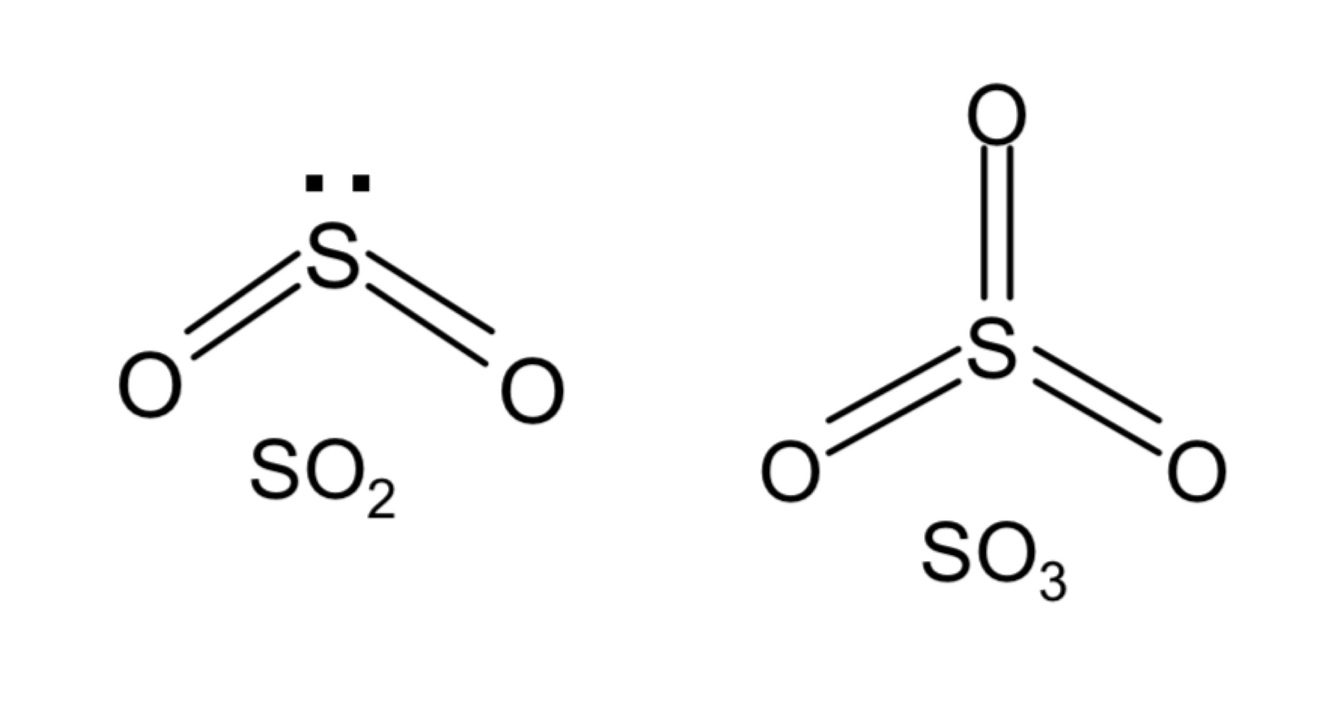
• What is the equation for the reaction of phosphorus with oxygen?
P4 (s) + 5O2 (g) -> P4O10 (s) • As an element, phosphorus can be found in two different forms (allotropes) • Red phosphorus is made of chains of P4 tetrahedrons • White phosphorus is single P4 tetrahedral molecules • They both undergo the same reaction with oxygen, however the red allotrope must be heated first, whereas the white allotrope reacts rapidly in air