Chapter 15 (Haloalkanes)
No description yet. This curated deck is ready for daily study.
Card preview (12)
what is the reactivity of Haloalkanes compared to alkanes?
• haloalkanes are much more reactive than alkanes due to the electronegative halogens, the C-halogen bond is polar causing a partial positive and negative charge
what type of reactions do haloalkanes undergo ?
• nucleophilic substitution reactions: a halogen is substituted for another atom or group of atoms • elimination reactions: a hydrogen haliide is elimnated, the key product are alkenes
What is a nucleophile ?
A species that donates a lone pair of electrons
What is hydrolysis ?
• it is a reaction involving water or an aqueous solution of OH ion that causes the breaking of a bond in a molecule
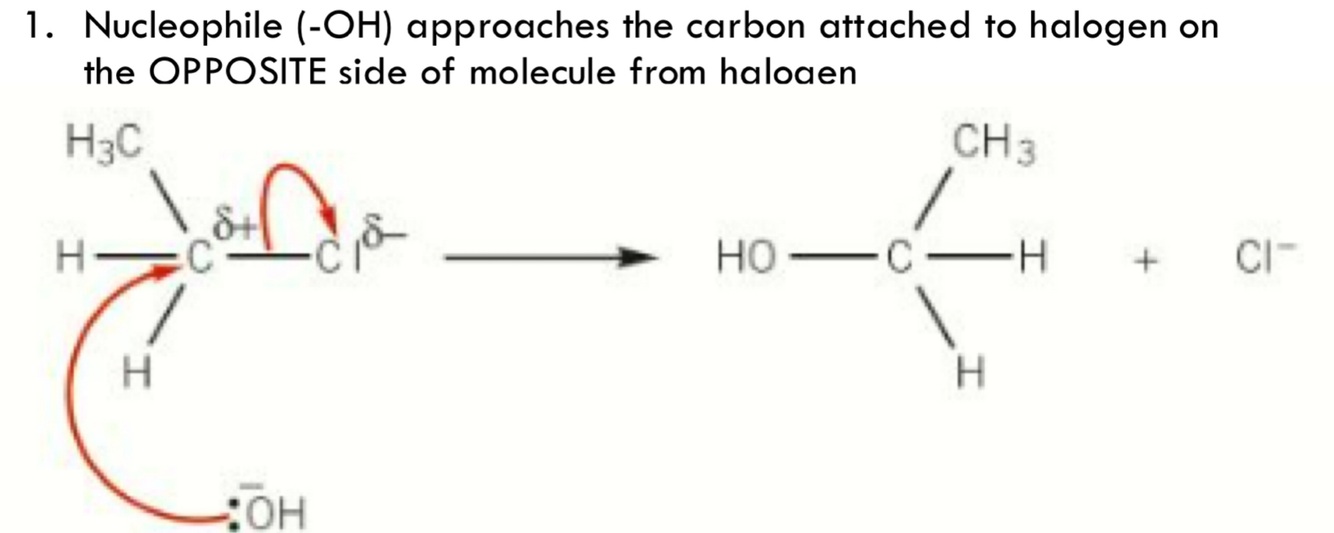
What is mechanism of the hydrolysis of haloalkanes ?
• the reaction is slow, so you need to heat under reflux to get a better yeild
What determines the rate of hydrolysis in haloalkanes ?
• the rate is dependant on the strength of the carbon-halogen bond • the strongest bond is C-F due to the great difference in electronegativity • the stronger the bond the slower the rate of hydrolysis
What is an organohalogen compound ?
• organohalogen compounds are compounds that contain at least one halogen atom joined to carbon chain
What happens in the stratosphere ? ozone
• Oxone is continuously being made and broken by UV • very high energy UV breaks O2 to form oxygen radicals • A steady state forms - rate of formation of ozone = rate at the breaking down for ozone • O2 + O -> O3
What happens with CFCs and the Ozone?
• CFC’s - Chlorofluorocarbons • CFC’s remain stable until the stratosphere where they break down, forming Chlorine radicals • these catalyse the breakdown of the ozone layer
What is the reactions that happen in the ozone with CFC’s ?
• due to the stability of CFC’s, they can spend a long time in the troposphere • once they reach the stratosphere, once here the UV gives the necessary energy to break C-halogen -> homolytic fission • C-Cl has lowest bond enthalpy so breaks first • photodissociation radiation starts the breakdown
What are the radical steps in the ozone ?
CF2Cl2 -> CF2Cl (radical) + Cl (radical) - chlorine radical is formed which is very reactive - it will react with an ozone molecule: 1) Cl (radical) + O3 -> ClO(radical) + O2 2) ClO (radical) + O -> Cl (radical) + O2 3) overall: O3 + O -> 2O2
What are the other radicals that catalyse the breakdown of ozone ?
• Nitrogen dioxide radical are formed naturally during a lighting strike and aircraft in stratosphere • NO radical causes breakdown of ozone 1) NO(radical) + O3 -> NO2 (radical) + O2 2) NO2(radical) + O -> NO(radical) + O2 3) overall: O3 + O -> 2O2