1. Atomic structure and the Periodic Table
No description yet. This curated deck is ready for daily study.
Card preview (24)
atomic number
proton number all isotopes have the same number of protons equal to no of electrons if uncharged
mass number
total number of protons and neutrons in the nucleus
mass and charge of subatomic particles
proton 1, +1 electron 1/2000, -1 neutron 1, 0
What are isotopes?
Different atoms of the same element with the same proton number but different neutron number
What is the Relative Atomic Mass?
The weighted mean mass of an atom of an element compared to 1/12th of the mass of an atom of carbon-12
What is the Relative Isotopic Mass?
Relative mass of an atom of an isotope compared to 1/12th of the mass of an atom of carbon-12
What is the M+ peak?
Molecular ion peak. Shows the relative molecular mass.
What is the M+1 peak?
The peak that has +1 m/z than the molecular ion peak due to the existence of a carbon 13 isotope.
Name the subshells, their orbitals and how many electrons each can hold
S, p, d, f 1, 3, 5, 7 2, 6 , 10, 14
Which shape does the s orbital have?
Spherical.
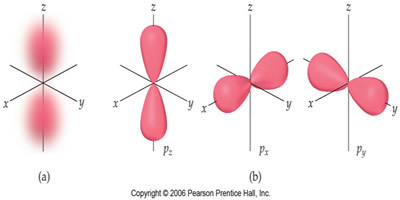
Which shape does the p orbitals have?
Dumbell (8) shape. 3 orbitals. Px, Py and Pz.
What does spin pairing mean?
Electrons occupying the same orbital have different spins.
What are the different subshells from lowest energy to highest?
1s, 2s, 2p, 3s, 3p, 4s, 3d
What is the electron configuration of Chromium?
1s2, 2s2, 2p6, 3s2, 3p6, 4s1, 3d5 An electron is excited from the 4s to fill the 3d orbitals.
What is the electron configuration of Copper?
1s2, 2s2, 2p6, 3s2, 3p6, 4s1, 3d10 an electron is excited from 4s to fill the 3d subshell.
Which block is the one in red?
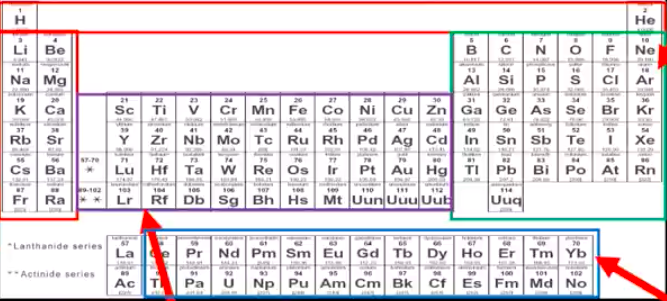
s block
Which block is the one in purple?
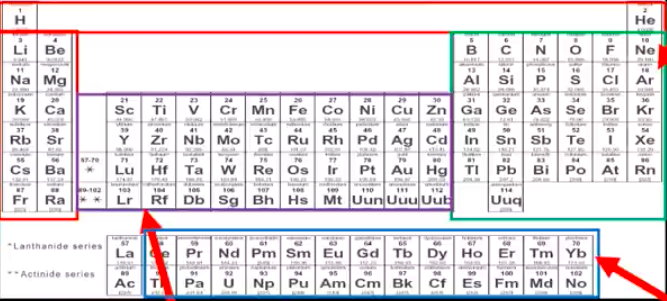
d block
Which block is the one in green?
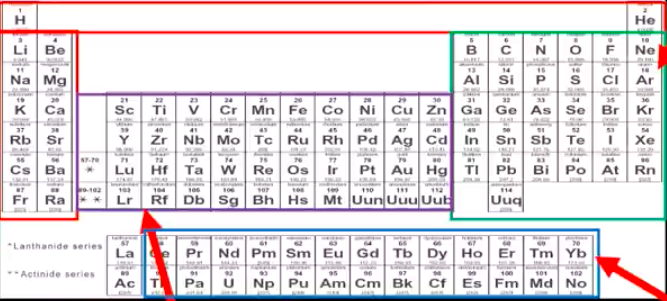
p block
Which block is the one in purple?
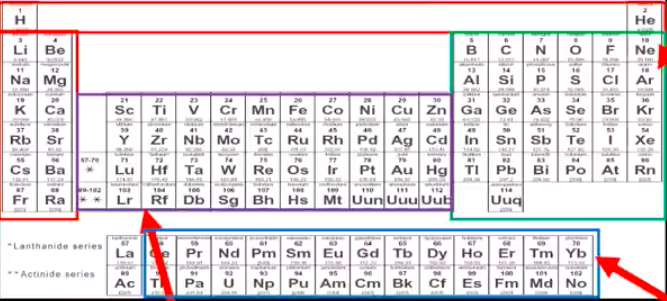
f block.
How are line spectra formed? How are they used to identify an element?
• Electron is in ground state. • Electron absorbs energy from surroundings and is excited (moves to a higher-energy shell) • Electron moves back to ground state and releases energy in the form of electromagnetic radiation with a specific frequency. • Emission spectra shows the frequency of light emitted. This is unique for every element.
How do line spectra prove that electrons exist in quantum shells?
Defined lines in the emission spectra show energy levels are discrete, electrons jump without an inbetween stage. This proves electrons exist in shells and each shell has a fixed energy.
What is ionisation energy?
Energy required to remove 1 mole of electrons from 1 mole of gaseous atoms to form 1 mole of gaseous 1+ions i.e. Na(g) > Na+(g) + e-
How does shielding affect ionisation energies?
The more electron shells between the positive nucleus and the negative outer electron that is being removed, the weaker the attraction and so less energy is needed.
How does nuclear charge affect ionisation energies?
The more protons in the nucleus, the bigger the positive charge and so the bigger the attraction between nucleus and electrons therefore more energy is needed to remove an electron.