Coordination Chemistry
No description yet. This curated deck is ready for daily study.
Card preview (24)
This type of associativemechanism where no intermediate is formed and the rate does depends on the nature of the entering group.
Associative interchange mechanism Bonding-making is more important than bond-breaking.
The dissociative mechanism where no intermediate is formed and the rate does not depends on the nature of the entering group.
Dissociative interchange mechanism Bonding-breaking is more important than bond-making.
Idenfity the mechanism below.
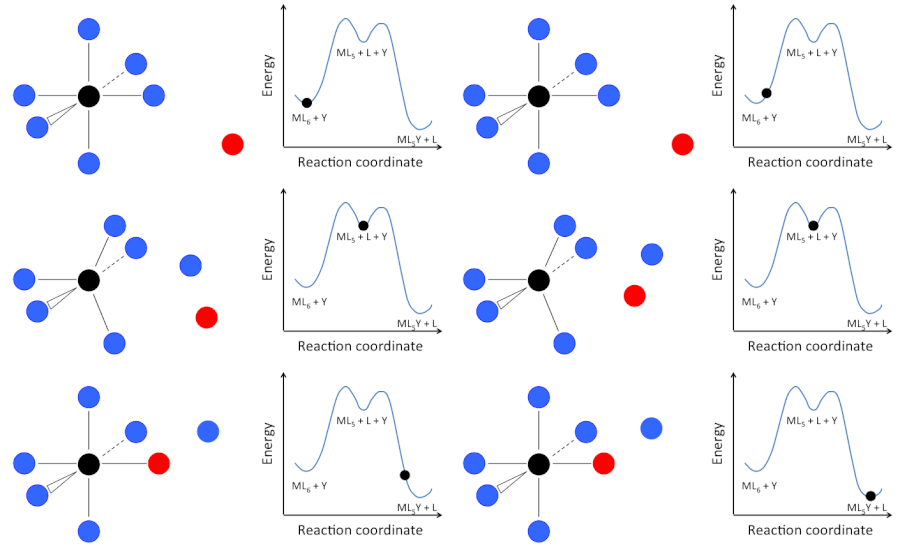
Dissociative mechanism The rate depends on breaking the bond of the leaving group.
Idenfity the mechanism below.
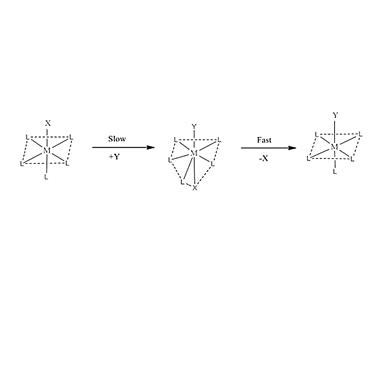
Associative mechanism The rate depends on the properties of the entering group and the encounter complex (intermediate)
As the size of the leaving group increases, the rate of a associative mechanism ________. Increases, Decreases, or No effect
No effect
As the size of the entering group increases, the rate of an associative mechanism ________. Increases, Decreases, or No effect
• *Decreases • (Associative mechanisms are sensitive to the entering group and larger ligands tend to form unfavorable steric interactions with bound ligands)***
As the size of the entering group increases, the rate of a dissociative mechanism ________. Increases, Decreases, or No effect
No effect (The rate determining step in a dissociative mechanism is breaking the metal-ligand bond)
As the size of the metal increases, the rate of an associative mechanism ________. Increases, Decreases, or No effect
Increases (Large Coordination sphere favors associative mechanism )
As the size of the metal increases, the rate of a dissociative mechanism ________. Increases, Decreases, or No effect
Increases
As the charge increases on the entering group, the rate of an associative mechanism ________. Increases, Decreases, or No effect
Increases
As the charge increases on the entering group, the rate of a dissociative mechanism ________. Increases, Decreases, or No effect
No effect (The rate determining step in a dissociative mechanism is breaking the metal-ligand bond)
As the negative charge increases on the leaving group, the rate of an associative mechanism ________. Increases, Decreases, or No effect
Decreases
As the neagtive charge increases on the leaving group, the rate of a dissociative mechanism ________. Increases, Decreases, or No effect
Decreases
As the charge increases on the metal center, the rate of an associative mechanism ________. Increases, Decreases, or No effect
Increases
As the charge increases on the metal center, the rate of a dissociative mechanism ________. Increases, Decreases, or No effect
Decreases
As the M-L bond strength __________it becomes more difficult to remove the L, and the rate decreases for a dissociative mechanism. Increases or Decreases
Increases
Jahn-Teller ions have __________ water exchange rates. Fast or Slow
Fast
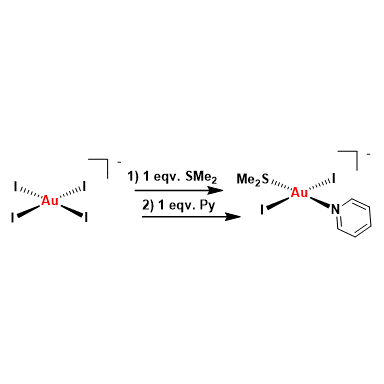
In what order should dimethyl sulfide and pyridine be adding to AuI4- below?
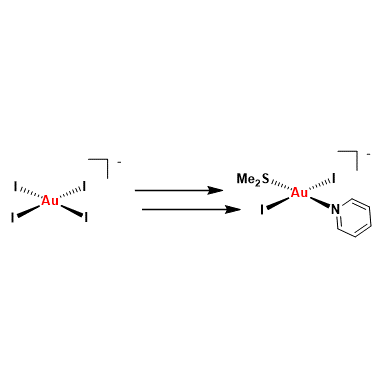
Dimethyl sulfide is more trans directing than iodine and pyridine
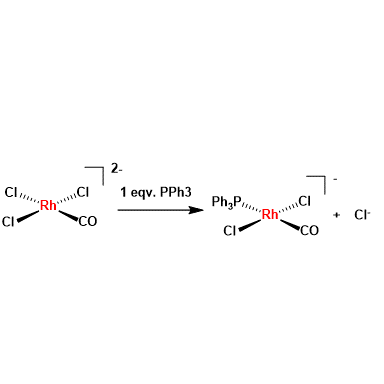
What would be the Rh product of the reaction between [Rh(Cl)3(CO)]- and 1 eqv. PPh3?
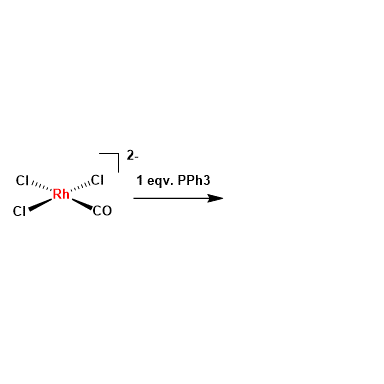
trans-[Rh(Cl)2(CO)(PPh3)]- Substitution occurs trans to the strongest trans effect ligand CO > Cl-
Refers to the impact of a ligand on the strength of the bond trans to it in the ground state of a complex.
Trans influence (Structrual trans effect) Ground State Property
Refers to the impact of a ligand on the length of the bond trans to it in the ground state of a complex.
Trans influence (Structrual trans effect) Ground State Property
Chelate ligands form much more stable metal complexes than monodentate ligands.
Chelate Effect
Refers to the observation that certain ligands increase the rate of ligand substitution when positioned trans to the departing ligand
Trans Effect [kinetic trans effect] Both σ-donors and/or π-donors
As the M-X bond strength increases, the rate of dissociative mechanism _____. Increases or Decreases
Decreases The rate determining step involves bond breaking