6.4 Gas Exchange
No description yet. This curated deck is ready for daily study.
Card preview (7)
Ventilation
Ventilation is the exchange of gases between the lungs and the atmosphere (achieved by the physical act of breathing) These gases are integral to the process of cell respiration * Oxygen is an input, carbon dioxide is a by-product Ventilation maintains the concentration gradient necessary for passive diffusion (O2 = into lungs, CO2 = out of lungs) Ventilation rates will change with exercise and can be measured via spirometry (measures amount / rate of air)
Lung Structure
larynx rib intercostal muscles trachea bronchiole bronchus alveolus lung diaphragm
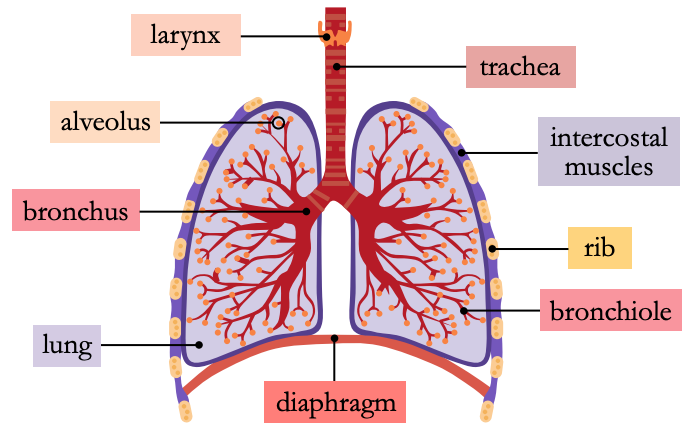
Mechanism of Breathing
Breathing utilises antagonistic sets of respiratory muscles in order to facilitate the passage of air (inhalation / exhalation) * Muscles change lung volume to create negative pressure * Negative pressure is equalised by air from atmosphere * Air flows in / out according to the volume of the thorax
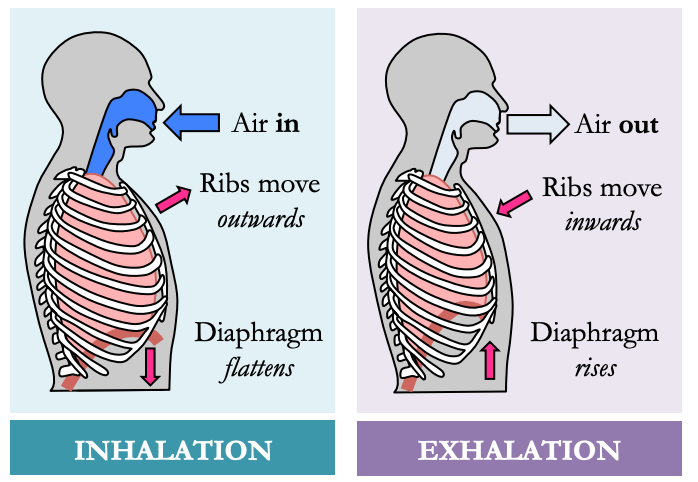
Mechanism of breathing: Inhalation
Inhalation * Diaphragm muscles contract (diaphragm flattens) * External intercostal muscles pull ribs up (outwards) * This increases the volume of the thoracic cavity * Pressure in lungs decreases below atmospheric pressure * Air flows into the lungs in order to equalise the pressure
Mechanism of Breathing: Exhalation
Exhalation * Diaphragm muscles relax (diaphragm curves upwards) * Internal intercostal muscles pull the ribs down (inwards) * Abdominal muscles contract to push diaphragm upwards * This decreases the volume of the thoracic cavity * Pressure in lungs increases above atmospheric pressure * Air flows out of the lungs to equalise the pressure
Pneumocytes
Pneumocytes (alveolar cells) line the alveoli and comprise the majority of the inner surface of the lungs Type I pneumocytes: * Involved in gas exchange between alveoli and capillaries * Are extremely thin (minimises gas diffusion distances) Type II pneumocytes: * Responsible for the secretion of pulmonary surfactant * This creates a moist surface that reduces surface tension (prevents sides of alveoli from adhering to each other)
Lung Disorders
Lung Cancer Cancer is uncontrolled cell proliferation, leading to tumors * Lungs possess a rich blood supply (for gas exchange), increasing the chances of metastasis (spread of cancer) There are many factors that contribute to lung cancer: * Intrinsic: Genetics, age, certain diseases / infections * Extrinsic: Smoking, asbestos, radiation exposure Emphysema Emphysema is the abnormal enlargement of the alveoli * These form air spaces and lower the overall surface area Emphysema is most commonly caused by smoking * Chemicals in the cigarettes damage the alveoli * Phagocytes release elastase as part of immune response * Elastase destroys the elastic fibres in the alveolar walls * Huge air spaces (pulmonary bullae) develop in the lungs