Addition Reactions of Alkenes
No description yet. This curated deck is ready for daily study.
Card preview (9)
What are the reagents of Markovnikov hydrohalogenation reactions?
HX
What are the reagents of Anti-Markovnikov hydrohalogenation reactions?
ROOR (alkyl peroxides)
What does a hydrohalogenation reaction add?
Adds a halogen across a pi bond
Describe the mechanism of a hydrohalogenation reaction.
First, there’a a proton transfer. H ends up on the less substituted side, forming a carbocation intermediate and an ion. Then, the ion functions as a nucleophile and attacks the carbocation intermediate.
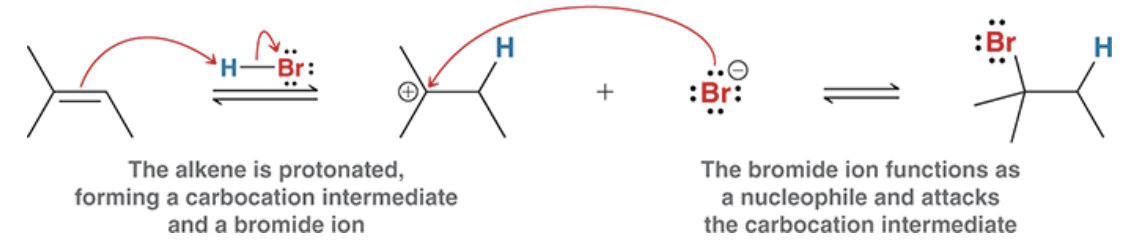
What is the intermediate of a hydrohalogenation reaction?
a carbocation`
During hydrohalogenation reactions, chiral centers often form. When that happens, what kinds of enantiomers are made?
a racemic mixture - equal amounts of both
What is hydration?
the process of adding water (H and OH) across a pi bond
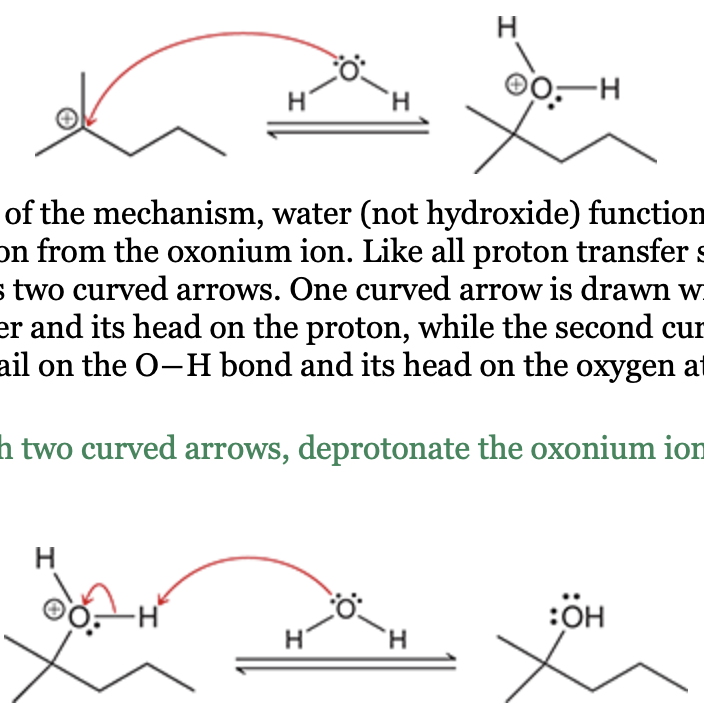
What is the reaction mechanism for acid-catalyzed hydration?
Markovnikov addition. Start with a proton transfer onto the alkene, forming a carbocation intermediate. Next, water functions as a nucleophile and attacks the carbocation, forming an oxonium ion. Finally, water functions as a base and deprotonates the oxonium ion.
What is the reagent for an acid-catalyzed hydration reaction?
H3O+ Could also be written as H2O and an acid with brackets around, indicating it’s a catalyst.