Carboxylic acids & derivatives
No description yet. This curated deck is ready for daily study.
Card preview (24)
Which carbon is carbon 1 when naming a carboxylic acid
The carbon with the carboxyl group
What is the test for for carboxylic acids. State the reagent and observation Write the full and ionic equation for the test for ethanoic acid
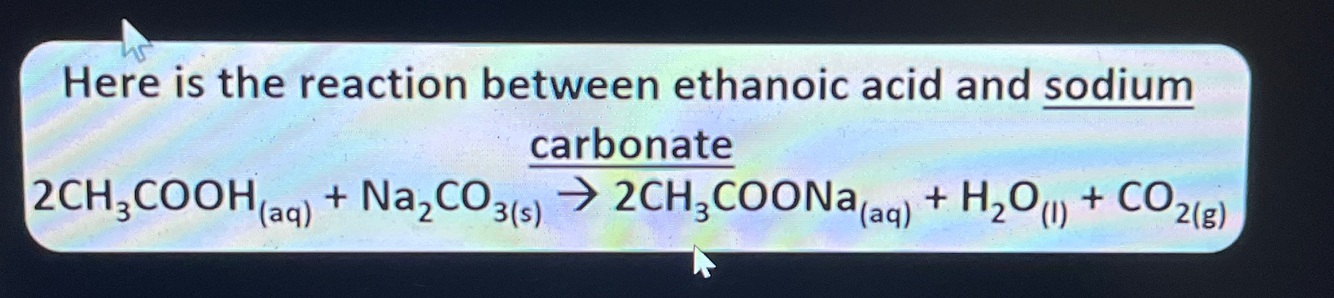
Reagent: Na2CO3 Observation: Effervescence due to CO2 2CH3COOH + Na2CO3 –> 2CH3COONa + CO2 + H2O 2H+ + CO32- —> CO2 + H2O
What is the general equation when a carboxylic acid reacts with a carbonate
carboxylic acid + carbonate –> Salt + water + carbon dioxide
What type of acid are carboxylic acids
Weak acids
What do carboxylic acids dissociate into
H+ and carboxylate ion
Write the equation for the reaction between ethanoic acid and sodium carbonate
What is the general equation for the reaction between a carboxylic acid and an alcohol
carboxylic acid + alcohol <—> Ester + water
What are the conditions for the reaction between a carboxylic acid and an alcohol to form an ester
Concentrated H2SO4 catalyst Warm conditions (reflux)
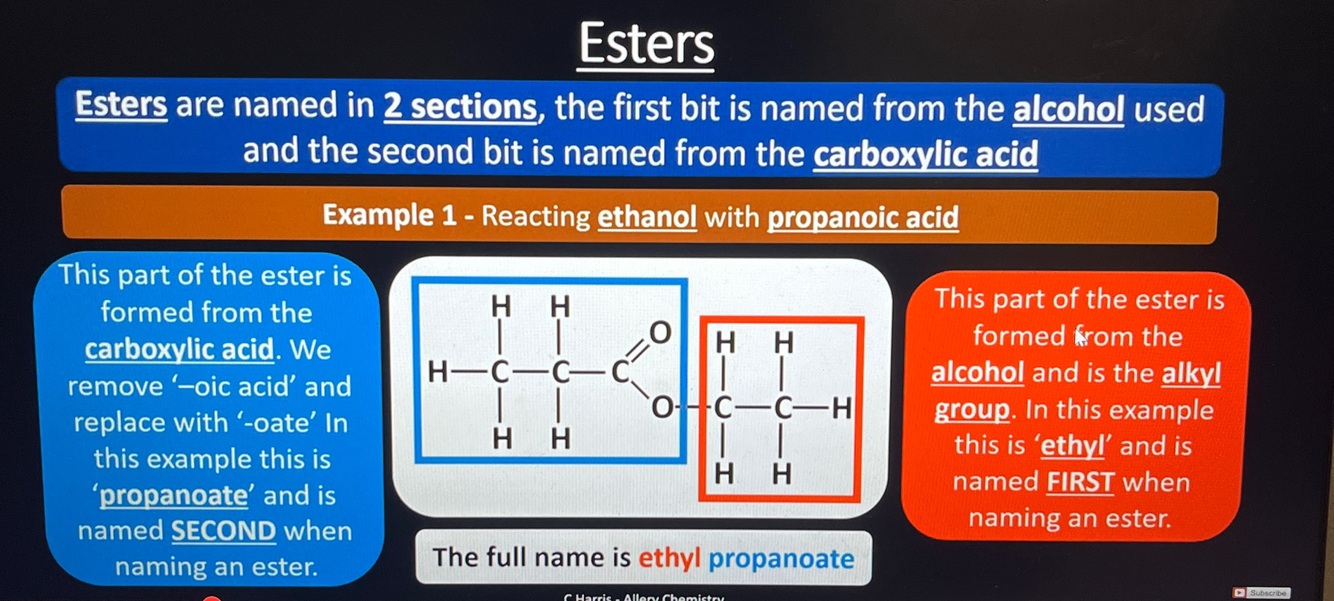
How do we name an ester
Right side then left side ALWAYS COUNT AWAY FROM THE O OR DOUBLE BOND O (AWAY FROM THE FUNCTIONAL GROUP), so C1 RHS is the C-O, C1 on LHS is C=O
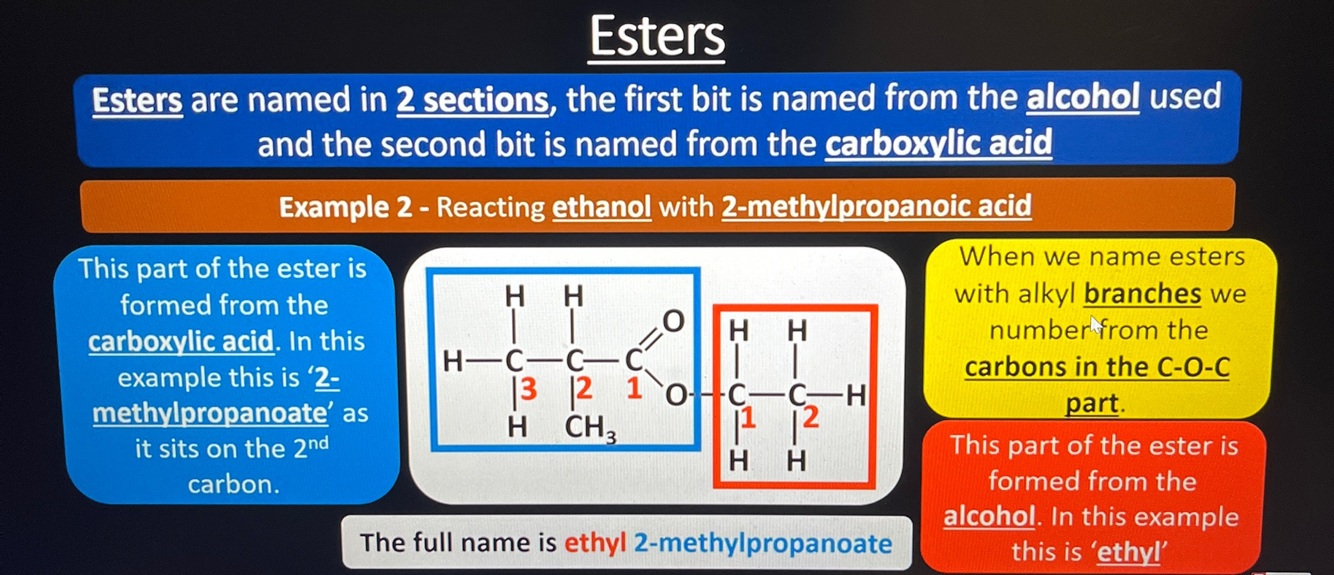
How do we name an ester with a methyl group
Right side then left side ALWAYS COUNT AWAY FROM THE O OR DOUBLE BOND O (AWAY FROM THE FUNCTIONAL GROUP), so C1 RHS is the C-O C1 on LHS is C=O
Give 4 uses of esters
Perfumes Food flavourings Solvents Plasticisers
Why are esters good solvents
They are polar so other polar solvents will dissolve well in them
Why can esters be used in making glues
They have a low boiling point and evaporate easily
What is the general equation for the hydrolysis of an ester in acidic conditions
Ester + water <—> carboxylic acid + alcohol
What is the general equation for the hydrolysis of an ester in alkaline conditions
Ester + sodium hydroxide —-> carboxylate salt + alcohol
What are the conditions for the hydrolysis of an ester in acidic conditions
Aqueous dilute H2SO4 catalyst Hot conditions (reflux)
What are the conditions for the hydrolysis of an ester in alkaline conditions
Aqueous NaOH Hot conditions (reflux)
Why is the hydrolysis of an ester in alkaline conditions to form a carboxylic acid preferred over acidic conditions and why may it not be preferred
Drawback: 2 step reaction so lower yield Benefit: Both reactions are not reversible so goes to completion (Both reactions being formation of carboxylate salt and turning the salt into a carboxylic acid)
Which way does equilibrium shift when we add water to the hydrolysis of an ester in acidic conditions
Equilibrium shifts right and so more of the product is produced
How do we turn a carboxylate salt from the hydrolysis of an ester in alkaline conditions into a carboxylic acid
Add dilute HCl
Write the general equation for the reaction between a carboxylate salt and HCl
Carboxylate salt + HCl —> Carboxylic acid + chloride salt
What are the conditions for the reaction between a carboxylate salt and HCl to form a carboxylic acid
Warm carboxylate salt Dilute HCl
What is propane-1,2,3-triol also known as
Glycerol
What do we get when we react glycerol and fatty acids together
An ester