Unit 4 structural deteremination
No description yet. This curated deck is ready for daily study.
Card preview (9)
In fragmentation in mass spectrometry, a molecular ion breaks up into fragments. What does each fragment carry and which one will be detected?
One fragment will carry a positive charge and the other will carry an unpaired electron. The fragment with a positive charge will be detected. M+•→X+ + Y•
What is the peak furthest to the right in a mass spectrum called? What does it tell you about the molecule?
The molecular ion peak, it tells you the Mr of the molecular ion.
What is the region called below 1500cm-1 in Infra-red spectroscopy? How is it useful in determining the structure of a substance?
It is called the fingerprint region. It is unique for any particular substance, so it can be used to indentify a substance by comparing its infra-red spectrum to a known sample’s.
What infra-red spectrum peaks would be expected for ethyl ethanoate?
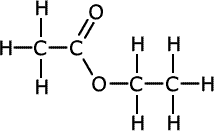
1 peak between 1680-1750cm-1 for a C=O bond, and 2 peaks between 1000-1300cm-1 for 2 C-O bonds.
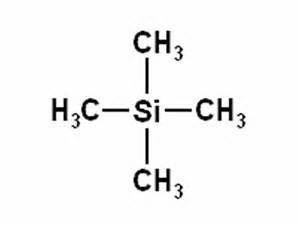
What is the name of the compound used to indicate 0 ppm in 13C and proton nmr? What is its structure?
Tetramethylsilane (TMS)
Ethanol has 2 peaks in a 13C nmr spectra, one between 5-40 ppm for a C-C bond and one between 50-90 ppm for a C-O bond, why does the carbon bonded to an oxygen have a higher chemical shift than the other carbon?
The oxygen draws electrons away from the carbon bonded to it, meaning the carbon is less shielded so it feels a greater magnetic field and resonates at a greater frequency and has a greater chemical shift value than the other carbon.
What does the integration trace tell you about a proton (1H) nmr spectra?
It tells you the ratio of hydrogens represented by each peak.
In proton (1H) nmr spectra, peaks are usually split into multiple smaller peaks. What does the number of peaks tell you about a hydrogen?
The number of peaks minus 1 tells you the number of hydrogens on carbon atoms adjacent to the hydrogen the peak is for.
What would the proton (1H) nmr spectra of propanoic look like?
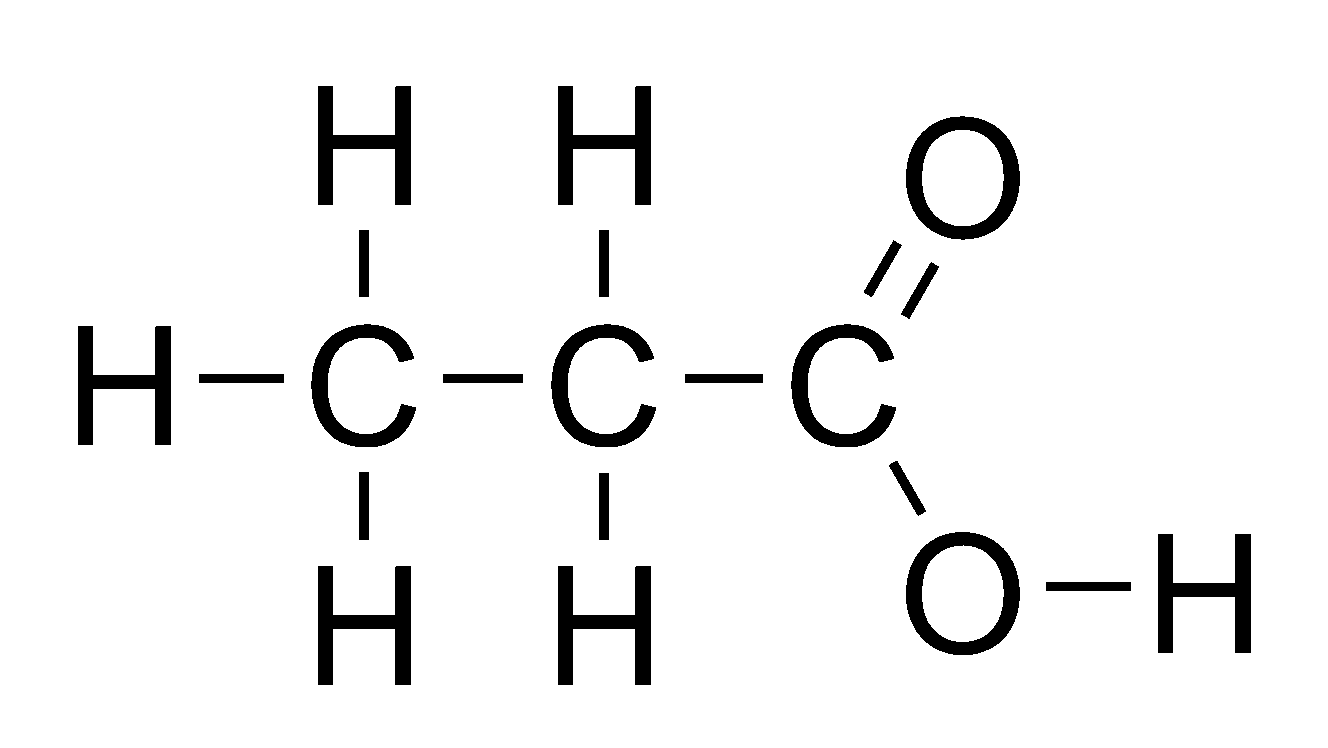
The ratio of hydrogens will be 3:2:1 which can be found by integration. The first peak has 3 hydrogens due to its ratio and will have 2 hydrogens on adjacent carbons as it is split into 3 peaks. The second peak has 2 hydrogens due to its ratio and will have 3 hydrogens on adjacent carbons as it is split into 4 peaks. The third peak won’t be split and will be between 10-12 ppm which represents the OH hydrogen. It will be a singlet as it has no hydrogens on its adjacent carbon.