12: Acid-base Equilibria
No description yet. This curated deck is ready for daily study.
Card preview (23)
What is a Brønsted–Lowry acid?
A proton donor
What is a Brønsted-Lowry base?
A proton acceptor
What is transferred in acid-base reactions?
Protons
State the conjugagte base of the acid HA
A-
State the equation for pH
pH = -log[H+]
State the equation to calculate the concentration of hydrogen ions in a solution from its pH.
[H+] = 10-pH
Describe the difference between a strong acid and a weak acid.
Strong acids fully dissociate, Weak acids partially dissociate.
Deduce the expression for the acid dissociation constant of the weak acid in this equation: HA <=> H+ + A-
Ka = [H+][A-] / [HA]
Explain 2 assumptions made when calculating the pH of a weak acid.
[H+] = [A-], because H+ from H2O is negligible, [HA] at equilibrium = Initial [HA], because dissociation is very small
State the equation for the ionic product of water
Kw = [H+][OH-]
State the equation for pKa
pKa = -log Ka
State the equation for pKw
pKw = -log Kw
Compare and explain the change in pH of a strong acid and a weak acid after dilution 10 times.
pH of a strong acid will increase by 1, because [H+] decreases by a factor of 10. pH of a weak acid will increase by 0.5, because some of the undissociated acid molecules split up, so [H+] decreases slower.
Descrive the titration curve for strong acid and strong base.
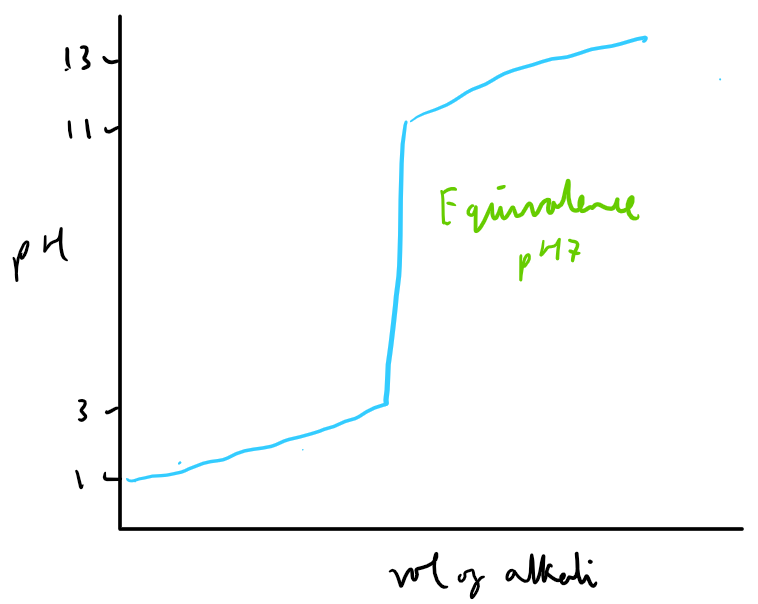
Describe the titration curve for strong acid and weak base.
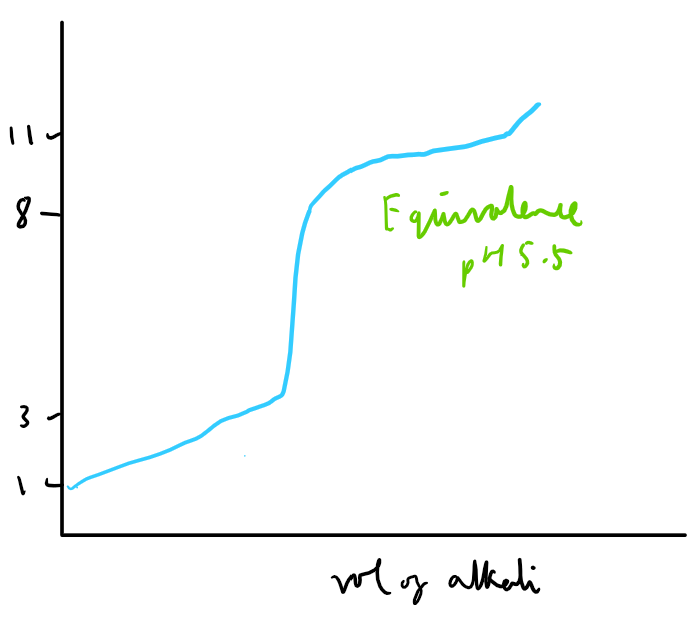
Describe the titration curve for weak acid and strong base.
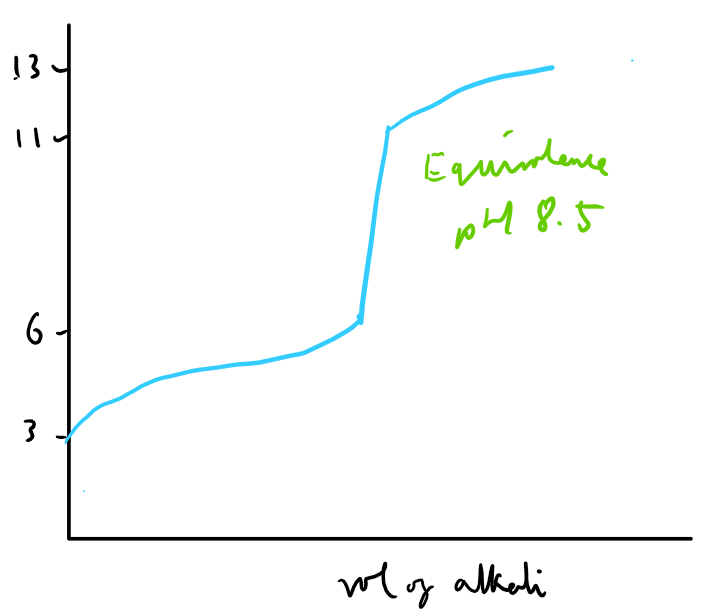
Describe the titration curve for weak acid and weak base.
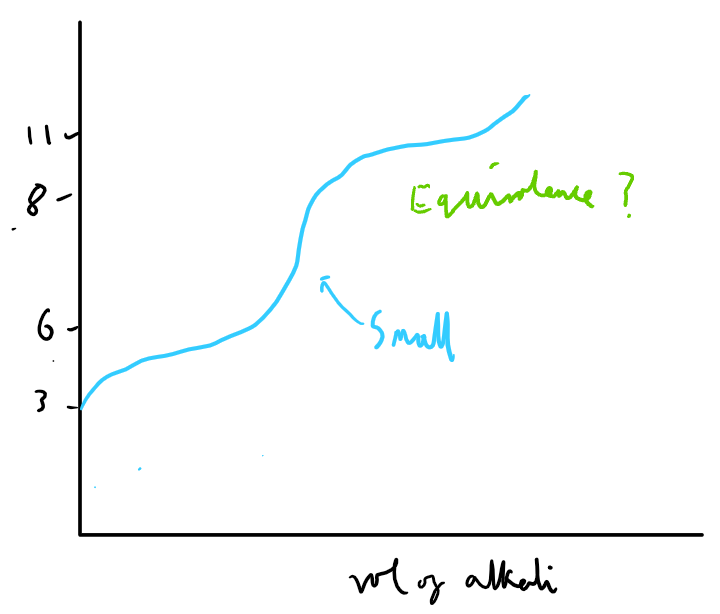
State how you would select a suitable indicator using a titration curve.
Choose an indicator with the equivalence point of the curve within its pH range.
Describe what is meant by the term ‘buffer solution’.
A system which resists dramatic changes in pH if small quantities of acid or alkali is added to it. Contains a weak acid and one of its salts in high concentration.
Explain the action of a buffer solution as a small quantity of acid is added.
HA <=> H+ + A- As H+ ions are added, they react with A- ions from the salt in the buffer solution, shifting equilbirium to the left, so [H+] stays approximately constant.
Explain the action of a buffer solution as a small quantity of alkali is added.
HA <=> H+ + A- As OH- ions are added, they react with H+ ions from the acid in the buffer solution, shifting equilbirium to the right, so [H+] stays approximately constant.
Explain why there is a difference in enthalpy changes of neutralisation values for strong and weak acids.
As weak acids are neutralised they dissociate more, so energy is used up, and the enthalpy change is less exothermic.
Explain how the pH of blood is controlled.
A buffer solution of carbonic acid molecules and hydrogencarbonate ions.