Unit 1 Communication
No description yet. This curated deck is ready for daily study.
Card preview (24)
Examples of cultural groups one may encounter:
➢Gender groups ➢Racial groups ➢Generational groups ➢Geographic groups ➢Sexual-preference groups ➢Religious groups ➢Groups based on nonracial physical characteristics (the blind, the deaf, the disabled, the obese) ➢Socioeconomic groups ➢Groups with various types of family structure (singles, unmarried couples with and without children, traditional nuclear families, single parents, parents with children and grandchildren, and large, close-knit extended families)
Culturally Significant Attitudes That May Impact Communication
Eye contact, touch, and gestures have different meanings in different cultures
Nonverbal Communication
• Examples ➢Eye contact ➢Touch ➢Appearance • Interpreted based on culture
Listening Skills
• Requires more than waiting for your turn to speak • Ability to give the speaker your full attention and focus
Verbal Skills
Ability to use language and content that is appropriate for your patient
Attitude
• Nonverbal cues communicate attitude • Assertiveness is often necessary (Not to be confused with aggression)
Validation of Communication
An indication of a clear understanding of the message
Communication Under Stress
• Stress interferes with our ability to process information accurately and appropriately • Suggestions to improve communication effectiveness in a crisis situation: ➢Lower your voice, speak slowly, and clearly. ➢Be nonjudgmental in both verbal and nonverbal cues. ➢Do not allow another’s inappropriate actions or speech to goad you into a similar response. ➢Request confirmation when you are uncertain of the listener’s understanding.
6 Communication Skills
• Nonverbal Communication • Listening Skills • Verbal Skills • Attitude • Validation of Communication • Communication Under Stress
Communication with Patients
• Addressing the patient • Valid choices • Avoiding assumptions • Assessment through communication • Therapeutic communication
Addressing the Patient
• Introductions are normally first. • Avoid impersonalizing patients, such as identifying patient by the exam rather than by name. • Address patient appropriately. ➢Avoid use of “honey,” “sweetie,” or other such names
Valid Choices
• Defined as alternatives that are all acceptable to you • Provide patient with a sense of participation in his or her care.
Avoiding Assumptions
• Helps in preventing errors during procedures • Examples of common assumptions: ➢Use of routine positioning techniques for all outpatients ➢Patient understood and followed preparation procedures for contrast
Therapeutic Communication
• A process in which the healthcare professional consciously influences a client or helps the client to a better understanding through verbal or nonverbal communication • Involves the use of specific strategies that convey acceptance and respect • Encourages the patient to express feelings and ideas
Special Circumstances That Affect Communication
• Patients who do not speak English • The hearing impaired • Deafness • Impaired vision • Inability to speak • Impaired mental function • Altered states of consciousness
Patients Who Do Not Speak English
• Federal law guarantees patients the right to effective communications. • Larger hospitals commonly employ interpreters and provide signs in several languages. • Other facilities have “on-call” interpreters. • Use of family members as interpreters often problematic -Tend to edit conversation • When using an interpreter, look at the patient when speaking -Looking at the interpreter makes the patient feel excluded.
The Hearing Impaired
• Useful tips for communicating with individuals who have hearing loss: ➢Talk to, not about, these persons. ➢Get the patient’s attention before starting to speak. ➢Face the person, preferably with light on your face. ➢Hearing loss is frequently in the upper register, so speak lower as well as louder. ➢Speak clearly at a moderate pace, and do not shout. ➢Avoid noisy background situations. ➢Rephrase when you are not understood. ➢Be patient.
Deafness
• Deaf persons have their own culture. • Chart should be flagged to alert care providers that patient is deaf. • Certified interpreters usually necessary for effective communications.
Impaired Vision
• Ability to function depends on degree of vision loss and length of time since sight was lost or impaired. • Useful to ask what assistance is needed ➢Some will prefer to touch your elbow as a guide. ➢Others will prefer a description of the surroundings. • Effective communications are essential.
Aphasia is a
defect or loss of language function in which comprehension or expression of words is impaired because of injury to language centers in the brain
Impaired Mental Function
• Abilities vary, so individual assessment is key. • Inappropriate to treat adults with mental disabilities as if they were children. • Repeating instructions is often useful
Altered States of Consciousness
• Important to communicate as if the patient can hear and respond • Constant observation is required to avoid accidents. • Tips: ➢Do not rely on patient to remember instructions. ➢Patients are not responsible for their actions/answers.
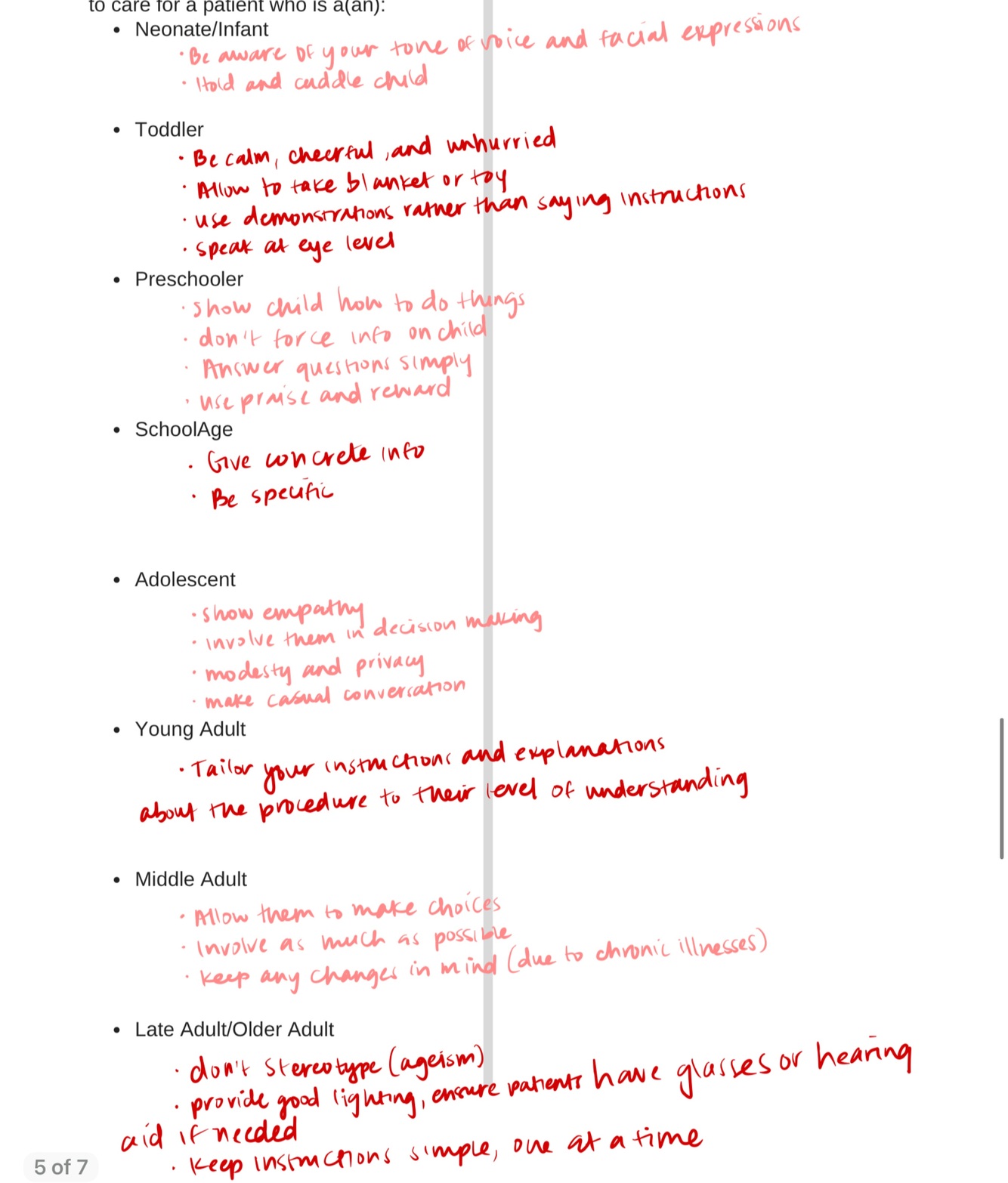
Age-Specific Communication
• Neonate and infant (birth to 1 year) • Toddler (1–2 years) • Preschooler (3–5 years) • School age (6–12 years) • Adolescent (13–18 years) • Young adult (19–45 years) • Middle adult (46–64 years) • Late adult (65–79 years) • Old adult (80 years and older) • Important to learn and practice age-specific communication skills • Avoid stereotypes. • Ageism is a discriminatory attitude toward the elderly that includes a belief that all elderly are ill, disabled, worthless, or unattractive
Dealing with Death and Loss • Kübler-Ross stages of grief:
➢Denial—refuses to accept the truth; may refuse to discuss the possibility of loss or death ➢Anger—experiences frustration, outrage; may vent on healthcare workers ➢Bargaining—attempts to earn forgiveness or mitigate loss by being “very good” ➢Depression—often acquiescent, quiet, and withdrawn, and may cry easily ➢Acceptance—accepts the loss or impending death and deals with life and relationships on a more realistic, day-to-day basis