1 1.5 Ideal gases
No description yet. This curated deck is ready for daily study.
Card preview (24)
What is the definition of an ideal gas?
A hypothetical gas that obeys the gas laws under all conditions of temperature and pressure, based on the assumptions of the kinetic molecular theory.
What are the key assumptions of the kinetic molecular theory of gases
• The particles in a gas have negligible volume compared with the volume the gas occupies. • There are no intermolecular forces between the particles except when the molecules collide. • Gas particles have a range of speeds and move randomly. The average kinetic energy of the particles is proportional to the temperature. • The collisions of the particles with the walls of the container and with each other are elastic: kinetic energy is conserved. - ideal gas particles are assumed to be perfectly elastic spheres
under which conditions do real gases follow the model
Real gases approximate ideal behaviour at low pressure (negligible volume) and high temperature (minimal intermolecular forces).
Do real gases behave exactly like ideal gases?
No. Although no real gas is perfectly ideal, many gases approximate ideal behaviour under typical conditions of temperature and pressure.
Which law connects gas particle motion with force?
Newton’s Second Law: 𝐹=𝑚𝑎 It can be applied to explain and predict the pressure exerted by gas particles colliding with container walls.
Why does a balloon shrink in the cold and expand in the heat?
Because gas volume is directly proportional to temperature (in Kelvin). As temperature decreases, average KE decreases → particles collide less strongly with the walls → volume decreases.
Q4: Do different gases respond differently to changes in 𝑃, 𝑉 and 𝑇
No. Experiments show all gases respond the same way when the mass of gas is fixed. - The chemical identity of the gas does not affect its pressure–volume-temperature relationship.
Why is the gaseous state easiest to describe using kinetic theory?
Because gas particles are widely spaced with negligible forces, making their motion simple to model mathematically.
Why does a gas exert pressure?
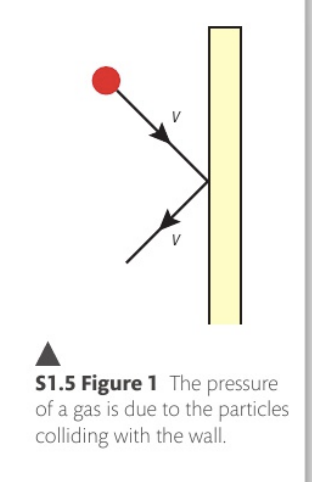
• The pressure of a gas is due to gas particles colliding with the walls of the container. • When a particle collides with the wall, it bounces back with the same speed. • These collisions are elastic (no kinetic energy lost), according to the fourth axiom of KMT.
What everyday example illustrates a sudden pressure change?
In the Mentos–soda fountain reaction, dissolved CO₂ rapidly escapes as gas in the presence of Mentos. The sudden pressure increase forces the soda out in a fountain of foam.
Why is gas pressure the same on all walls of the container?
Because particles move randomly with no preferred direction (third axiom). - A large number of random, elastic collisions with the walls produce uniform pressure in all directions.
How does KMT explain the volume of a gas?
The volume of a gas is the total volume of its container, since particles spread out to fill all available space.
What happens to gas pressure when volume increases (at constant T)?
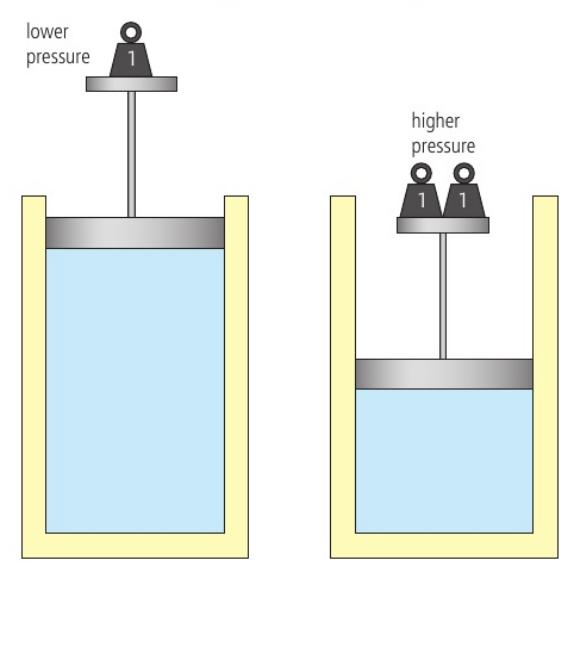
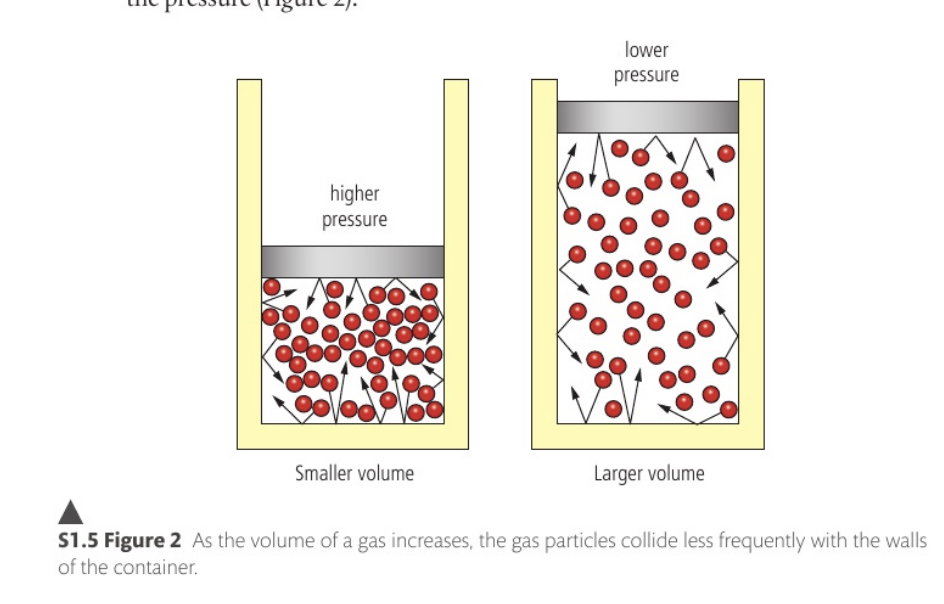
When the container volume increases, particles travel further between collisions and collide with the walls less frequently. This lowers the pressure.
What happens to gas pressure when temperature increases (at constant V)?
Increasing temperature increases the average kinetic energy of the particles (third axiom). - They move faster, collide more often, and with greater force → pressure increases.
What would happen if molecular collisions were not perfectly elastic?
• If collisions were inelastic, kinetic energy would not be conserved. • Particles would lose energy when colliding with walls or each other, so the pressure exerted would be lower.
On which factors does the volume of a gas depend?
The volume that a gas occupies depends on its pressure (P) and temperature (T).
What is the difference between elastic and inelastic collisions?
• Elastic collisions: energy conserved; particles bounce apart after impact. • Inelastic collisions: kinetic energy not conserved; particles may stick together.
Why do real gases deviate from the ideal gas model?
Because the assumptions of the ideal gas model are not valid under all conditions. Specifically: - Gas particles have non-negligible volume at high pressure. - There are intermolecular forces at low temperature.
What happens when the volume of gas particles is not negligible?
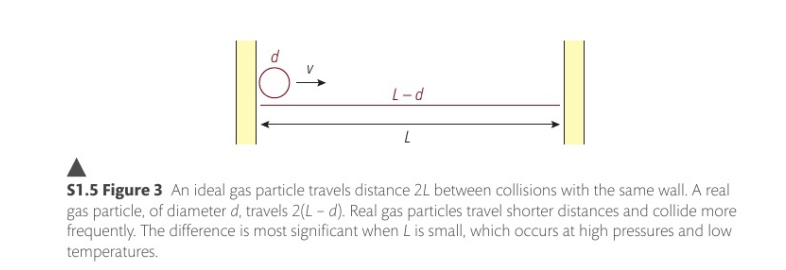
• Real particles occupy space and travel shorter distances between wall collisions. • Collisions with container walls occur more frequently than predicted. • Pressure is greater than predicted by the ideal gas model (PV/RT>1) • This effect is most noticeable at very high pressures and low temperatures when particles are confined in a small volume and distance between particles is significantly reduced
Under what conditions do real gases deviate most from ideal behaviour?
Real gases deviate most at: - High pressure → particle volume significant. - Low temperature → intermolecular forces significant. These are conditions close to liquefaction.
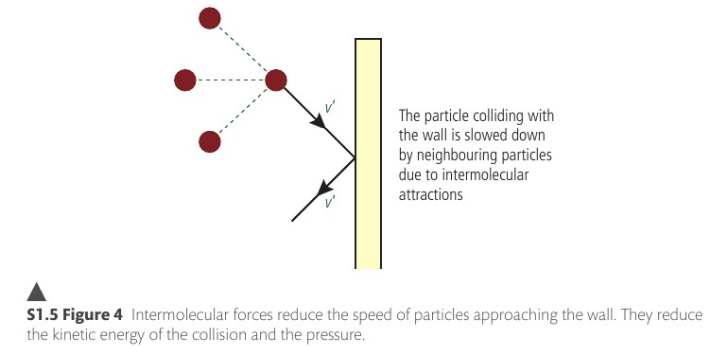
What happens when there are attractive forces between particles?
• Intermolecular attractions slow particles as they approach the walls. • Collisions are less energetic. • Pressure is lower than predicted by the ideal gas model (PV/RT<1). • This is most significant at low temperatures (lower KE means attractions have stronger effect).
How do gas molecules exert pressure in a container?
Gas molecules are in constant random motion. They collide with the walls of the container, and each collision exerts a force. The combined effect of many collisions produces gas pressure.
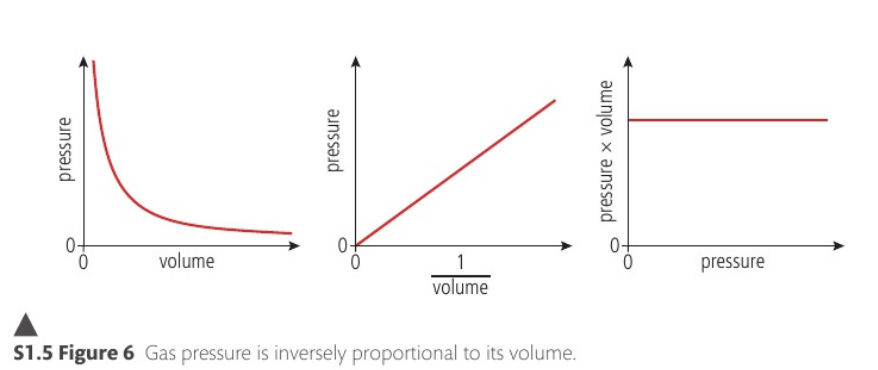
How can P∝1/V be shown graphically
• Pressure vs Volume → inverse curve. • Pressure vs 1/Volume → straight line. • PV vs P → horizontal line. • this relationship can be explained in terms of the decreased frequency of particle collisions with the walls of the container as the gas expands
What happens to gas pressure when volume decreases at constant temperature?
• If the temperature of a gas is held constant • increasing the pressure of a fixed mass of gas decreases its volume • the pressure of a gas is inversely proportional to its volume, and the product of pressure and volume is a constant PV = a constant P∝ 1/V • this is boyle’s law