Nuclear atom
No description yet. This curated deck is ready for daily study.
Card preview (24)
What is an atom, and what sits at its centre?
• An atom is the smallest particle of an element that retains that element’s chemical properties. • At its centre is the nucleus — a tiny, dense region containing protons and neutrons (collectively called nucleons). • Electrons move around the nucleus in regions of space called energy levels or orbitals.
Name the three subatomic particles and where they are found.
• Proton (p⁺): in the nucleus • Neutron (n): in the nucleus • Electron (e⁻): in orbitals around the nucleus Together they form the structure of the atom.
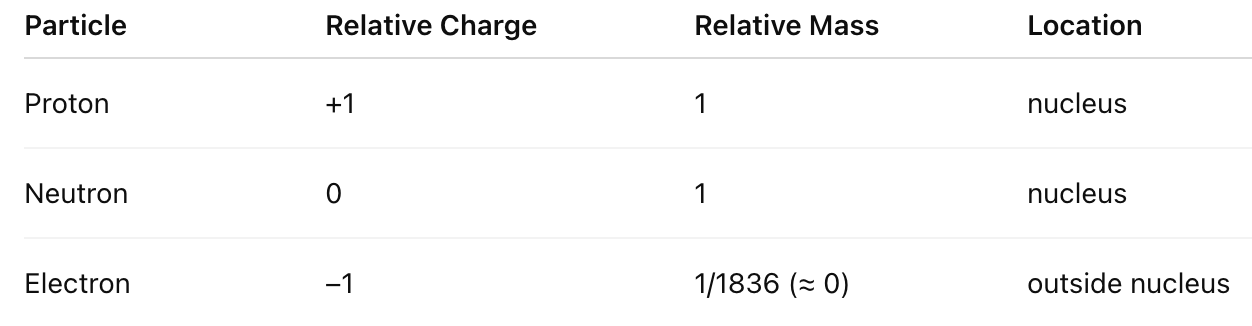
Relative Charge and Mass of subatomic particles
Exam tip: Always give relative values — no units.
Define atomic number (Z) and mass number (A)
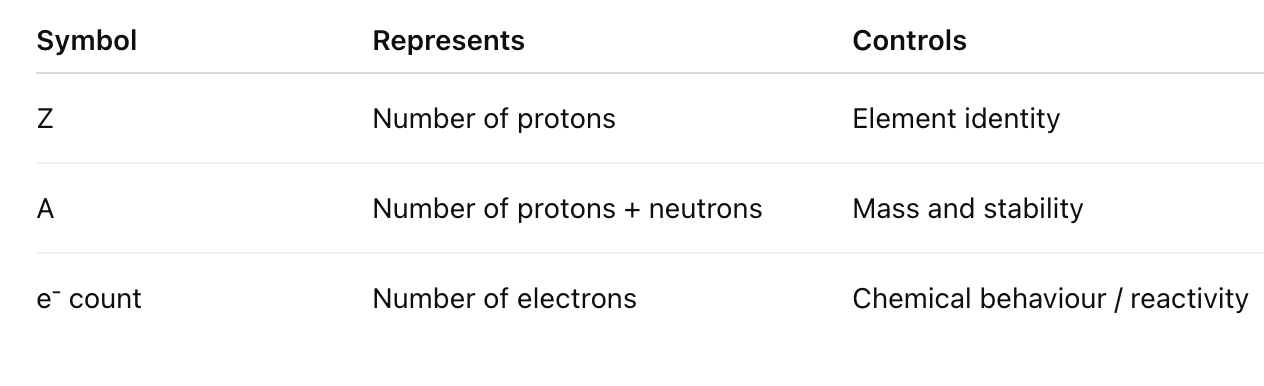
Atomic number (Z): the number of protons in the nucleus. It defines the element. Mass number (A): the total number of protons + neutrons (nucleons) in the nucleus.
What role does each subatomic particle play?
• Proton: determines the identity of the element (its atomic number). • Neutron: contributes to mass and nuclear stability. • Electron: controls the chemical properties and bonding behaviour.
How do you determine the number of protons, neutrons and electrons in an atom or ion written as …photo?

p=Z, n=A−Z, e=Z−q where q is the ionic charge (+ for cations, – for anions). Example: 40 20Ca2+ : p = 20, n = 20, e = 18.
How do ions form, and what changes during a chemical reaction?
Ions form when electrons are lost or gained. - Cations (+): electrons lost. - Anions (–): electrons gained. In chemical reactions, only electrons change; protons and neutrons remain constant.
What evidence shows that atoms are mostly empty space?
Rutherford’s gold-foil experiment showed that most α-particles passed straight through the foil, while a few were deflected. - This means the nucleus is extremely small and dense, and the rest of the atom is mostly empty space where electrons move.
What is the role of neutrons in the nucleus?
• Neutrons stabilize the nucleus. They experience the strong nuclear force, which attracts both protons and neutrons together. • Because neutrons have no charge, they help offset proton–proton repulsion without adding extra repulsion. • If there are too few or too many neutrons, the nucleus becomes unstable and may undergo radioactive decay. “Neutrons act as a nuclear glue, providing attraction through the strong nuclear force that balances proton repulsion.”
What are isotopes, and how do they differ?
Isotopes are atoms of the same element (same Z) but with different numbers of neutrons (different A). - They have identical chemical properties (same electron configuration) but different physical properties such as density, diffusion rate, or melting point.
Chlorine has 75 % ³⁵Cl and 25 % ³⁷Cl. Calculate Aᵣ.
Ar=(35×0.75)+(37×0.25)=35.5
Why are most atomic masses not whole numbers?
Isotopic Mixtures: Elements exist as mixtures of isotopes, each with different numbers of neutrons. The listed atomic mass is a weighted average of these isotopic masses. Example: Cl = 35.5 (average of ³⁵Cl and ³⁷Cl).
Define relative atomic mass.
The weighted mean of the masses of the isotopes of an element relative to 1/12 of the mass of a carbon-12 atom.
Describe the evidence that led to the nuclear model of the atom.
Rutherford’s α-particle scattering showed that: - Most particles passed straight through → atoms are mostly empty space. - A few deflected strongly → a small, dense, positively charged nucleus exists. This replaced the “plum-pudding” model and led to the nuclear model.
What forces act within atoms?
• Electrostatic attraction between the nucleus (+) and electrons (–) keeps electrons bound. • Electrostatic repulsion between protons tends to push them apart. • Strong nuclear force binds nucleons in the nucleus and overcomes proton repulsion at very short distances.
How are these subatomic particles related in a neutral atom?
• In a neutral atom, the number of electrons = number of protons, so overall charge is zero. • The number of neutrons can vary (different isotopes) without affecting neutrality.
Compare a neutral sodium atom and a sodium ion.
Na atom: 11 p, 12 n, 11 e → neutral. Na⁺ ion: 11 p, 12 n, 10 e → +1 charge (lost one electron).
Summary of What Each Number Represents
exam answer
An atom is the smallest particle of an element that retains its properties. - It consists of a dense, positively charged nucleus containing protons and neutrons, surrounded by negatively charged electrons in energy levels. - Protons determine the element’s identity, - electrons determine its chemistry, and neutrons stabilise the nucleus by reducing proton–proton repulsion. - Most atomic masses are not whole numbers because natural elements are mixtures of isotopes and because a small mass defect occurs when nucleons bind together.
What role do neutrons play in the atom?
• Neutrons have no electrical charge but are vital for nuclear stability. • Protons in the nucleus repel each other because they are all positively charged. • Neutrons add attractive strong nuclear forces between all nucleons (p–p, p–n, n–n) that overcome this repulsion at very short distances (≈ 10⁻¹⁵ m). • Because neutrons don’t contribute to electrostatic repulsion, they act as a nuclear glue, holding the nucleus together. A balanced neutron : proton ratio keeps the nucleus stable. - Too few neutrons → proton repulsion dominates → β⁺ decay. - Too many neutrons → excess stability → β⁻ decay. “Neutrons stabilise the nucleus by providing strong-force attraction without adding charge, preventing protons from repelling each other apart.”
Why is carbon-12 used as the reference standard for atomic masses?
Carbon-12 was chosen because it is: - Stable (non-radioactive) and abundant, - Found in pure form, easy to measure precisely, - Provides a convenient integer reference (12 u) that gives almost whole-number relative masses for most other elements. - All relative atomic masses are defined against it: 1 atomic mass unit (u) = 1/12 of the mass of one atom of 12C - Exam phrase: “The carbon-12 isotope was adopted as the universal reference because it is stable, widely available, and allows atomic masses to be measured on a consistent, reproducible scale.”
Why is it important to have a fixed atomic-mass standard?
• A fixed standard ensures that relative masses of all elements are measured consistently worldwide. • It provides a common scale for comparing atomic, molecular, and formula masses and allows data from different experiments and instruments to be directly comparable.
Describe Rutherford’s gold-foil experiment and explain what it revealed about atomic structure.
Experiment: - A thin sheet of gold foil was bombarded with α-particles (positively charged helium nuclei). - Most α-particles passed straight through; a few were deflected at small angles, and very few bounced straight back. Observations and Conclusions: Observation Conclusion Most α-particles passed through → Atoms are mostly empty space. Some deflected slightly→ There is a small, dense, positively charged nucleus. A few bounced back → The nucleus contains most of the atom’s mass and positive charge. Impact: This experiment disproved Thomson’s “plum pudding” model and led to the nuclear model, where a dense nucleus is surrounded by orbiting electrons. Exam phrase: “Rutherford’s experiment demonstrated that atoms consist of a tiny, dense, positively charged nucleus containing most of the mass, surrounded by mostly empty space where electrons are found.”
What are isotopes?
Isotopes are atoms of the same element (same atomic number Z) but with different numbers of neutrons and therefore different mass numbers A. Example: 17 17 35Cl and 37Cl • Both have 17 protons & 17 electrons → same chemical behaviour, but masses = 35 and 37. Exam phrase: “Isotopes are atoms with the same proton number but different numbers of neutrons.”