Hemoglobin
No description yet. This curated deck is ready for daily study.
Card preview (24)
Hemoglobin
an allosteric oxygen-binding protein that carries oxygen from the lungs to the tissues for cellular respiration
Hgb consists of how many subunits?
Four total subunits 2 a subunits (141 amino acids each) 2 b subunits (146 amino acids each)
Tetramer
Hgb is a tetramer (tetra=four) for containing 4 subunits
Heme Moiety
Each subunit has a heme moiety which can bind one O2. Therefore, a single hgb molecule can bind up to 4 oxygen molecules.
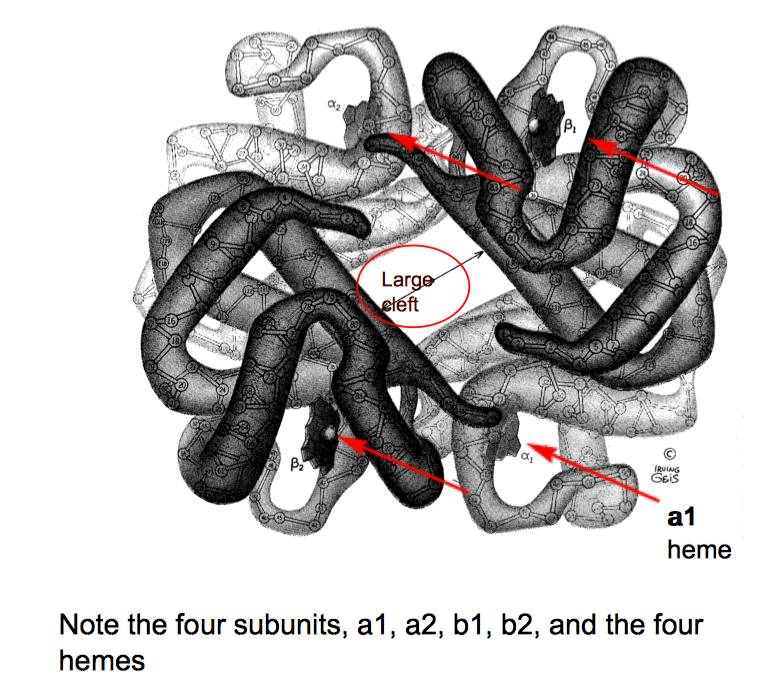
Deoxyhemoglobin
No oxygen bound to the hemes. Large cleft.
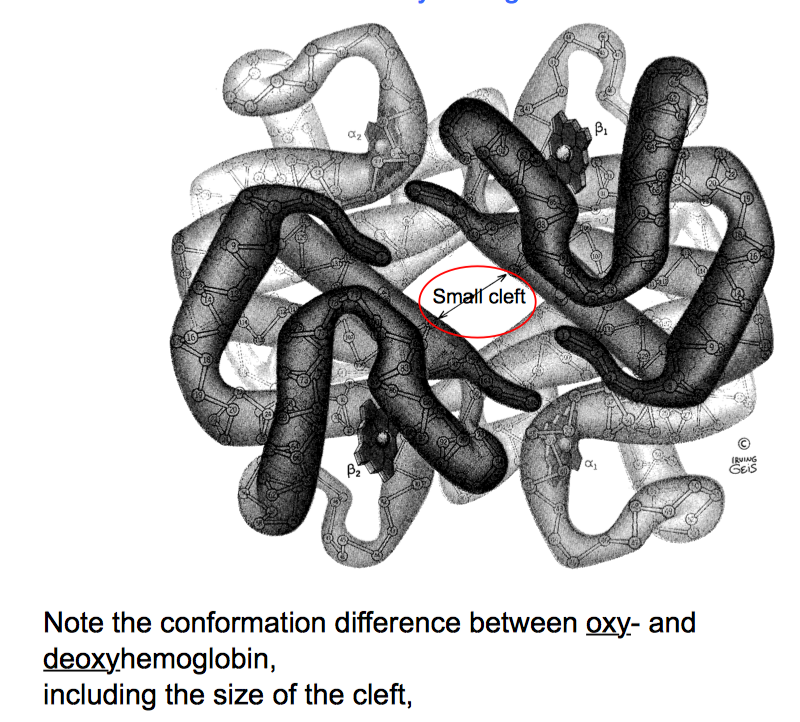
Oxyhemoglobin
Small cleft.
Affinities of oxygen binding to Hgb
The first oxygen binds with the lowest affinity, each subsequent oxygen binds with higher affinity. This causes the sigmoidal (s-shape) uptake curve.
Locations of Oxygen saturation
In the lungs, oxygen tension is high and Hgb is nearly saturated with oxygen. In deep tissues, oxygen tension is low and hemoglobin releases half of its oxygen.
Saturated
each hgb holds 4 oxygen molecules
Allosteric Effect
cooperative binding (increasing binding affinity) is due to an allosteric effect where binding to one site affedts the binding at another site.
Why don’t we have much deoxyHgb in our blood?
Because most of the hemoglobin is bound to oxygen.
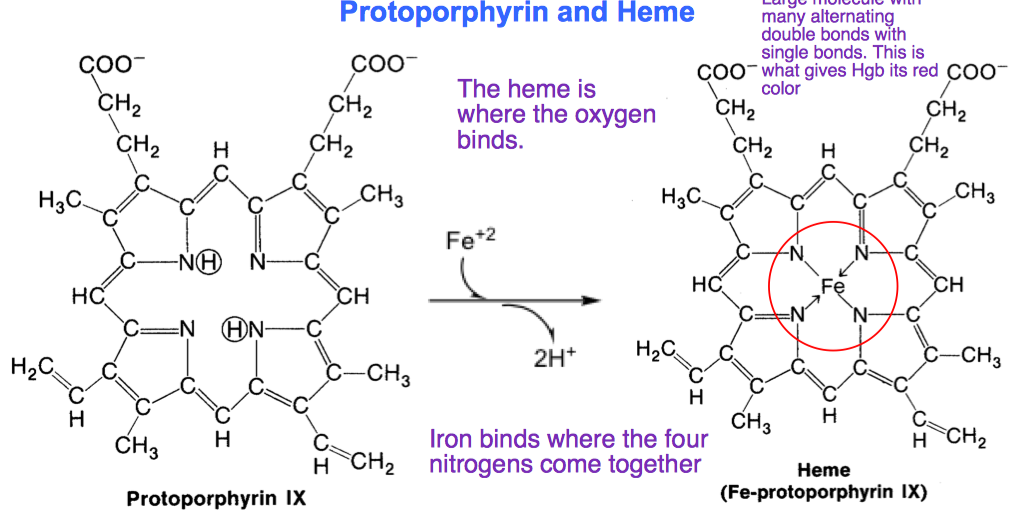
Protoporphyrin and the Formation of Heme
Ligation of protoporphyrin IX with an Iron atom (Fe) results in the formation of heme. The 4 bonds to Fe are to the nitrogens (coordination sites) of the protoporphyrin group. In Hgb the 5th Fe bond is to histadine residue in the protein mortion. When oxygen is present it binds to the 6th coordination site of Fe.
Deoxyhemoglobin
Fe+2 Fe+2 is not bound in deoxy form, but will bind O2 and CO when each is present
Oxyhemoglobin
Fe+2…O2 Ferrous iron is bound to oxygen. After one O2 is bound, others bind more readily because of conformation change.
Carboxyhemoglobin
Fe+2…CO Ferrous iron is bound to CO. This forms a stronger bond than with O2
Methemoglobin
Fe+3 The iron is in the ferric form and will NOT bind O2 or CO. Oxidation of Fe+2 to Fe+3 is caused by oxidants such as chlorates, nitrates, and nitric oxide (NO)
Sulfmethemoglobin
Fe+3…SH Rare, in H2S (hydrogen sulfide) toxicity. Blood is a purple to green color and unable to bind oxygen.
Cyanmethemoglobin
Fe+3…CN Cyanide poisoning. Iron must be ferric before it will bind CN. This property of methemoblobin can be used in cyanide poisoning to sequester CN. If you suspect cyanide poisoning, you can oxidize the Hgb and that Hgb will then bind with cyanide
Fetal hemoglobin
Has a slightly higher affinity for O2 than adult hgb (left shift)
Oxygen Saturation Formula
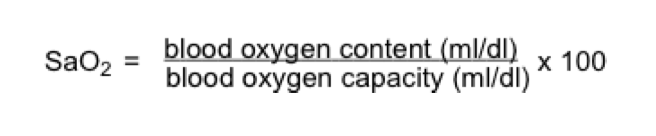
SaO2
arterial oxygen in RBCs.
SaO2 is independent of what?
independent of the amount of Hgb present or forms of Hgb present
Blood Oxygen Content =
Concentration of Hgb x % saturation of Hgb + O2 stabilized in plasma
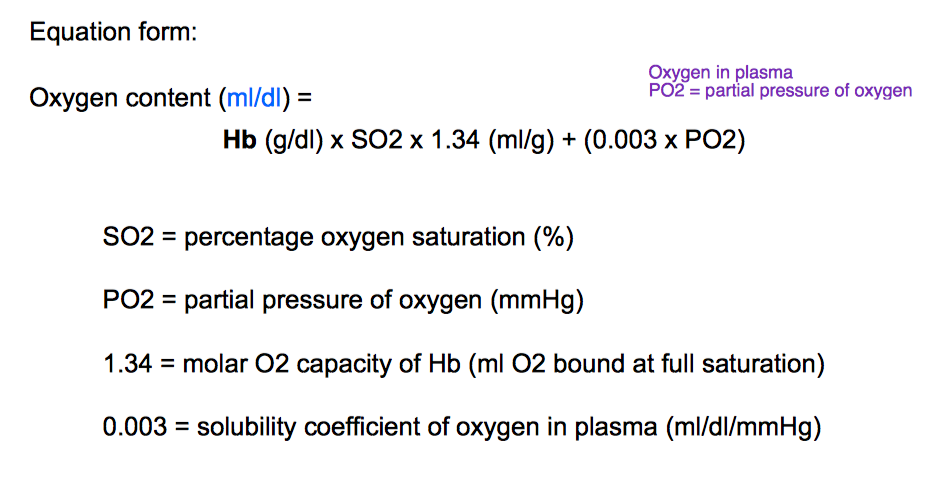
Blood Oxygen Content of normal person
15g Hgb/100mL blood Each gram of Hgb holds 1.34 mL of O2 Therefore, Hgb in 100mL (dL) of blood can bind up to 20mL of O2 20mL of O2/dL blood = 20% vol