Organic 1: Nucleophilic addition to the carbonyl group
No description yet. This curated deck is ready for daily study.
Card preview (9)
what does ⇒ mean
can be made from
2 main steps of nucleophilic addition to C=O?
• Nucleophilic addition to carbonyl • Protonation of resulting anion
Why is the C in C=O attacked rather than O?
• C & O in carbonyl are sp2 • So O lone pairs are in sp2 orbitals perpendicular to pi system • Largest pi* coefficient is on C • So strongest interaction with nucleophile is with C (Incomplete explanation: large carbonyl dipole & electrostatic attraction between carbon & nucleophile)
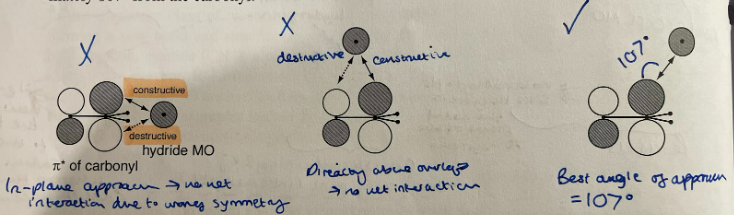
Why is the 107o angle of attack most favourable? (Burgi-Dunitz trajectory)
• In-plane approach, 180o → no net interaction due to equal degrees of constructive & destructive interference • Directly above, 90o → no net overlap for same reason • From this alone, ideal angle would be 135o to align with C=O pi* & therefore give maximum overlap • But angle is decreased to 107 by repulsion of nucleophile from electrons in filled pi bonding MO
Reactions of aldehydes/ketones with hydride • Why can’t H- directly be used to nucleophilically attack / reduce C=O? • What source of hydride is used?
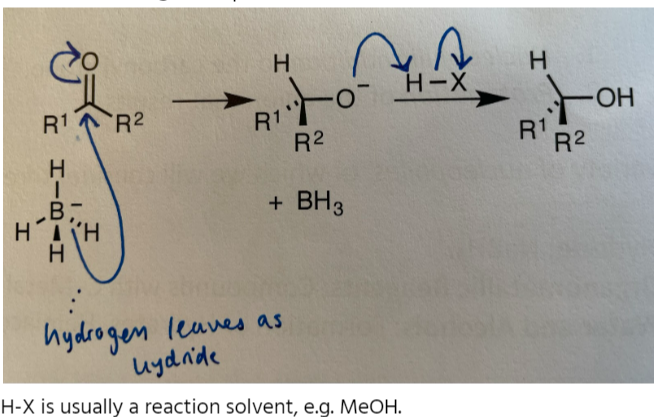
• H- acts as a base, preferentially reacting with H-X rather than C=O, because the filled H- is orbital is better-matched in size to H’s contribution to the sigma* MO in H-X than to C’s more diffuse contribution to the pi* (LUMO) of the C=O group • Source of hydride is NaBH4, sodium borohydride (rather than a metal hydride) Note: NaBH4 is ionic so it’s BH4- which attacks.
Reactions of aldehydes/ketones with hydride Draw the mechanism for the reduction of a generalised ketone by sodium borohydride.
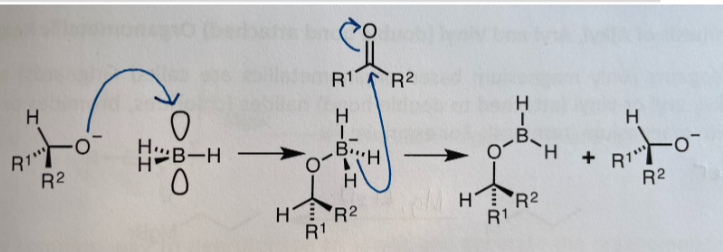
Reactions of aldehydes/ketones with hydride Explain how the BH3 produced above can cause reduction of more reagent molecules. Use a mechanism.
• BH3 is Sp2 hybridised. Has an empty p-orbital, so is a Lewis acid • Reacts rapidly with either the oxyanion intermediate or a solvent molecule → tetravalent boron anion produced • Can react again, transferring another hydride as below (could transfer all 4 Hs, but is rarely this efficient) • So reaction (in water/alcoholic solution) gives good yield
What is the functional group R-O-C-O-R? Why is it different from ethers?
Acetal Different since the lp on one O can attack into its C-O bond, then the other C-O bond breaks by attacking into its O. So acetal can cause the bond to cleave, forming R-O-, which can then be protonated etc