Bonding
No description yet. This curated deck is ready for daily study.
Card preview (17)
Ionic bonding
Ionic bonding is the electrostatic force of attraction between oppositely charged ions formed by electron transfer
covalent bond
A covalent bond is a shared pair of electrons
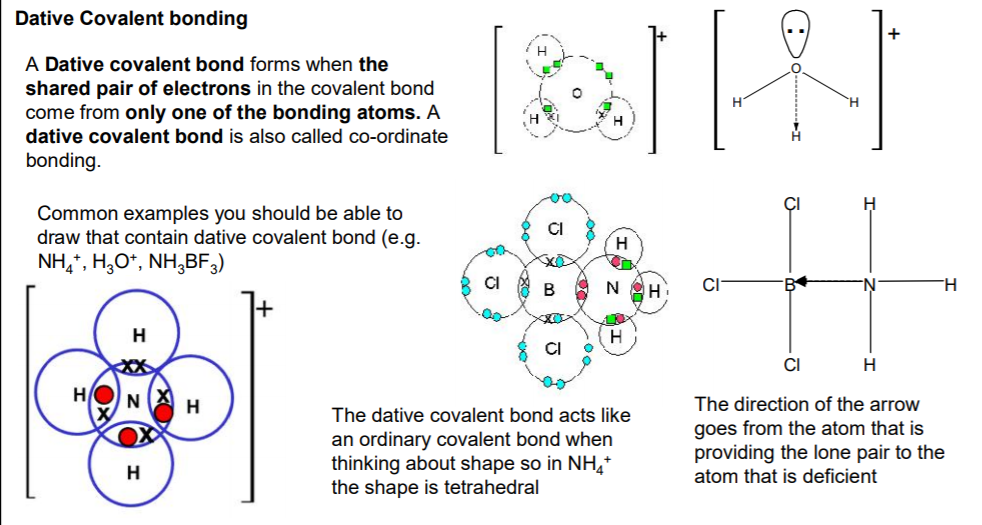
Dative Covalent bonding
A Dative covalent bond forms when the shared pair of electrons in the covalent bond come from only one of the bonding atoms. A dative covalent bond is also called co-ordinate bonding.
Draw NH4+ , H3O+ , NH3BF3
Metallic bonding
Metallic bonding is the electrostatic force of attraction between the positive metal ions and the delocalised electrons
The three main factors that affect the strength of metallic bonding are:
• A number of protons/ Strength of nuclear attraction. The more protons the stronger the bond • Number of delocalized electrons per atom (the outer shell electrons are delocalized) The more delocalized electrons the stronger the bond • Size of ion. The smaller the ion, the stronger the bond.
How to explain the shape 6
• State number of bonding pairs and lone pairs of electrons. • State that electron pairs repel and try to get as far apart as possible (or to a position of minimum repulsion.) • If there are no lone pairs state that the electron pairs repel equally • If there are lone pairs of electrons, then state that lone pairs repel more than bonding pairs. • State actual shape and bond angle. • lone pairs repel more than bonding pairs and so reduce bond angles
Electronegativity
Electronegativity is the relative tendency of an atom in a covalent bond in a molecule to attract electrons in a covalent bond to itself. Electronegativity is measured on the Pauling scale (ranges from 0 to 4) F, O, N and Cl are the most electronegative atoms The most electronegative element is fluorine and it is given a value of 4.0
Factors affecting electronegativity
Electronegativity increases across a period as the number of protons increases and the atomic radius decreases because the electrons in the same shell are pulled in more. It decreases down a group because the distance between the nucleus and the outer electrons increases and the shielding of inner shell electrons increases
Intermediate bonding
Ionic and covalent bonding are the extremes of a continuum of bonding type. Differences in electronegativity between elements can determine where a compound lies on this scale A compound containing elements of similar electronegativity and hence a small electronegativity difference will be purely covalent A compound containing elements of very different electronegativity and hence a very large electronegativity difference (> 1.7) will be ionic
Formation of a permanent dipole – (polar covalent) bond
A polar covalent bond forms when the elements in the bond have different electronegativities. (Of around 0.3 to 1.7) When a bond is a polar covalent bond it has an unequal distribution of electrons in the bond and produces a charge separation, (dipole) δ+ δ- ends.
Symmetric molecules
A symmetric molecule (all bonds identical and no lone pairs) will not be polar even if individual bonds within the molecular ARE polar The individual dipoles on the bonds ‘cancel out’ due to the symmetrical shape of the molecule. There is no NET dipole moment: the molecule is NON POLAR
Van der Waals’ Forces
These are also called transient, induced dipole-dipole interactions. They occur between all simple covalent molecules and the separate atoms in noble gases. In any molecule the electrons are moving constantly and randomly. As this happens the electron density can fluctuate and parts of the molecule become more or less negative i.e. small temporary or transient dipoles form. These instantaneous dipoles can cause dipoles to form in neighbouring molecules. These are called induced dipoles. The induced dipole is always the opposite sign to the original one
Main factor affecting size of Van der Waals
The more electrons there are in the molecule the higher the chance that temporary dipoles will form. This makes the Van der Waals stronger between the molecules and so boiling points will be greater
Permanent dipole-dipole forces
• Permanent dipole-dipole forces occurs between polar molecules • It is stronger than Van der Waals and so the compounds have higher boiling points • Polar molecules have a permanent dipole. (commonly compounds with C-Cl, C-F, C-Br H-Cl, C=O bonds) • Polar molecules are asymmetrical and have a bond where there is a significant difference in electronegativity between the atoms.
Hydrogen bonding
It occurs in compounds that have a hydrogen atom attached to one of the three most electronegative atoms of nitrogen, oxygen and fluorine, which must have an available lone pair of electrons. e.g. a –O-H -N-H F- H bond. There is a large electronegativity difference between the H and the O,N,F
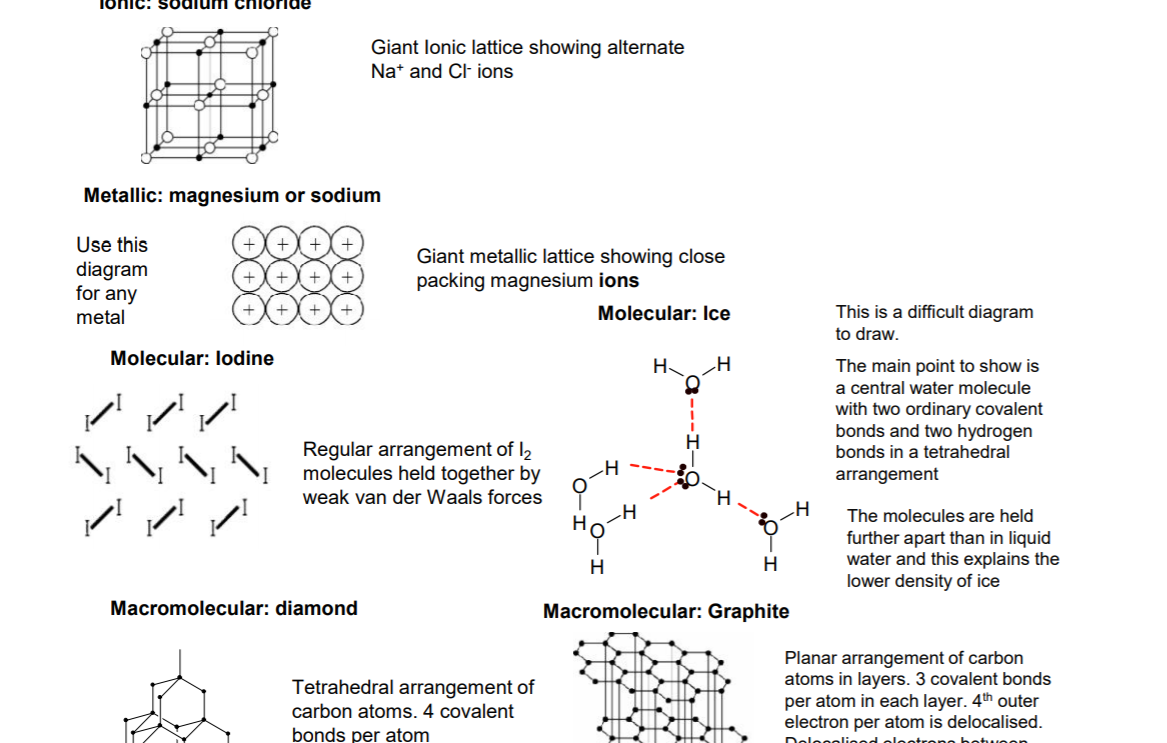
Four types of crystal structure: ionic, metallic, molecular and giant covalent (macromolecular).