Organometallic Chemistry
暂无描述。系统推荐的高质量记忆内容,适合每天坚持背诵学习。
卡片预览 (20 张)
What is Organometallic Chemistry?
An organometallic complex is one which contains, by definition, at least one metal-carbon bond (ionic or covalent, localised or delocalised) between one or more carbon atoms of an organic groups or molecule and a main group, transition, lanthanide, or actinide metal atom (or atoms)
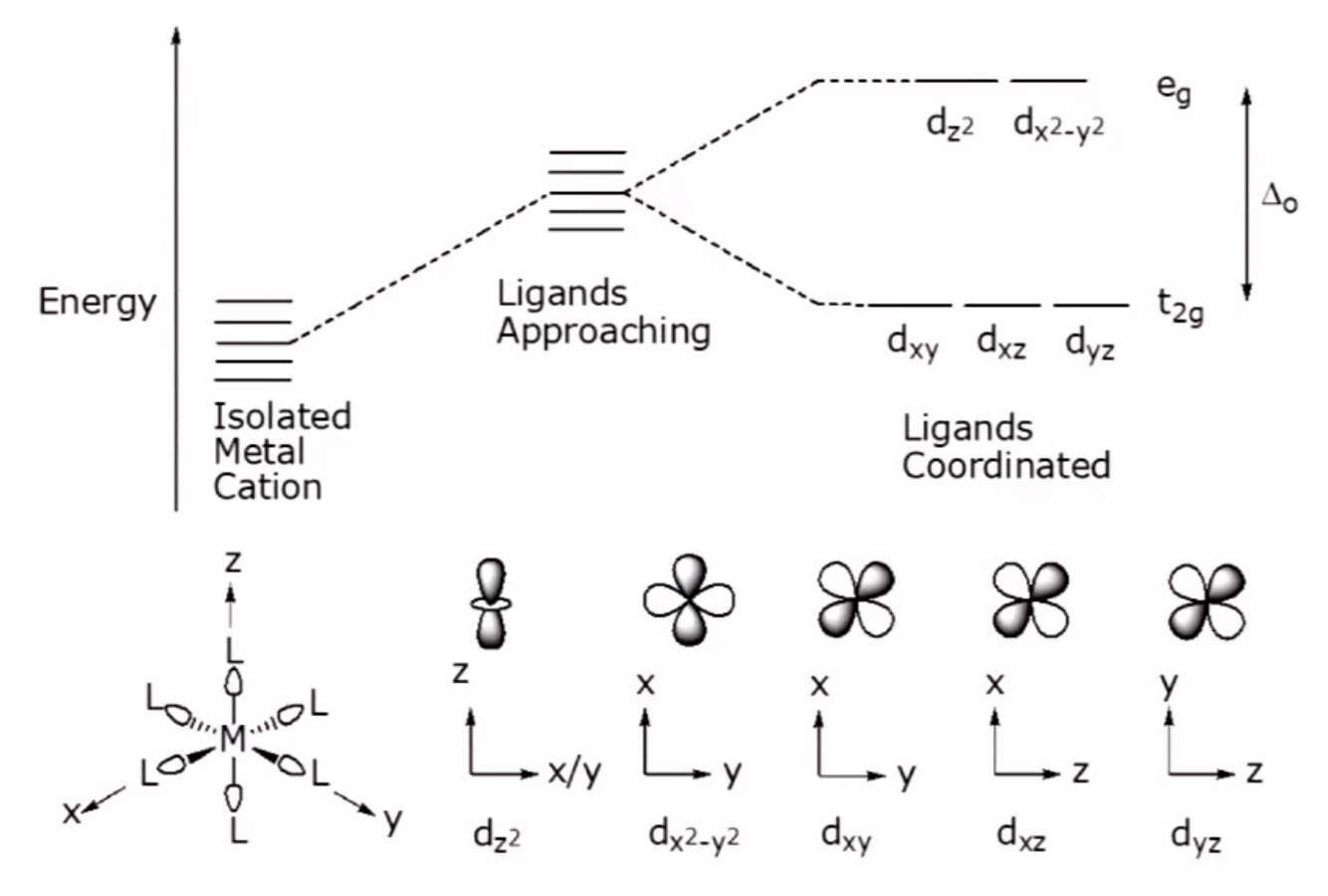
How does the formation of bond between ligands and transition metals in an octahedral complex, affect the energy of the d-orbitals within the metal
• We get this octahedron splitting pattern with a t₂g set and a eg set split by the energy of Δo • dxy, dxz and dyz are in t₂g (orbitals away from ligands = lower repulsion = lower energy) • dz² and dx²-y² are in eg (orbtials towards ligands = more repulsion = higher energy)
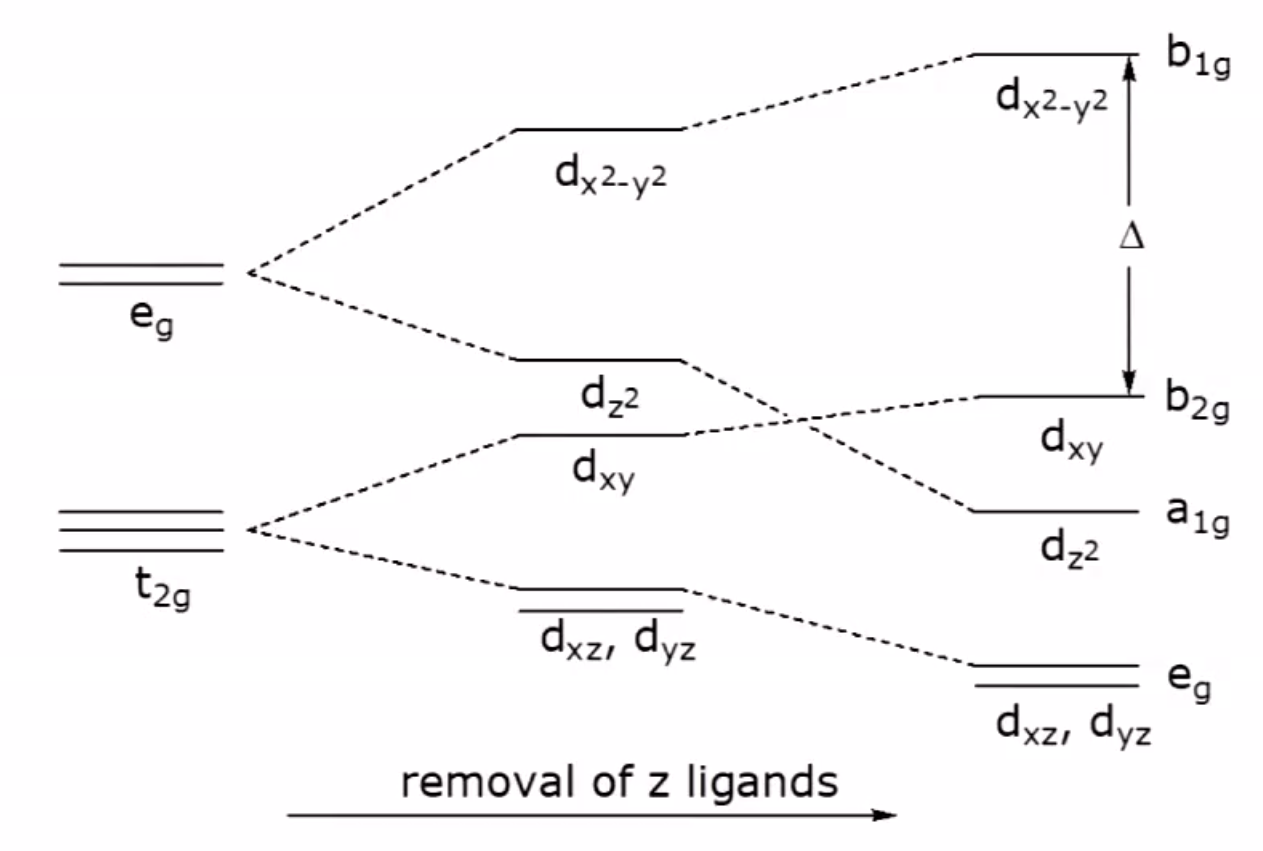
How does the formation of bond between ligands and transition metals in a square planar complex, affect the energy of the d-orbtials within the metal
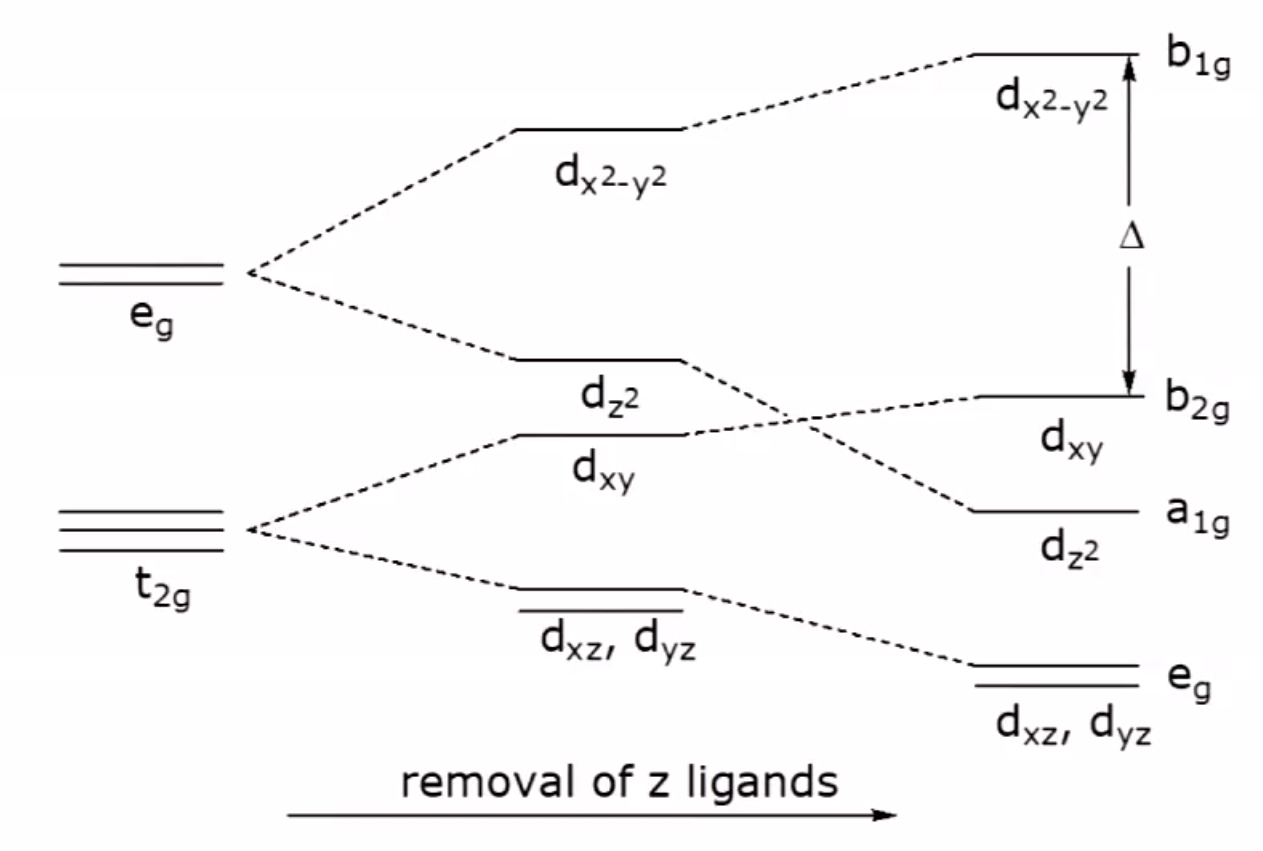
• Going from an ocethedral to a square planar complex it is essentially like the z-plane has been removed, hence the dxz and dyz orbitals are lowest in energy • Ligands in the x-y plane go up in energy, so the dx²-y² and dxy go up in energy
What is the most likely transition see in a square planar complex?
d-d transition From the dxy orbtial to the dx²-y² orbtial
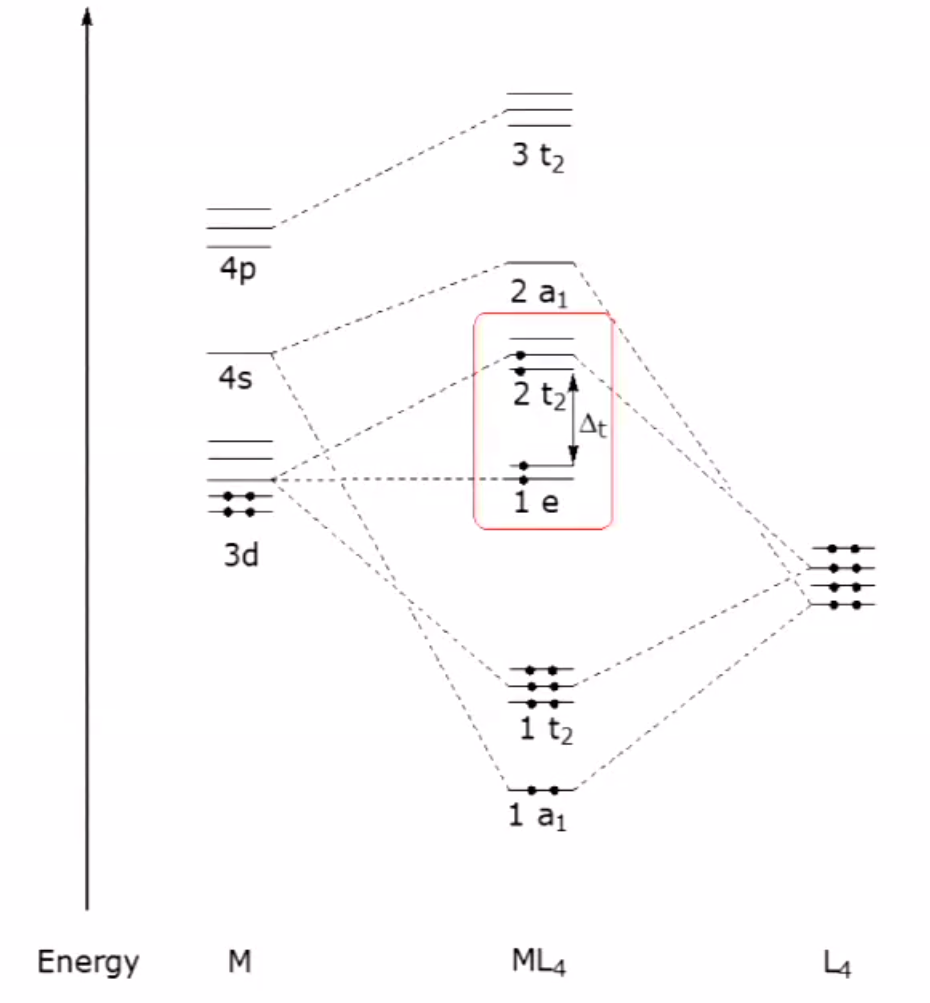
How does the formation of a bond between ligands and transition metals in a tetrahedral complex, affect the energy of the d-orbitals within the metal
• We get this tetrahedral splitting pattern with a t₂ set and a e set split by the energy of Δt • (no g because no centre of inversion) • dz² and dx²-y² are in the lower energy e set • dxy, dxz and dyz are in the higher energy t₂ set
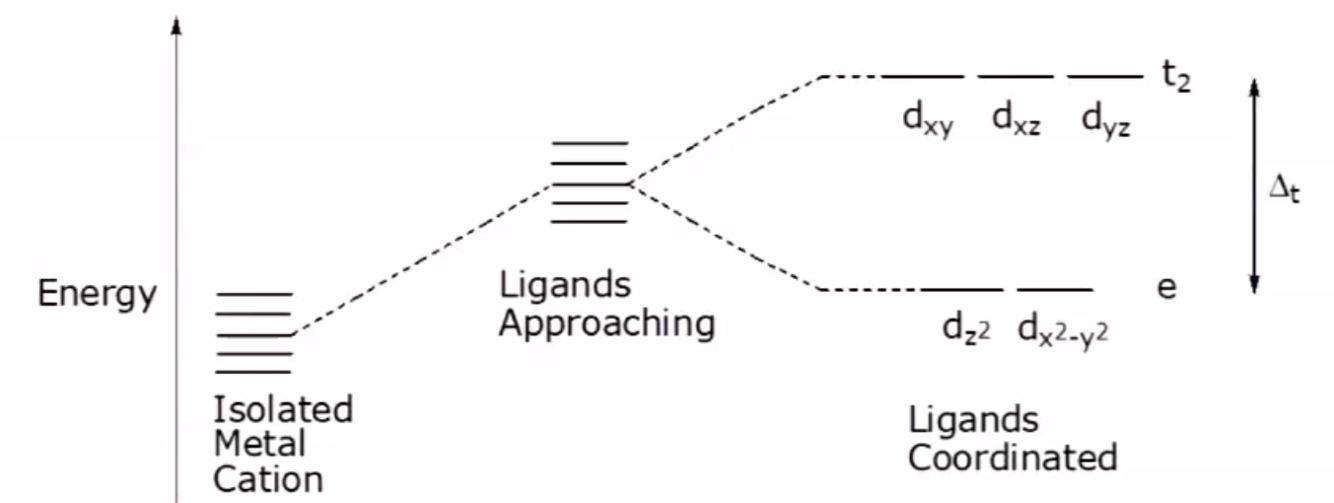
What is Δt for a transition metal complex
= 4/9 Δo
What factors affect Δ?
• Metal oxidation state - higher O.S. bigger Δ. • On moving from 3d→4d→5d = increase in Δ • Number and geometry of ligands (tetrahedral always high spin due to large Δt) • Nature of ligands - strong vs weak field ligands

What is the difference between a and b as symmetry lables
a singly degenerate, symmetric w.r.t. rotation about principal axis b singly degenerate, antisymmetric w.r.t. rotation about principal axis
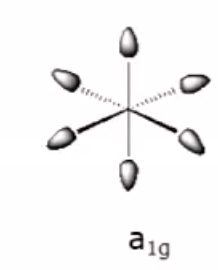
What do the symmetry lables e and t stand for
e doubly degenerate t triply degenerate
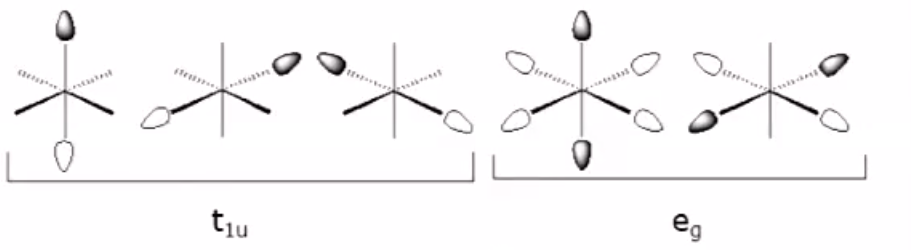
What do the symmetry lables g and u stand for?
g centre of symmetry, even with respect to inversion (gerade) u no centre of symmetry, odd with respect to nversion (ungerade)
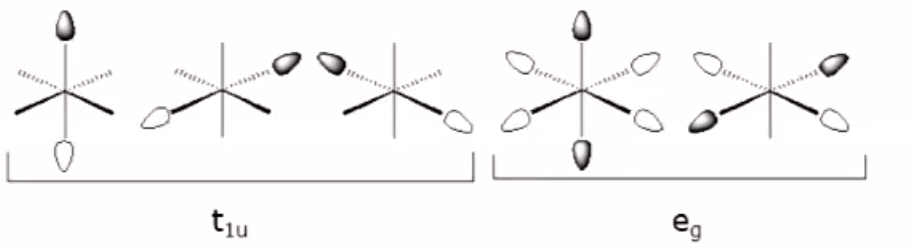
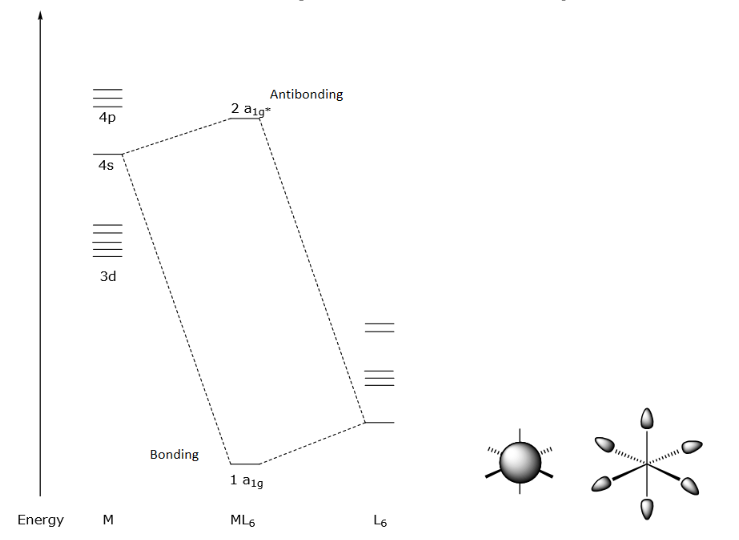
The 4s orbitals on the metal form which bonding + antibonding molecular orbitals with ligands?
1 a1g bonding MO 2 a1g’ antibonding MO
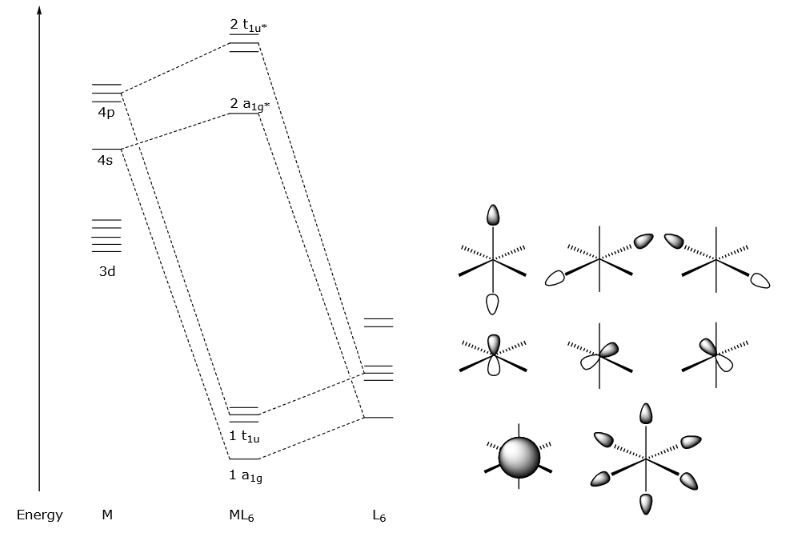
The 4p orbitals on the metal form which bonding + antibonding molecular orbitals with ligands?
1 t1u bonding MO 2 t1u’ antibonding MO
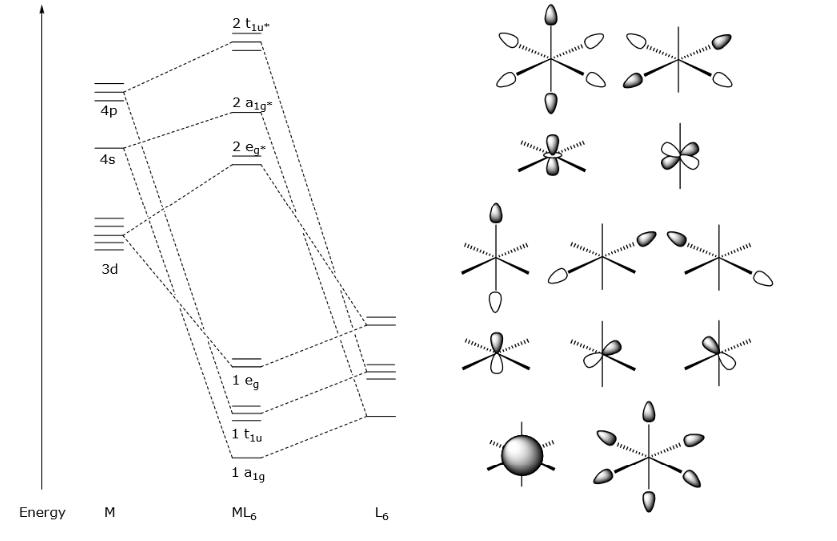
The 3d orbtials on the metal form which bonding + antibonding molecular orbitals with ligands?
1 eg bonding MO 2 eg’ antibonding MO
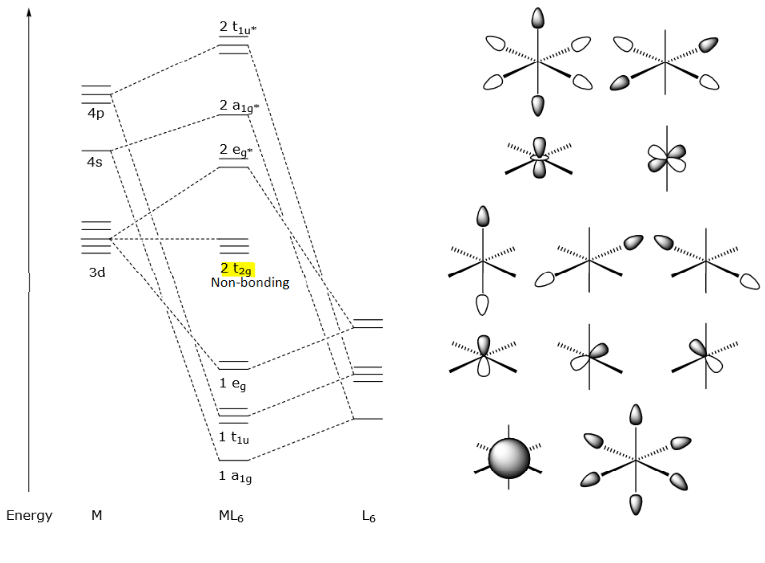
Some of the 3d orbitals on the metal form which non-bonding molecular orbitals?
2 t2g
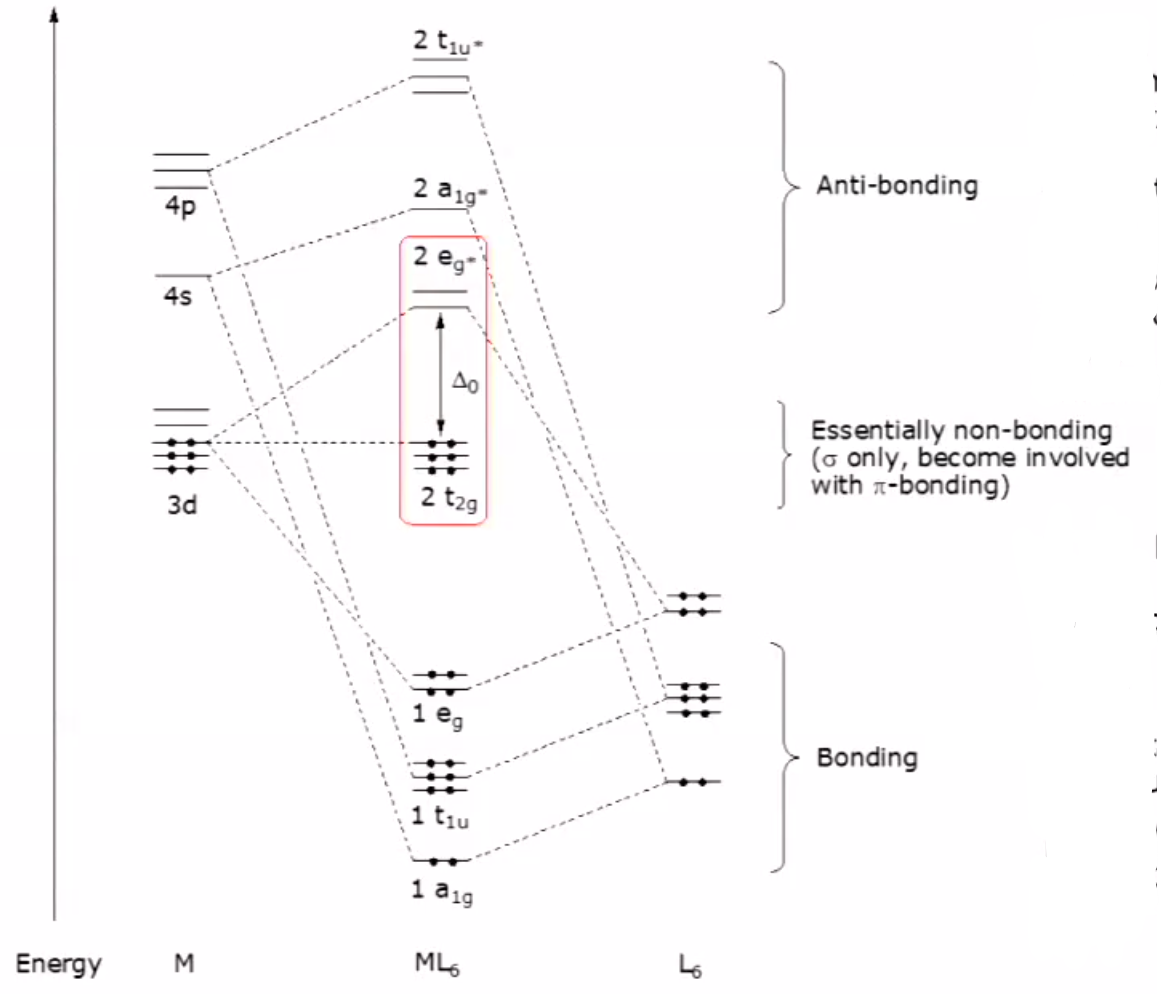
Most stable octahedral complexes have 18e- and up to which molecular orbital is filled?
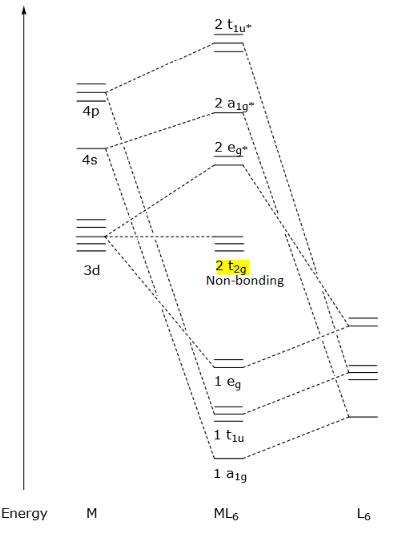
Filling up to the t2g level (dxz, dyz, dxy) A large HOMO-LUMO gap results and no antibonding orbitals are filled
The following diagram is molecular orbital theory for a square planar complex Which orbtials are the antibonding and non-bonding MOs
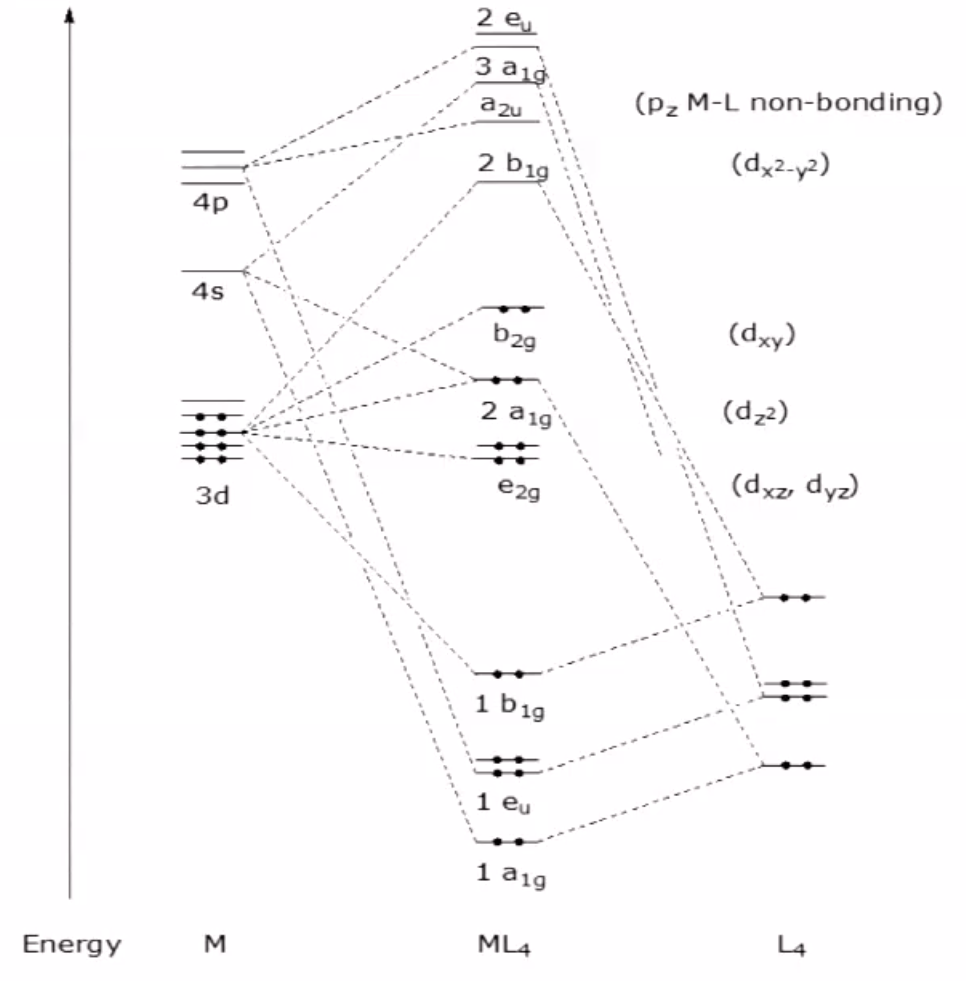
2 b1g (dx²-y²) orbital is essentially anti-bodning 2 a1g (dz²) orbital is essentially non-bonding
The square planar arrangement is frequently observed for…
group 10 M²⁺ complexes and other d⁸ metals If not d⁸ (no electronic driver) it will be tetrahedral instead
What is the HOMO for a tetrahedral complex?
the 2 t2 MO (small Δ means high spin and the 1 e and 2 t₂ are singly paired)
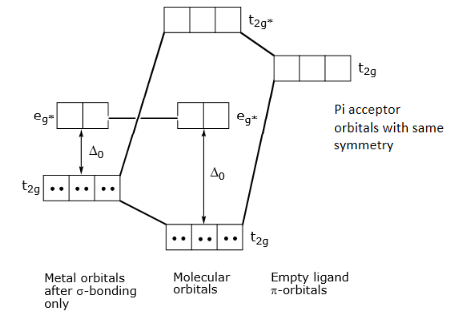
Name some π-acceptor ligands and explain how they affect Δo
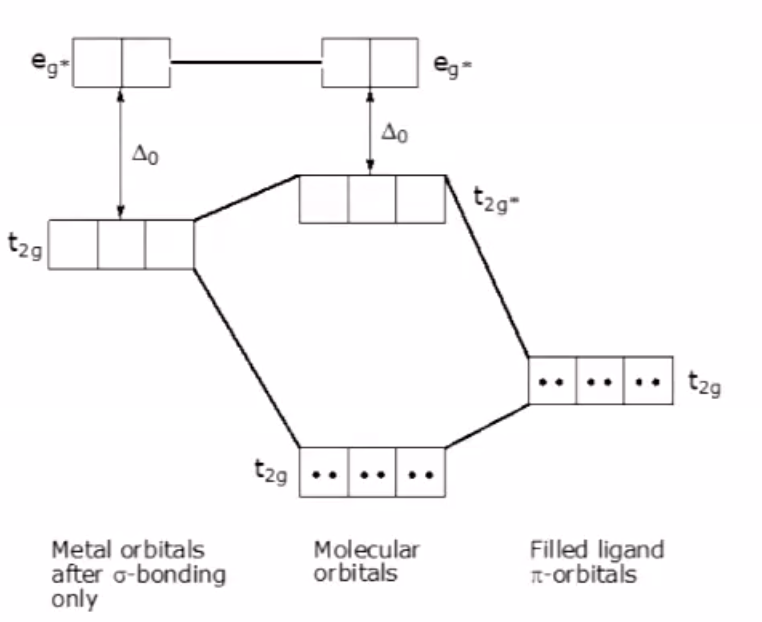
π-acceptor ligands increase Δo (electron density transferred to ligand π’ orbital so t2g orbitals are lowered in energy) e.g. CO, PR₃, CN⁻
Name some π-donor ligands and explain how they affect Δo
π-donor ligand decreases Δo (electron density transferred from ligand π orbtial, or lone pairs, so t2g set raised in energy) Weak field ligands: Cl, O, F