Module 6: Organic and Analysis
No description yet. This curated deck is ready for daily study.
Card preview (24)
General formula of an alkane
CnH2n+2
Tollen’s Reagent
Formed by reacting a basic solution of silver nitrate with ammonium hydroxide. Used to identify Aldehydes. It works because as Silver ions are reduced to elemental silver, aldehyyde is oxidised to carboxylic acid. Ketones cannot be further oxidised, so no reaction with Tollen’s.
2,4-Dinitrophenylhydrazine (Brady’s reagent)
This reacts with the carbonyl group of aldehydes and ketones to give a yellow/orange precipitate. This does not react with esters or with carboxylic acids. Precipitate is collected by filtration and purified by recrystallisation. Melting point measured to identify the aldehyde or ketone
Conditions for aromatic nitration
Mixture of of conc nitric acid in conc sulfuric acid Temperature below 50 oC (ensures only one nitro group on ring) Reflux condenser fitted to prevent loss of volatile substances
Conditions for bromination
Use elemental bromine (Br2) and a catalyst - either AlBr3 or FeBr3.
Conditions for chlorination
Conditions for Friedel-Crafts alkylation
Conditions for Friedel-Crafts acylation
Describe or draw the Kekule structure of benzene
Discuss the shortcomings of the Kekule structure of benzene
• Unlike alkenes, benzene is resistant to addition reactions • Benzene is more stable that the kekule model predicts • X-ray diffraction techniques have shown that all 6 bonds in benzene are the same length (not three shorter C=C bonds as kekule predicted)
What evidence is there for Benzene not having a Kekule structure?
Essentially there are 3 headings: • Aromatic compounds undergo electrophilic substitution (whereas alkenes undergo electrophilic addition) • C-C bond lengths in benzene are all the same length and are longer than C=C (as in alkenes) and shorter than C-C (as in alkanes). • The energy released by hydrogenation of benzene is about 150kJ less than predicted for cyclohexatriene
Draw or describe how a sigma bond forms
Draw or describe how a pi bond is formed
Explain why phenols neutralise sodium hydroxide but do not react with sodium carbonate.
Compare and explain the conditions for nitrating phenols with the conditions for nitrating benzene.
Directing effect of electron donating groups (and examples of electron donating groups)
2- 4- and 6- directing effect e.g. OH and NH2
Directing effect of electron withdrawing groups (and examples of electron withdrawing groups).
3- and 5- directing effect e.g. NO2
Describe the solubility of carboxylic acids
very soluble in polar solvents such as water. this is because hydrogen bonds can form between the carboxylic acid functional group and water
chemical properties of carboxylic acids
weak acids that partially ionise in solution releasing the H+ ion from the carboxylic acid group , forming a carboxylate ion.
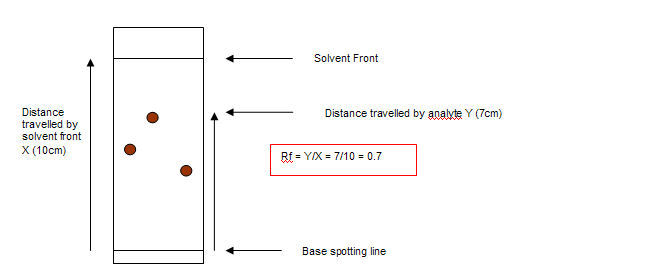
Thin Layer Chromatography (TLC)
stationary phase- thin piece of inert material e.g glass, covered with an absobent chemical Mobile phase- organic solvent Rf=distance moved by component/ distance moved by solvent
alkenes with a strong sigma bond have a 99% chance of stealing your electrophile
Gas Chromatography
Used to seperate volatile liquids Stationary Phase- The tube is coated in a liquid ( retention time depends on solubility) or a solid ( retention time depends on adsorption). Mobile phase- Inert carrier gas Results shown on a gas chromatogram, where the area under each peak is proportional to the relative amount of each component.
Retention Time
The time taken for the substance to pass through the coiled tube and reach the detector in a gas chromatogram Compared with values in a reference table to identify the substance (must ensure the conditions are the same)
NMR internal standard
Tetramethylsilane (CH3)4Si Good internal standard because: • Contains both carbon and hydrogen so can be used for both types of NMR • Produces one sharp signal as all of the hydrogen atoms are in the same environment • non-toxic • Inert so unlikely to react with the chemicals being investigated