M2 - Amount of Substance
No description yet. This curated deck is ready for daily study.
Card preview (24)
How is the molecular formula found?
Find empirical formula. Divide molar mass of a molecule by molar mass of empirical formula. Multiply empirical formula by the result.
What is the equation for the number of moles of a substance?
n=m/Mr n - number of moles (mol) m - mass (g) Mr - molar mass (g mol-1)
Define empirical formula (1)
Simplest whole number ratio of atoms
What is the percentage yield?
The actual yield divided by the theoretical yield expressed as a percentage. (actual yield / theoretical yield ) X100
What is the concentration of a solute?
The amount of solute (in moles) dissolved in each 1dm3 of solution
What is the value of gas molar volume at room temperature and pressure?
1 mole of any gas takes up 24 dm3 mol-1 at rtp
What is gas molar volume?
The volume per mole of a gas.
What are the benefits of a high atom economy?
Produce a larger proportion of desired products and few waste products. Important for sustainability, the best use of natural resources.
How is the empirical formula found?
E Element M Mass or % --- ---------------- M Molar mass A Answer (moles) ------------------------ Smallest answer R Ratio
What is atom economy?
The molar mass of desired product divided by the sum of the molar masses of all products expressed as a percentage. (mr of desired products/ mr of total products) X100
What is a titration?
A technique used to accurately measure the volume of one solution that reacts exactly with another solution.
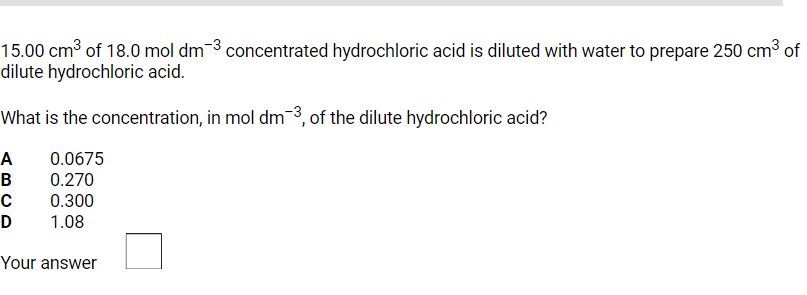
D
When can a mean titre be worked out?
When two or more concordant results are obtained.
What is relative formula mass?
The weighted mean mass of the formula unit of a compound compared with 1/12th of an atom of carbon-12
What is stoichiometry?
The balancing numbers giving the ratio of the amount, in moles, of each substance in a balanced equation.
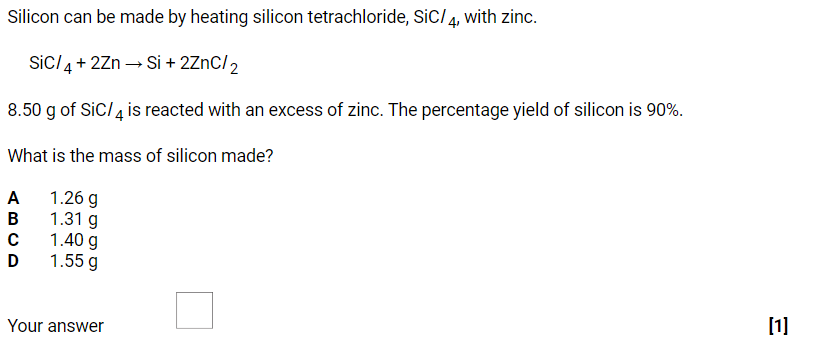
A
What is the empirical formula?
The simplest whole-number ratio of atoms of each element in a compound.
What is the equation to calculate moles of a gas at RTP?
n = v / 24 molar gas volume = 24 (dm3 mol-1) n - number of moles (mol) V - volume (dm3)
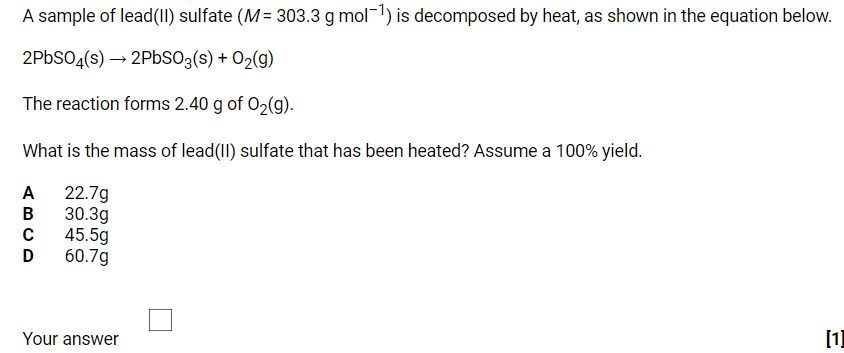
C
What are titrations used for?
Finding the concentration of a solution. Identification of unknown chemicals. Finding the purity of a substance.
What are the standard conditions for temperature and pressure?
T = 298K or 25oC P = 1atm or 100kPa 101kPa or 1 atm of pressure
What is the limiting reagent?
The reactant that is not in excess.
What is the molecular formula?
The number of atoms of each element in a molecule.
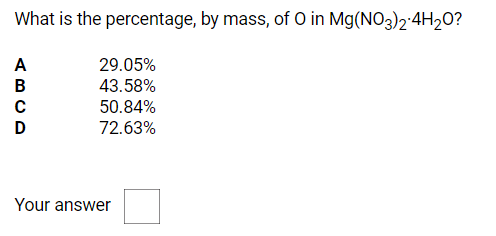
D