AQA A Level Chemistry - Energetics
No description yet. This curated deck is ready for daily study.
Card preview (24)
• What are exothermic processes?
• Energy is released from the chemical to the surroundings during the process • The temperature of the surroundings increases
• What are endothermic processes?
• Energy is taken in by the chemical from the surroundings during the process • The temperature of the surroundings decreases
• What is the definition for enthalpy change?
• Enthalpy change is the change in heat energy at constant pressure
What are the standard conditions for enthalpy change?
• 100kPa (1 atmosphere, 1 atm) pressure • 298K (25 degrees celcius) temperature • 1.0moldm-3 concentration for all solutions
• What must happen in order for a reaction to happen?
• Bonds in the reactants must first be broken • Bonds in the products must then be formed
• What type of processes are breaking and making bonds?
• Breaking bonds: requires energy - endothermic process • Making bonds: releases energy - exothermic process
• What is activation energy?
• Chemical reactions require an initial input of energy to get started. This is called the activation energy. • The activation energy is the minimum energy needed to start a reaction
• What is the definition for mean bond enthalpy?
• A mean bond enthalpy is the energy required to break one mole of covalent bonds into gaseous atoms, averaged over a range of different compounds • Mean bond enthalpies are always endothermic processes and therefore have a positive sign • This is because energy is required to break the bonds • The more positive the bond enthalpy the larger the amount of energy needed to break the bond and so the stronger the bond
• How do you calculate the enthalpy change for a type of reaction using bond enthalpies?

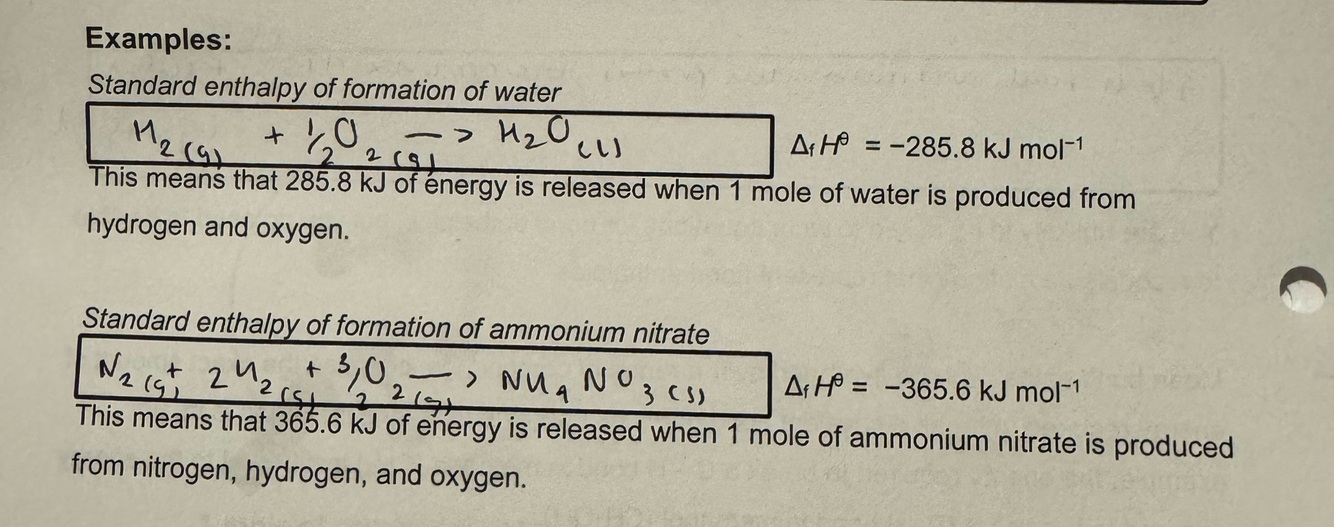
What is the definition for the standard enthalpy of formation? ΔfH
• The enthalpy change when one mole of a substance is formed from its elements under standard conditions, with all reactants and products being in their standard states Examples:
• What is the standard enthalpy of formation of all elements in their standard states?
• The standard enthalpy of formation of all elements in their standard states is zero
• State why the enthalpy of formation of Na(s) is zero
• Because Na is an element in its standard state
• State why the enthalpy of formation of liquid Na is not zero
• Because Na (l) is not the standard state of Na
• What is the definition for the standard enthalpy of combustion? ΔHc°.
• The enthalpy change when one mole of a substance is completely burnt in excess oxygen under standard conditions, all reactants and products being in their standard states • Substances that cannot be combusted like water, carbon dioxide and most other oxides, have zero enthalpy of combustion
• Why may the enthalpy of combustion of a compound be difficult to measure?
• Incomplete combustion may occur (less exothermic than expected)
• What is Hess’ Law?
• Hess’ Law states that the enthalpy change for a chemical reaction is the same, whatever route is taken from reactants to products • The enthalpy change for a chemical reaction is independent of the route taken
• How to determine enthalpy change of a reaction using calorimetry
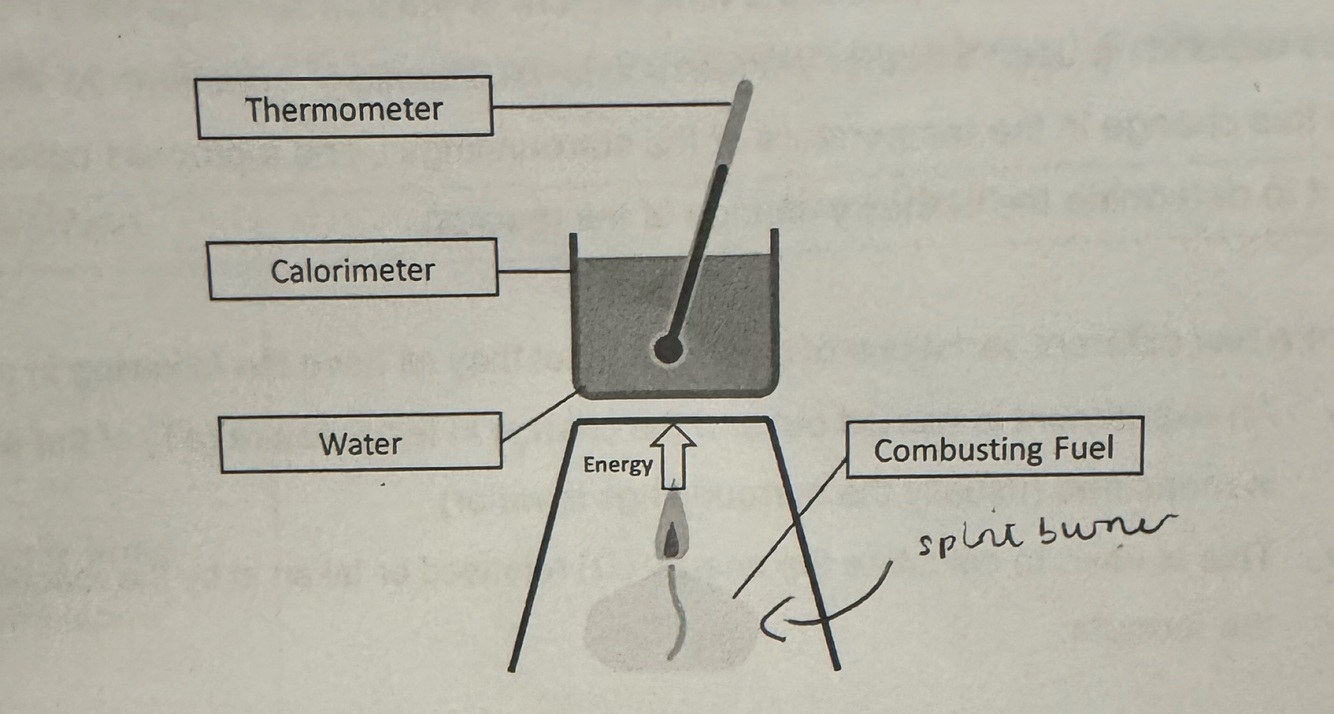
• Q = mc🔺T • Q = heat energy released/taken in, units = Joules (J) • M = mass of a solution/liquid that changes temperature, units = grams • c = specific heat capacity (for water), normally 41.18jK-1mol-1 • 🔺T = change in temperature, units = Kelvin or degrees C. Change in Kelvin = change in degrees C • 🔺H = Q/n • 🔺H = enthalpy change, units = kJmol-1 • Q = energy taken in/released, units = kJ • n = moles of substance that causes 🔺J, units = mol
• Calorimetry Type 1: Combustion Reactions
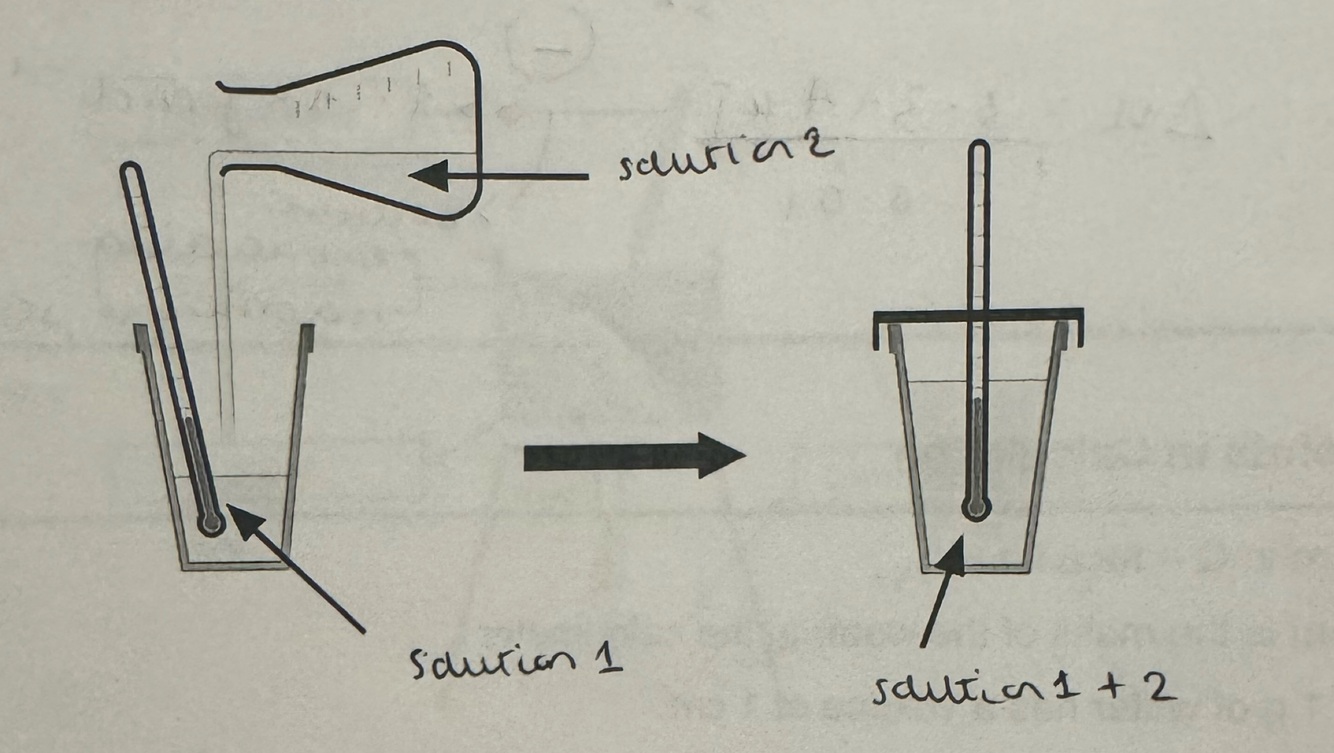
• Calorimetry type 2 - Two Solutions Reacting
• For two solutions reacting together, add the volumes of both solutions together for the mass • Only use 1 set of moles for 🔺H = Q/n - when the moles are different, always use the limiting reagent
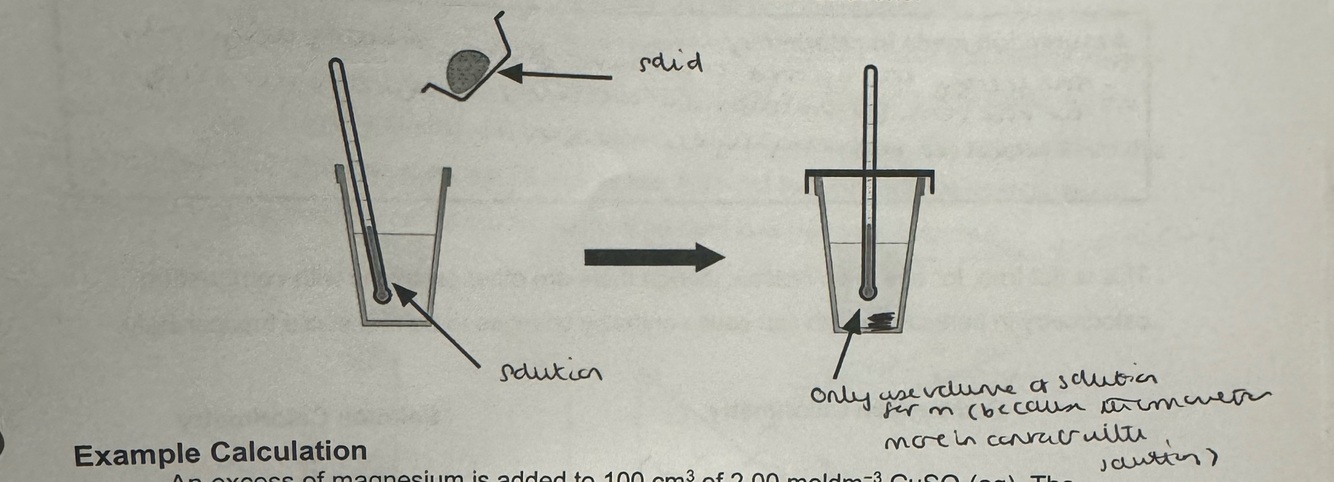
• Calorimetry type 3 - adding a solid to a solution (ie adding a metal to acid)
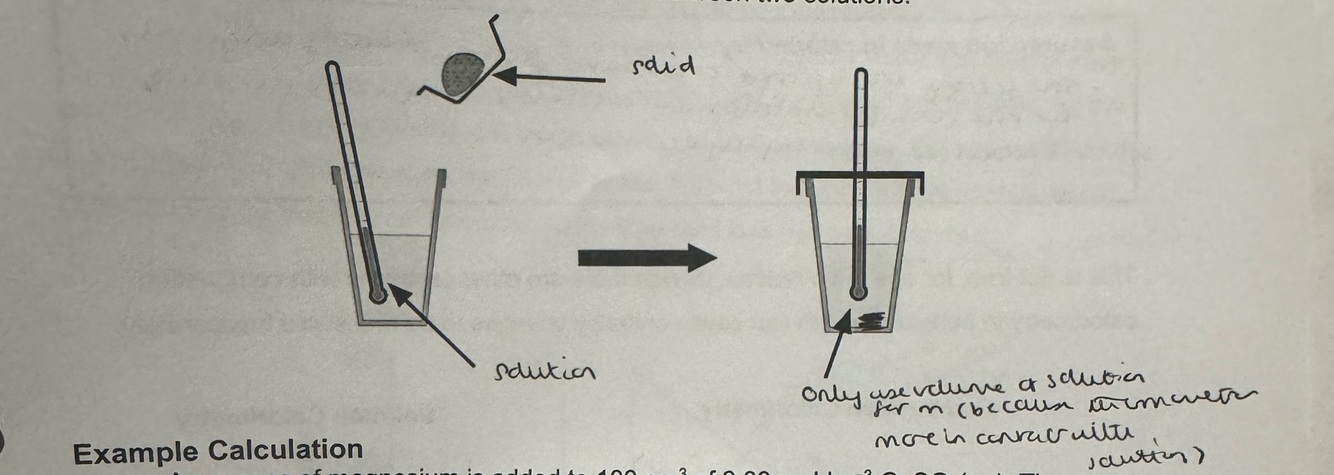
• Only use the volume of the solution for the mass, because the thermometer is more in contact with the solution • Use the moles of the limiting reagent
• Calorimetry type 3 - adding a solid to a solution (ie adding a metal to acid)
• Onlt use the volume of the solution for the mass, because the thermometer is more in contact with the solution • Use the moles of the limiting reagent for 🔺H = Q/n
• What is the assumption that is made in Calorimetry?
• The assumption that is made in Calorimetry is that the energy transferred to the water from the reacting chemicals (or vice versa for endothermic reactions) is equal to the energy released (or taken in) by the reaction
• What are the sources of error in combustion Calorimetry and what are the improvements to minimise the sources of error?
• Sources of error: • Heat loss to the surroundings • Incomplete combustion of the fuel • Heat energy transferred to the metal calorimeter • Some fuel evaporates • Improvements to minimise sources of error: • Add a lid - reduces heat loss • Insulate sides of calorimeter - reduces heat loss • Reduce distance between flame and beaker - reduces heat loss • Put sleeve around flame to protect it from droughts (bomb calorimeter)
• What are the sources of error in solution calorimetry and what are the improvements to minimise the sources of error?
• Sources of error: • Heat loss to the surroundings • Sometimes incomplete combustion takes place • Improvements to minimise sources of error: • Add a lid - reduces heat loss • Insulate calorimeter - reduces heat loss