Chapter 26 Carbonyls
No description yet. This curated deck is ready for daily study.
Card preview (20)
What are carbonyls ? how is the double bond formed
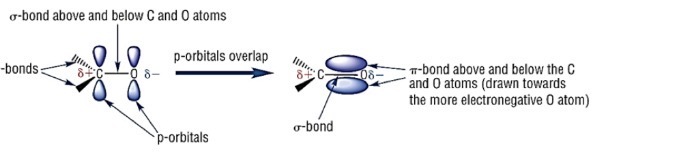
• The carbonyl functional group is a C=O double bond • the double bond is formed by the side-on overlap of p-orbital electrons forming a pi bond above the atoms
How are aldehydes and ketones reduced ?
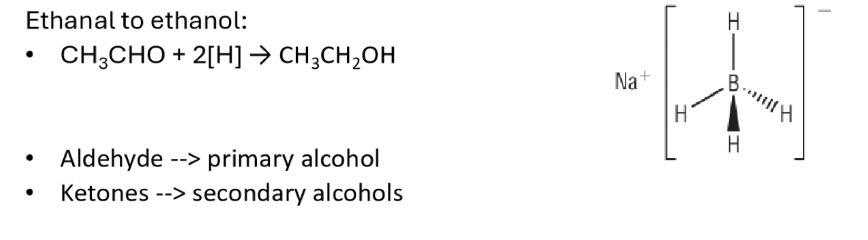
• they can be reduced to their respective alcohols • warm sodium tetrahydridoborate NaBH4 is the reducing agent
What is the mechanism for nucleophilic addition ? reduction of carbonyl
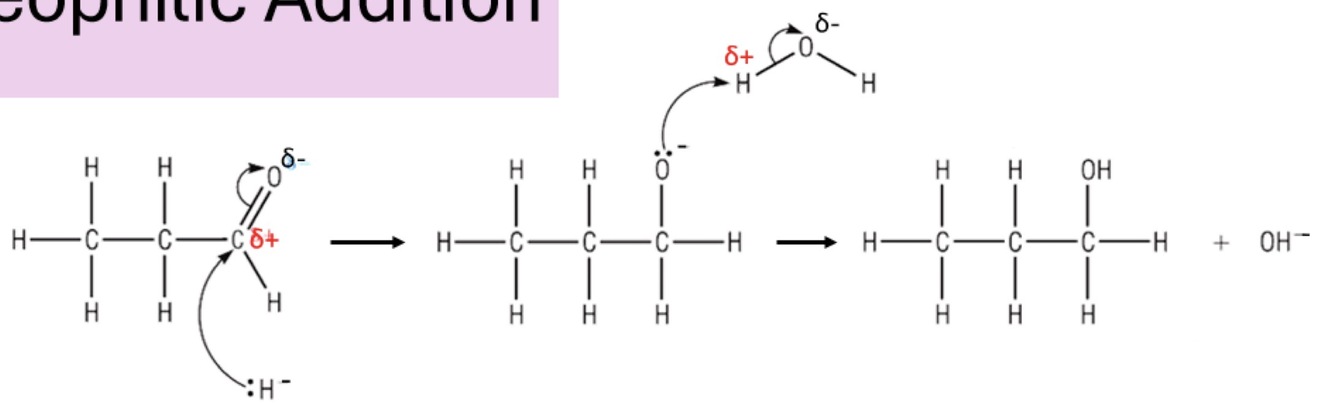
• NaBH4 releases a hydride ion (H-), which acts as a nucleophile and attacks the electron deficient carbon atom on the C=O double bond • the H- donates a pair of electrons forming a dative bond • the pi bond in the carbonyl breaks • the intermediate anion donates a pair of electrons to a hydrogen in a water molecule, forming a bond, at the same time the OH bond breaks (the anion can also donate a pair of electrons to H+ in acid) • forming the respective alcohol and a OH- ion
What is the reaction for the formation of a nitrile ?
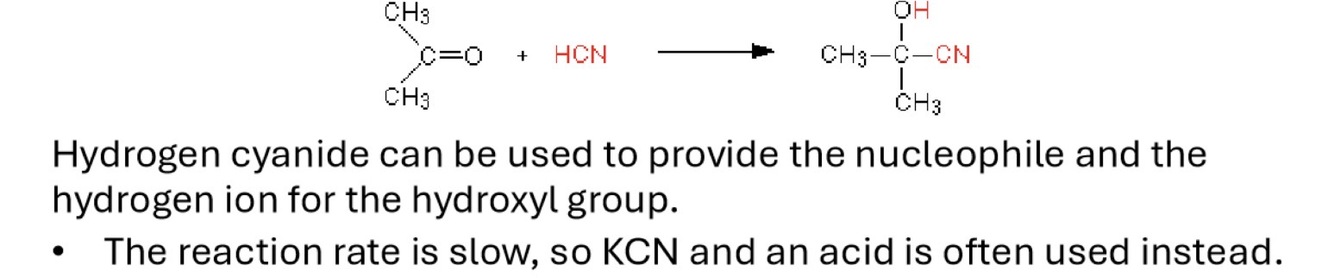
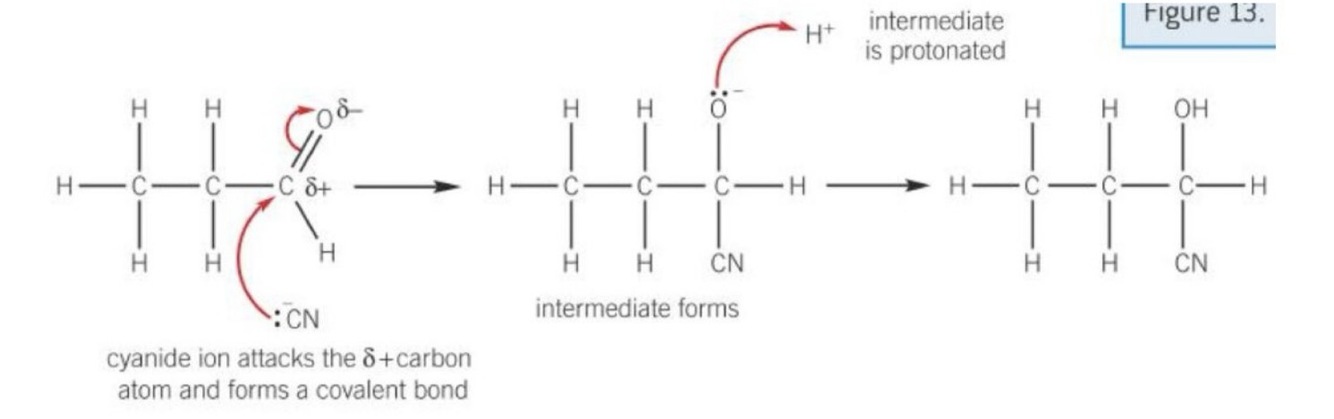
What is the mechanism for the formation of a nitrile from a carbonyl ?
• similar to reduction of carbonyl
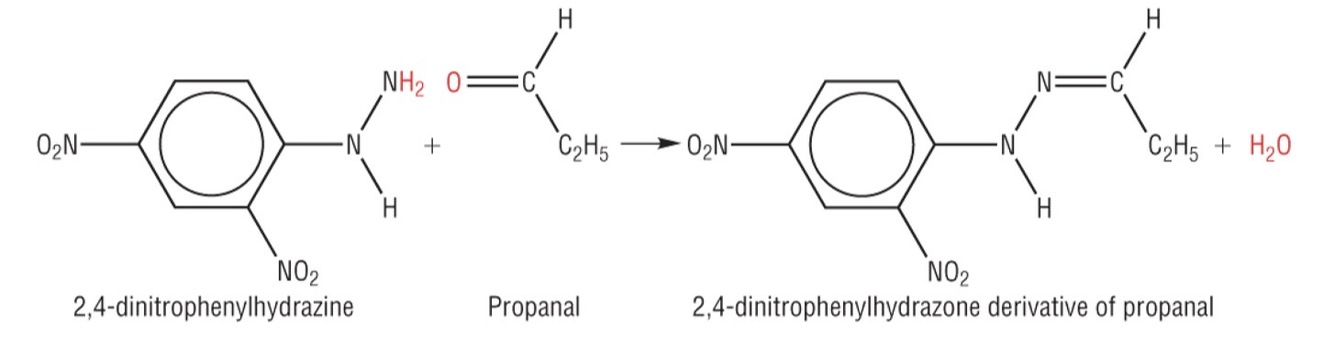
How to identify carbonyls ?
• Brady’s reagent - a solution of 2,4-dinitrophenylhydrazine (2,4-DPN/H) in a mixture of methanol and H2SO4, has a pale orange colour • a positive result for a carbonyl is a yellow/orange precipitate forming
How is tollens reagent made ?
• tollens reagent - a solution of AgNO3 and NH3
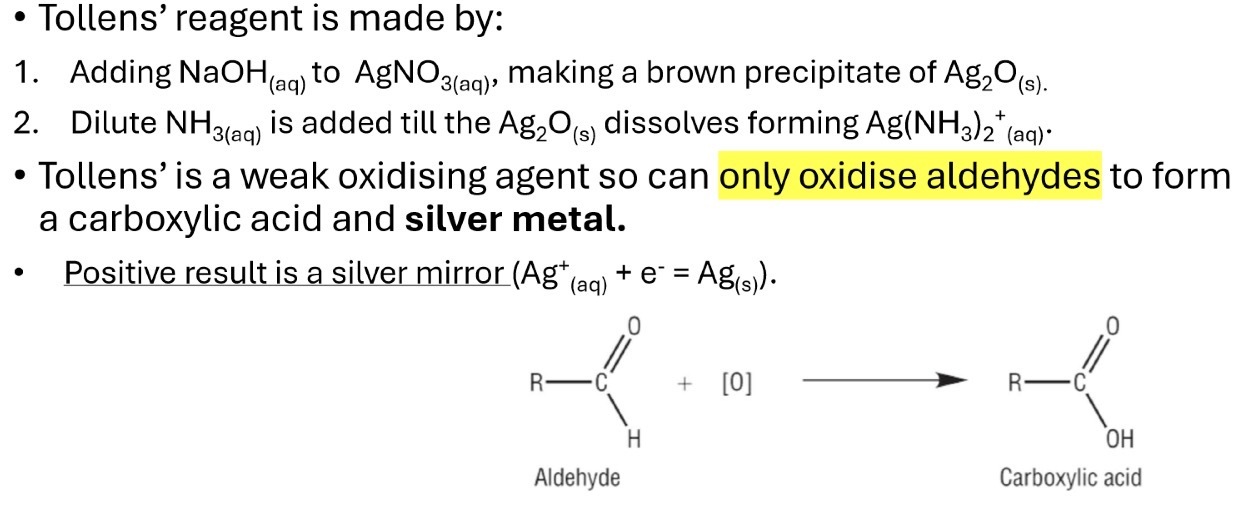
What is a positive result for the test for aldehydes ?
• tollens reagent is a weak oxidising agent so can only oxidise aldehydes to form a carboxylic acid and silver metal • a positive test result for aldehyde is the formation of a silver mirror, Ag+ has been reduced to Ag and aldehyde has been oxidised to a carboxylic acid
How to identify a ketone ?
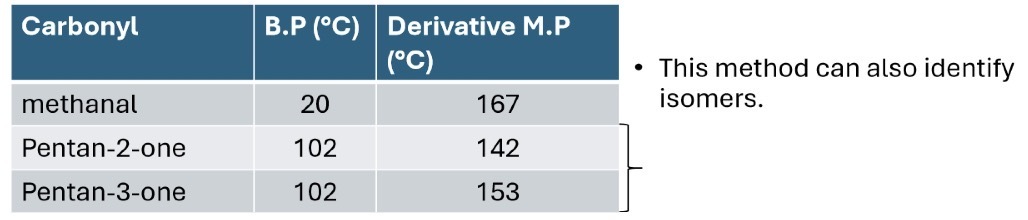
• the yellow/orange precipitate (2,4-dinitrophenyldrazone derivative) is purified by recrystallisation • melting point apparatus is then used to determine the identity of 2,4-DNP derivative
What are the properties of carboxylic acids (bonding) ?
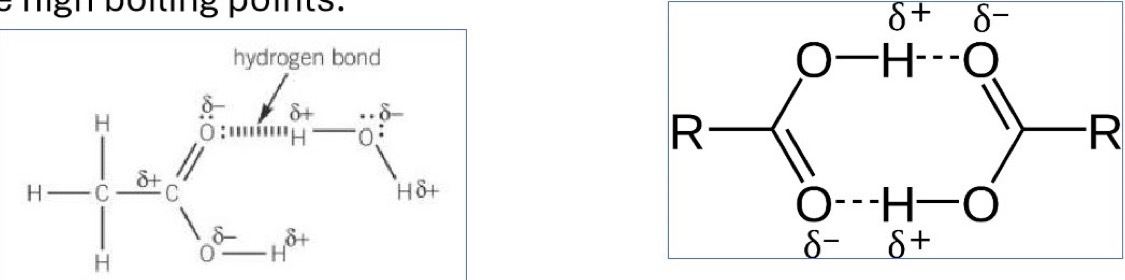
• the OH group is polar, meaning CA experience dipole-dipole interactions as well as being able to form H-bonds, so have high boiling points • the H-bonds allows CA’s to dissolve in water, however CA’s with more than 4 carbons are insoluble in water • in the absence of water CA’s can form H-bonds with each other to form dimers
What are the properties of carboxylic acids (weak acid) ?
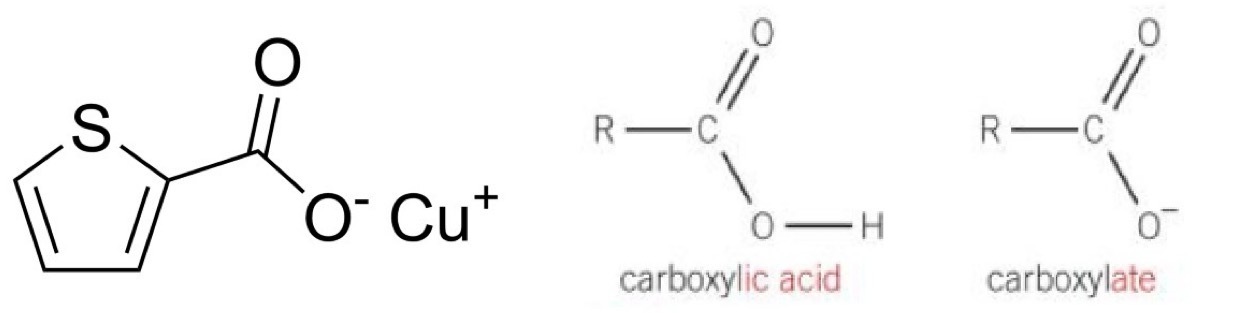
• CA’s are able to partially dissociate the H from the OH bond so acts as a weak acid • the remaining compound forms a negative ion, carboxylate
What reactions can carboxylic acids undergo ?
What is a carboxylic acid derivative ?
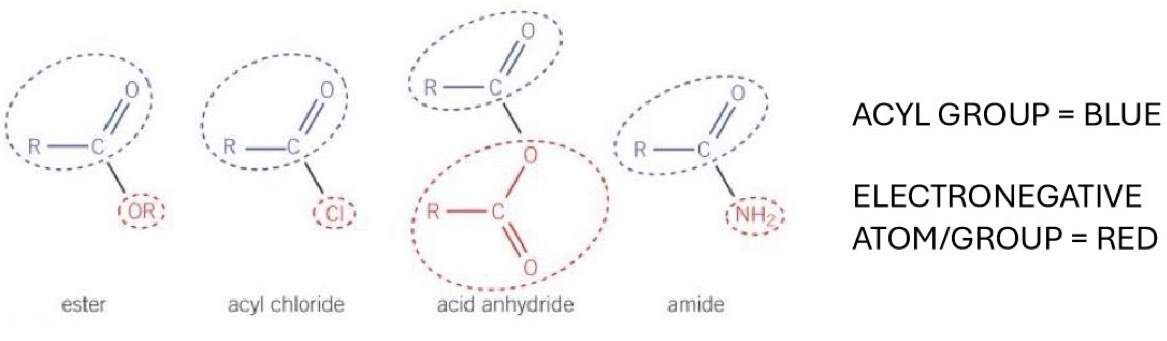
• a CA derivative is a compound which can be hydrolysed to form the parent CA • e.g esters, acyl halides, acid anhydrides, amides
What are esters ?
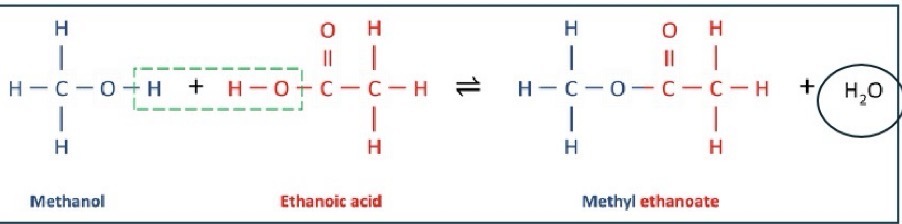
• Esters contain the functional group COO (ester linkage) • formed by reacting alcohol and CA in the presence of conc H2SO4, called condensation/esterification • naming: alcohol becomes suffix CA is suffix
What is ester hydrolysis (acidic) ?
• Ester is heated under reflux with concentrated aqueous acid (for water) • ester is broken down by water with the acid acting as a catalyst

What is ester hydrolysis (alkaline) ?
• a process called saponification and irreversible • this happens when refluxing an ester under alkaline conditions (NaOH) to form an alcohol and a carboxylate salt
How to make acyl halides from CA’s ?
• react CA with SOX2 (thionyl halide) • acyl halides and SOX2 react with water so the reaction must be carried out in anhydrous conditions • the 2 gasses that evolve are harmful so done in a fume hood

What reactions can acyl chlorides undergo ?
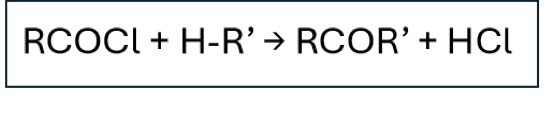
• they react via elimination reactions where the Cl is eliminated for another nucleophile • water = CA • alcohols/phenols = esters • ammonia/amine = amide • all these reactions are irreversible
What are acid anhydrides ?
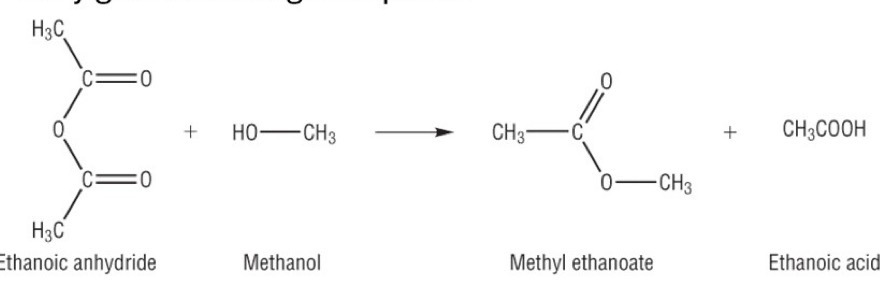
• acid anhydrides are dehydrated CA’S • 2 CAs combine

What reactions can acid anhydrides undergo ?
• acid anhydrides react with alcohols/phenols to form esters • only gentle heating is required