AQA A Level Chemistry Group 2 (Inorganic)
No description yet. This curated deck is ready for daily study.
Card preview (21)
What is the trend in atomic radius for the Group 2 elements?
• Atomic radius increases down the group • As one goes down the group, the atoms have more shells of electrons making the atom bigger
What is the trend in Melting Points for the Group 2 Elements?
• Melting points decrease down the group. The metallic bonding weakens as the atomic size increases. The distance between the positive ions and delocalised electrons increases. Therefore the electrostatic attractive forces between the positive ions and the delocalised electrons weaken.
• What is the trend in 1st ionisation energy for the group 2 elements?
• The outermost electrons are held more weakly because they are successively further from the nucleus in additional shells • In addition, the outer shell electrons become more shielded from the attraction of the nucleus by the repulsive force of inner shell electrons • Both of these make it easier to remove the outer electron and so less energy is needed to remove the outer electron
• What are the reactions of the group 2 elements with oxygen?
• The reactivity of the group 2 metals increases down the group • The group 2 metals will burn in oxygen • Mg burns with a bright white flame • The MgO appears as a white powder • 2Mg + O2 -> 2 MgO • MgO IS A WHITE SOLID WITH A HIGH MELTING POINT DUE TO ITS IONIC BONDING • Magnesium will also react slowly in oxygen without a flame • Magnesium ribbon will often have a thin layer of magnesium oxide on it formed by the reaction with oxygen in the air • 2Mg + O2 -> 2 MgO • The magnesium oxide needs to be removed by emery paper before doing reactions with magnesium ribbon • If testing for reaction rates with Mg and acid, an un-cleaned Mg ribbon would give a false result because both the Mg and MgO would react but at different rates. • Mg + 2 HCl -> MgCl2 + H2 MgO + 2 HCl -> MgCl2 + H2O
• What are the reactions of magnesium with water?
• Magnesium reacts in steam to produce magnesium oxide and hydrogen. The Mg would burn with a bright white flame. The MgO appears as a white powder. • Mg(s) + H2O(g) -> MgO(s) + H2(g) • Magnesium will also react with warm water, giving a different magnesium hydroxide product • Mg + 2H2O -> Mg(OH)2 + H2 • THIS IS A MUCH SLOWER REACTION THAN THE REACTION WITH STEAM AND THERE IS NO FLAME • The other group 2 metals will react with cold water with increasing vigour down the group to form hydroxides • Ca + 2H2O (l) -> Ca(OH)2 (aq) + H2 (g) • Sr + 2H2O (l) -> Sr(OH)2 (aq) + H2 (g) • Ba + 2H2O (l) -> Ba(OH)2 (aq) + H2 (g) • The hydroxides produced make the water alkaline (if they are soluble in water) • One would observe: fizzing (more vigorous down the group), the metal dissolving (faster down the group), the solution heating up (more down the group), with calcium a white precipitate appearing (less precipitate forms down group with other metals)
• Using Magnesium to extract Titanium
• Titanium is a very useful metal because it is abundant, has a low density and is corrosion resistant - it is used for making strong, light alloys for use in aircraft • Titanium is extracted by reaction with a more reactive metal eg Magnesium
• Why can titanium not be extracted with carbon or by electrolysis?
• Titanium cannot be extracted with carbon because titanium carbide (TiC) is formed rather than titanium • Titanium cannot be extracted by electrolysis because it has to be very pure
• What are the steps in extracting titanium?
1) TiO2 (solid) is converted to TiCl4 (liquid) at 900 degrees c - TiO2 + 2Cl2 + 2C -> TiCl4 + 2CO 2) The TiCl4 is purified by fractional distillation in an argon atmosphere 3) The Ti is extracted by Mg in an argon atmosphere at 500 degrees C - TiCl4 + 2Mg -> Ti + 2MgCl2
• Why is TiO2 converted to TiCl4?
• TiO2 is converted to TiCl4 as it can be purified by fractional distillation, TiCl4 being molecular (liquid at room temperature) rather than ionic like TiO2 (solid at room temperature
• Why is Titanium expensive?
• Titanium is expensive because: • The cost of magnesium is expensive • This is batch process which makes it expensive because the process is slower (having to fill up and empty reactors takes time) and requires more labour and the energy is lost when the reactor is cooled down after stopping • The process is also expensive due to the argon, and the need to remove moisture (because TiCl4 is susceptible to hydrolysis) • High temperatures are required in both steps • This all makes titanium expensive even though it is a relatively abundant metal • It is only therefore used to a limited amount even though it has useful properties
• This question is about the elements in Group 2. Explain why the third ionisation energy of beryllium is much higher than the second ionisation energy of beryllium. (3)
• Electron is removed from 1s rather than 2s • 1s is lower in energy than 2s/ has no shielding/ is closer to the nucleus • Stronger attraction between nucleus and outer electron
• The reaction of calcium with water is a redox reaction. Explain in terms of oxidation states why this reaction involves both oxidation and reduction (2)
• Oxidation state of Ca increases from 0 to +2, so Ca is oxidised • Oxidation state of H decreases from +1 to 0, so H is reduced
• As tudy is provided with separate unlabelled samples of four different solutions The four solutions are known to be ammonium nitrate, potassium sulfate, sodium carbonate and magnesium nitrate, but the student does not know which sample is which. Outline a series of test-tube reactions that the student can use to identify each of these solutions. Include: • the expected observations • ionic equations for any reactions (6)
• Magnesium nitrate: • Add NaOH • Mg2+ will give a white precipitate with NaOH • Mg2+ + 2OH- -> Mg(OH)2 • Ammonium nitrate: • Add NaOH and warm then hold damp red litmus paper at mouth of test tube • Red litmus paper at mouth of test tube will turn blue for NH4+ • NH4+ + OH- -> NH3 + H2O • Sodium carbonate: • Add nitric acid/hydrochloric acid • CO32- /Na2CO3 will effervescence with acid • The gas formed turns limewater cloudy • CO32- + 2H+ -> CO2 + H2O • Potassium sulfate: • Add acidified BaCl2 • SO42- will give a white precipitate with BaCl2 • SO42- + Ba2+ -> BaSO4 • If only three tests have been done, the final tube will be the remaining solution
• What is the equation for the reaction between strontium hydroxide and hydrochloric acid
• Sr(OH)2 + 2 HCl -> SrCl2 + 2H2O
• This question is about the elements in group 2. Describe the structure and bonding in magnesium (2)
• Giant lattice of Mg2+ cations • Strong electrostatic attraction between Mg2+ ions and delocalised electrons
• State the trend in the atomic radius of the elements down Group 2 from Mg to Ba. Give a reason for this trend. (2)
• Trend: Increases • Reason: The number of electron energy levels/electron shells increases
• This question is about ionisation energies of the group 2 elements. Explain why the first ionisation energy of the group 2 elements decreases down the group. (2)
• The outer electron is in a higher energy level/there is an increase in shielding • So there is a weaker attraction between the nucleus and the outer electron
Explain why the third ionisation energy of magnesium is much higher than the second ionisation energy of magnesium (2)
• The electron is removed from the 2 p sub shell/lower energy level/sub shell that is closer to the nucleus • The electron being removed is less shielded
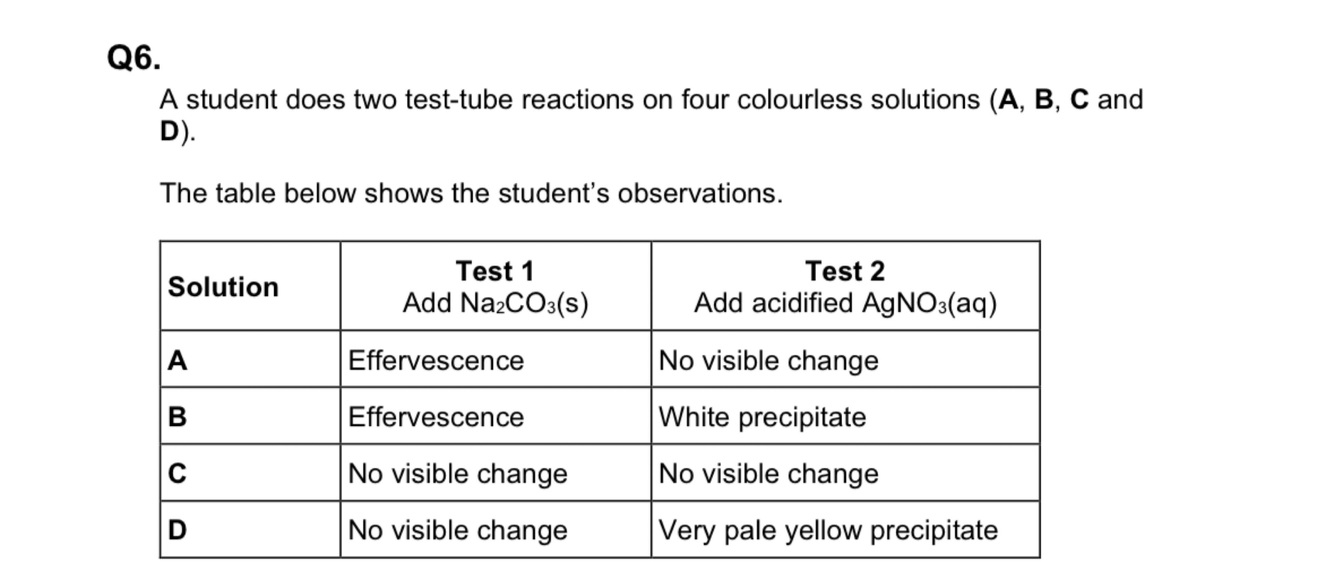
• Identify the gas formed in test 1. Describe a further test to confirm the identity of this gas (2)
• Identity of gas: CO2 • Test: When the gas is bubbled through limewater it turns milky/cloudy / a white precipitate is formed
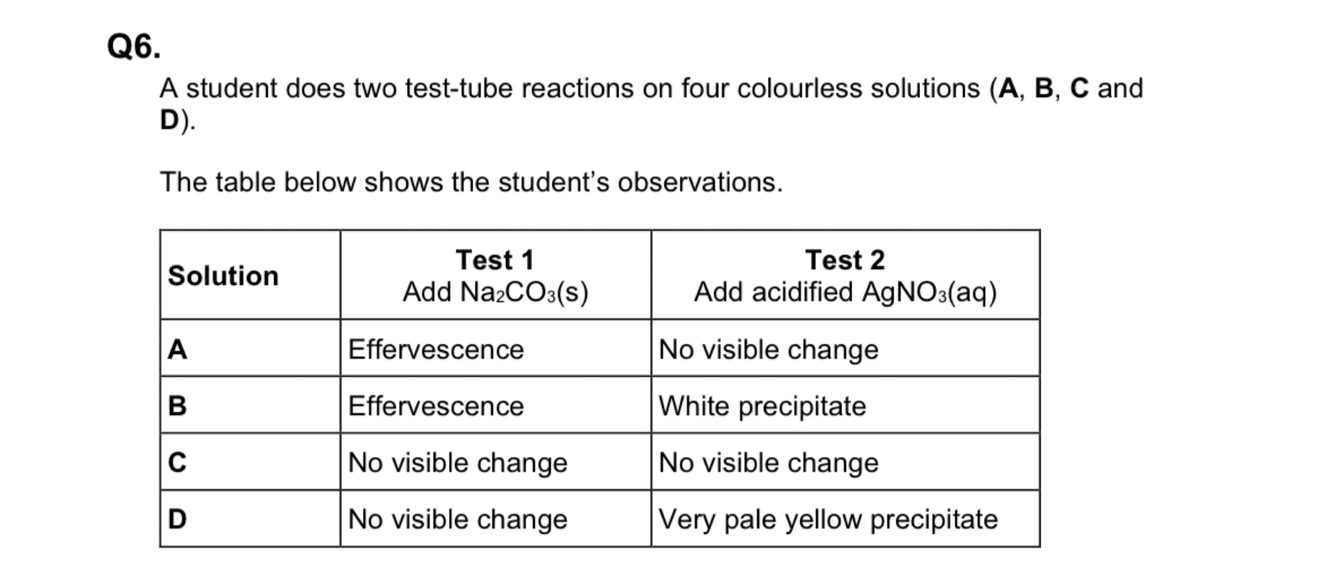
• Explain how the observation from Test 1 and Test 2 can be used to show that solution B contains hydrochloric acid (2)
• Effervescence with Na2CO3, so contains H+ ions • Effervescence with Na2CO3, so is acidic • White precipitate with AgNO3, so contains chloride ions
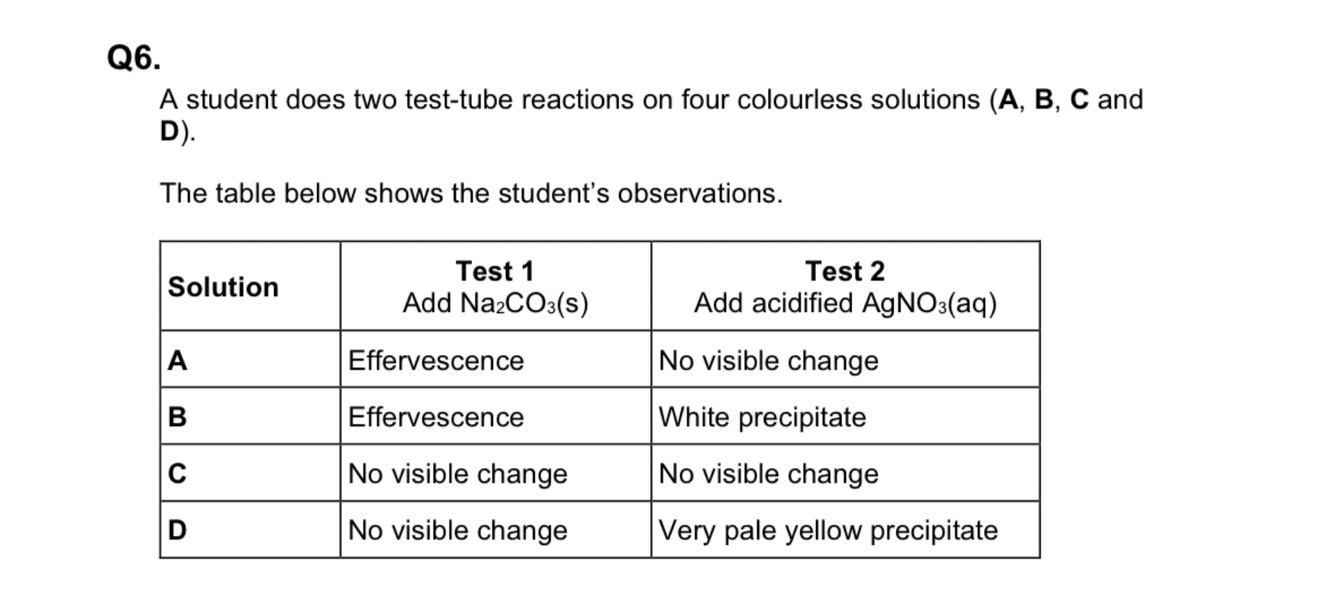
• Describe a series of tests that the student can use to show that solution C contains ammonium sulfate (4)
• Warm with NaOH • Damo red litmus paper near mouth of test tube turns blue • Add acidified BaCl2 • White precipitate forms is sulfate ions present