The Oceans
No description yet. This curated deck is ready for daily study.
Card preview (24)
What happens when ionic compounds dissolve in water?
The ionic lattice breaks up New bonds are formed between water molecules and the seperate ions
What is the enthalpy change of solution? What is its symbol?
ΔsolutionH The enthalpy change when 1mol solute dissolves to form a solution e.g. CaCl2(s) + (aq) → Ca2+(aq) + 2Cl-(aq)
What is lattice enthalpy? What is its symbol?
ΔLEH Enthalpy change when 1mol ionic solid formed from gaseous ions e.g. Ca2+(g) + 2Cl-(g) → CaCl2(s)
What is enthalpy change of hydration? What is its symbol?
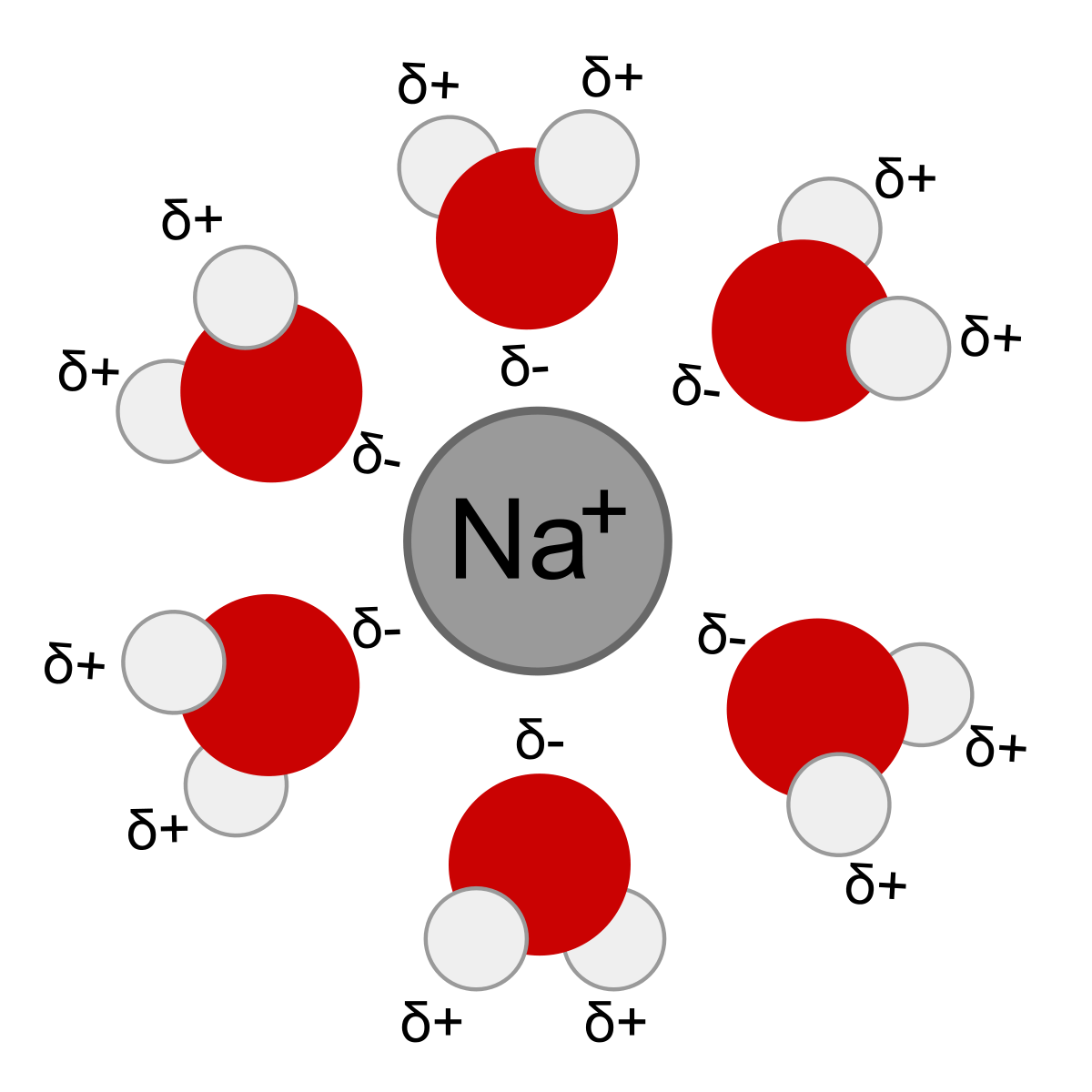
ΔhydH Enthalpy change when 1mol gaseous ions is hydrated by forming bonds to water molecules e.g. Ca2+(g) + (aq) → Ca2+(aq)
What is a hydrated ion?
Ion bonded to/surrounded by water molecules Bonded by ion-dipole bonds
What factors will cause lattice enthalpy to be more negative?
Ions in lattice more highly charged Ions in lattice smaller i.e. more negative if ions have greater charge density
What factors will cause the enthalpy change of hydration (of ions) to be more negative?
Ionic charge is greater Ionic radius is smaller i.e. more negative if ions have higher charge density
Why will the enthalpy change of hydration be more negative if the ion has a greater charge density?
Because this means the ion attracts more water molecules/forms stronger ion-dipole bonds Hence the energy released by bond forming is greater
If a different solvent is used to water, what is enthalpy change of hydration called and what is its symbol?
Enthalpy change of solvation ΔsolvH
What formula can be used to measure ΔsolH experimentally?
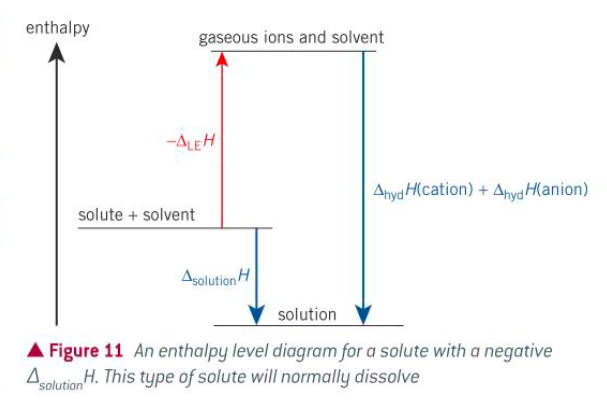
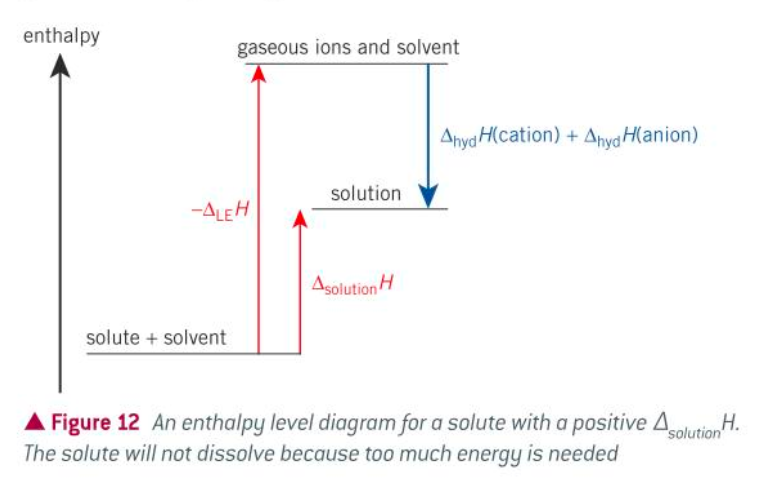
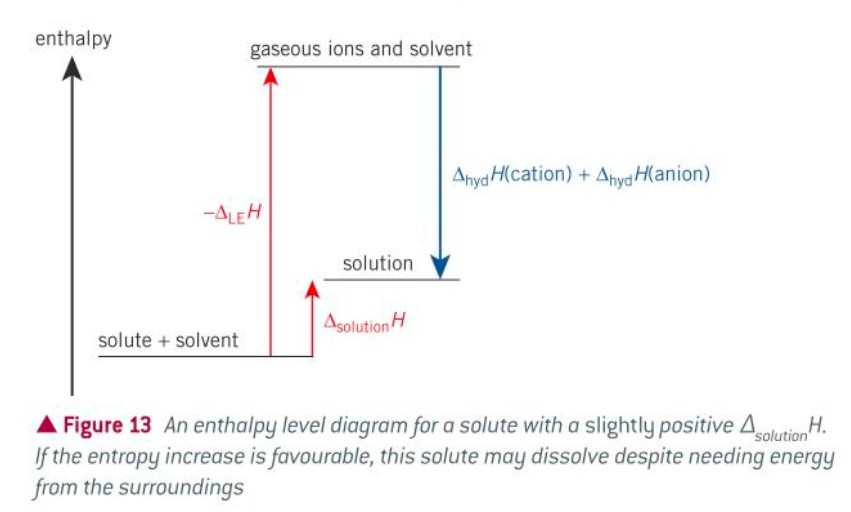
ΔsolH = (ΔhydH(cation) + ΔhydH(anion)) - ΔLEH Can be used to construct a Hess’ Cycle
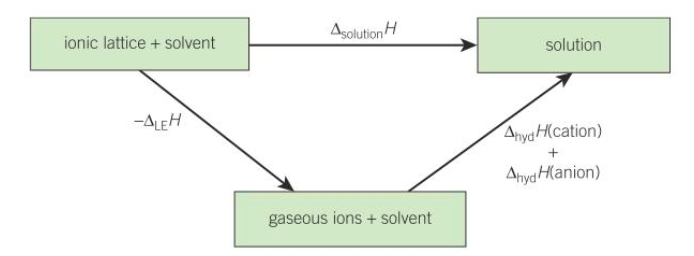
Draw an enthalpy level diagram for the dissolution of a water-soluble salt
Draw an enthalpy level diagram for an insoluble salt
Draw an enthalpy level diagram for a salt that may be soluble
Many ionic substances are soluble in water. Explain why
Ionic bonds are broken when an ionic substance dissolves. Some hydrogen bonds also break between water molecules Ion-dipole bonds form between water molecules and the free ions The strength of the bonds formed is similar to the strength of the bonds broken So the energy released by bond formation is sufficient to compensate for the energy required to break the bonds between ions
Sodium chloride doesn’t dissolve in cyclohexane. Explain why
In order to dissolve, ionic bonds would need to break between the ions in the sodium chloride lattice Instantaneous dipole-induced dipole bonds would also need to break between the cyclohexane molecules Because cyclohexane molecules don’t have permanent dipole bonds, only weak ion-dipole bonds can form between cyclohexane molecules are the free ions The strength of the bonds that could form is much weaker than the bonds that would need to break So the energy released by bond formation is not sufficient to compensate for the energy required to break the bonds between ions
What is entropy?
A measure of the number of ways in which molecules + energy quanta can be arranged Shown by the symbol S
What is a feasible reaction/process?
One which can occur without any energy input However may occur very slowly (or have a high EA) A reaction is feasible if ΔtotS is positive
List the states of matter in order of increasing entropy (from lowest to highest)
Solids Liquids Solutions Gases
Why do gases have a greater entropy than solids?
Particles in a solid are rigidly fixed in place, whereas particles in a gas are free to move around + take up many different positions Hence there are more ways of arranging the particles + energy quanta, so entropy is greater
What is ΔtotS?
The total change in entropy of a process Is the sum of 2 entropy changes: The entropy change of the system - ΔsysS The entropy change of the surroundings - ΔsurrS
What is the formula for calculating the total entropy change of a process/reaction?
ΔtotS = ΔsysS + ΔsurrS
What is the formula for calculating ΔsysS?
ΔsysS = ΣS (products) - ΣS (reactants)
What is the formula for calculating ΔsurrS?
ΔsurrS = - ΔH / T Where T is temp given in K ΔH given in Jmol-1
If the forwards reaction of a reversible reaction is feasible (at a given temp), what signs will ΔtotS for the forwards and backwards reactions have?
For the forwards (feasible) reaction: + For the backwards (unfeasable) reaction: -