Integration of Metabolism
No description yet. This curated deck is ready for daily study.
Card preview (24)
What is the % body weight of muscles and which energy sources do they use?
40% of total body weight uses carbohydrates and FA
What is the % body weight of brain and which energy sources do they use?
2% of total body weight - uses 20% of resting metabolic rate uses mainly carbohydrates, cannot use FA
What is the % body weight of adipose tissue and what do they store?
15% total body weight Long-term storage of triacyl glycerols
What is the % body weight of heart and which energy sources do they use?
1% total body weight - uses 10% of resting metabolic rate uses carbohydrates and FA
What is the % body weight of liver and what does it store?
2.5% of total body weight - uses 20% of resting metabolic rate glycogen storage and source of blood glucose
Which energy source does the brain need continuously?
Glucose
What can partially substitute for glucose in the brain?
ketone bodies (e.g. β-hydroxybutyrate)
What are the terms called when there is not enough blood glucose or too high blood glucose?
Hypoglycaemia Hyperglycaemia
How is the energy supplied for light contraction of skeletal muscle?
OxPhos
How is the energy supplied for vigorous contraction of skeletal muscle?
O2 becomes limiting factor → Glycogen breakdown in muscles → Lactate formation
Can heart muscle also rely on anaerobic metabolism?
No, it utilises only aerobic metabolism
Which energy sources can the heart use?
TCA cycle substrates (e.g. free fatty acids, ketone bodies)
Which organ/tissue can interconvert nutrient types?
Liver
What is the normal range for blood glucose?
4.0-5.5 mM
What happens to Acetyl CoA during fasting?
Rather than entering TCA cycle, most of it is converted into ketone bodies
Which enzyme is used to convert lactate back to pyruvate?
Lactate dehydrogenase (LDH)
What is glycerol converted into for gluconeogenesis?
DHAP
Which molecules can be derived from amino acids to start gluconeogenesis?
Oxaloacetate and Pyruvate
What is lactate converted into for gluconeogenesis?
Pyruvate
How is gluconeogenesis not just reverse glycolysis?
Irreversible steps in glycolysis need to be bypassed
What is the net change in ATP for gluconeogenesis?
net loss of 6 ATP
Gluconeogenesis How is pyruvate kinase bypassed?
1st step: Pruvate converted into oxaloacetate by pyruvate carboxylase 2nd step: Oxaloacetate converted into phosphoenolpyruvate by phosphoenolpyruvate carboxykinase
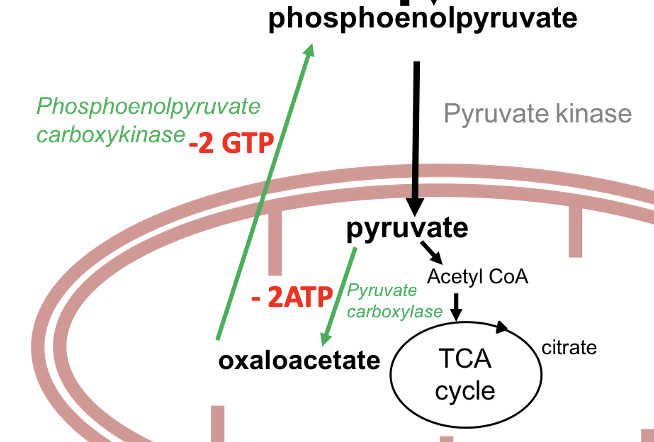
Gluconeogenesis Which enzyme bypasses phosphofructokinase?
Fructose 1-6 bisphosphatase
Gluconeogenesis Which enzyme bypasses hexokinase?
Glucose-6-phosphatase