1.3.1 Databases
No description yet. This curated deck is ready for daily study.
Card preview (13)
What is a database?
A structured store of data. Usually consists of tables, fields, and records.
What is a flat-file database, and what issues do they face?
A database where all data is stored in one table • Difficult to change the format of the data • Space is wasted through redundant data which increases the size of the database • Data is harder to update as it could be in multiple places - Data might become inconsistent for example the amount of an item in stock might be reduced in one record but not in other records. • Data access speed is slow
What is a relational database, and what are the benefits of using them?
Multiple related tables • Simpler to change the format of data • Saves space by reducing data duplication • Maintains data consistency/integrity • Improved security as able to control access to data
Define and give an example of a primary key
A field that has a unique value to act as a unique identifier for every record in that table. Example: UserID in a table of users
Define and give an example of a foreign key
• A field that links to a (primary) key in a second table. • Provides a link between tables Example: CustomerID in an orders table to link to the users table
Define and give an example of a secondary key
• Not unique but are likely to be the fields that users are likely to want to search by. • Indexed allowing for faster searching. Example: Surname or date of birth in a user table.
Define indexing and its associated pros and cons.
The index gives the position of each record according to its primary key. Advantage: Searches of indexed fields can be performed more quickly. Disadvantage: The index has to be rebuilt on edit and takes up extra space in the database.
What three types of database relationships exist, and which one is prohibited?
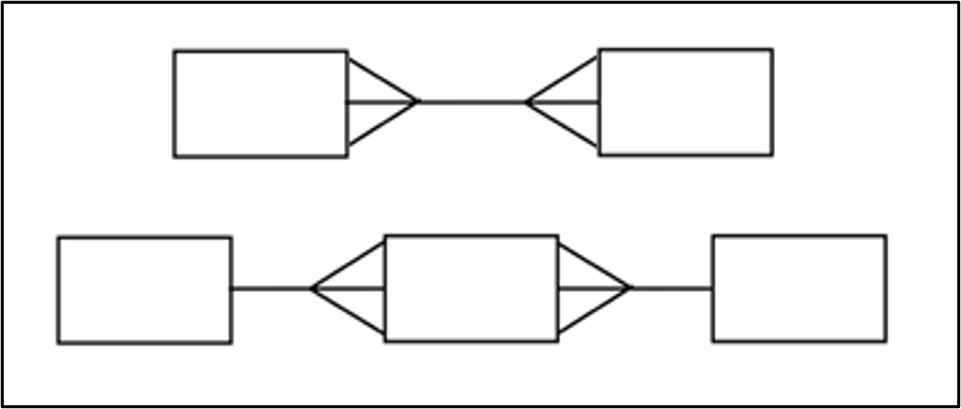
• 1:1 – One to One • 1:M – One to Many • M:M – Many to many M:M - These need to be resolved using a middle table with many coming out of each side.
What would a resolved M:M relationship diagram look like?
M:M - These need to be resolved using a middle table with many coming out of each side.
Give some examples of how data can be captured
• Online Form • Optical Character Recognition (OCR) • Optical Mark Recognition (OMR) • Sensors
Give some examples of sensors and what they may be used for.
Altimeter: Measures height from sea level Accelerometer: Measure forces – When it moves. Gyroscope: Used to measure rotation. Thermistor: To read the temperature GPS: To determine geographical location Magnetometer: To determine direction. Heart rate sensor: Detects electrical activity in the heart
Give some examples of the methods used to exchange data
CSV: A format with values separated by commas JSON: Uses human-readable text to transmit data objects consisting of attribute-value pairs XML: A mark-up language that uses tags to denote data. API: A prewritten set of subroutines that provide access to a company’s data. Used by programmers to transfer data between computer systems.
Data Capture: What is OMR and OCR?
Optical Mark Recognition (OMR) - Reads marks on pre-formatted forms to enable inputs to be quickly scanned. Also reduces human error. Optical Character Recognition (OCR)- Allows a computer to identify characters and convert them into their binary equivalents. Example use: Automatic number plate recognition (ANPR).