Module 1: Deck 1/Questions 1-7
No description yet. This curated deck is ready for daily study.
Card preview (24)
What are the four major lipoprotein particles? 4
• chylomicrons 2. very low density lipoproteins 3. low density lipoproteins 4. high density lipoproteins
What are the largest lipoproteins?
chylomicrons
What characterized chylomicronemia syndrome? 5
• abdominal pain 2. hepatosplenomegaly 3. pancreatitis 4. eruptive xanthomas 5. lipemia retinalis
Conditions that exacerbate hypertriglyceridemia? 7
• poorly controlled DM 2. excessive alcohol intake 3. atherogenic diets 4. hypothyroidism 5. nephrotic syndrome 6. HIV 7. other insulin resistance states
Commonly implicated drugs associated with hypertriglyceridemia? 5
• estrogens 2. tamoxifen 3. glucocorticoids 4. HIV drug therapies 5. isotretinoin
How are Chylomicrons formed? 1
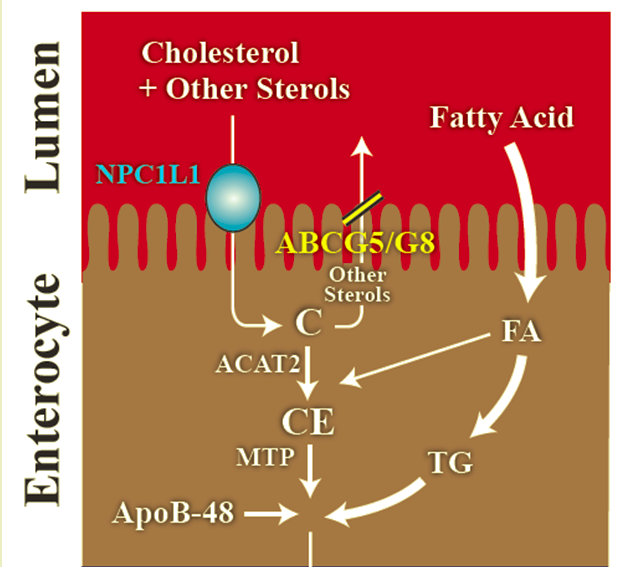
How are chylomicrons formed? 2
Following ingestion of a fatty meal, dietary lipid are emulsified by (1) into mixed (2) which are hydrolyzed by (3) in the (4). About 50% of luminal cholesterol, the majority of which is (5) in origin, is absorbed into (6) each day. Absorption of free cholesterol and non-cholesterol plant sterols is facilitated by (7). Luminal TG are broken down into (8). These (9) are then absorbed from the (10) into the (11). The enterocyte, free cholesterol is esterfied into (12) by (13).
• bile salts • micelles • pancreatic lipases • Proximal small intestine • biliary • enterocytes • Niemann-Pcik C1-Like 1 (NPC1L1) protein • 2 monotriglyceride and fatty acids • fatty acids • lumen • enterocyte • cholesteryl esters • acyl-coenzyme A (CoA): cholesterol acyltransferase-2 (ACAT-2).
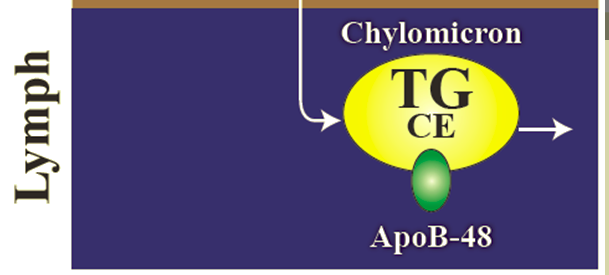
The great majority of absorbed plant sterold are transported back into the (1) by the ATP binding cassette transporter (2). Fatty acids combine with (3) to form triglycerides. (4) combines with cholesteryl esters; triglycerides that are incorporated via microsomal triglyceride transfer protein, apolipoprotein A-I, and apolipoprotein A-IV to form (5), that are secreted into the (6) and subsequently, into the (7).
• intestinal lumen • G5/G8 protein • glycerol • ApoB-48 • nascent chylomicrons • intestinal lymphatics • systemic circulation
Nascent chylomicrons are formed from what ? 3
Triglycerides that are incorporated via microsomal triglyceride transfer protein, apolipoprotein A-I, and apolipoprotein A-IV to form
G5/G8 protein is what kind of transporter?
ATP binding cassette transporter
Following nascent chylomicrons are are secreted into the circulation, their premature clearance is prevented by?
Apo B-48
Apo B-48 facilitates the binding of what? and prevents what?
• lipids to chylomicrons • receptor-mediated hepatic re-uptake
Once the circulation, nascent chylomicrons acquire apos (4) from what?
• Apos C-I, C-II, C-III and E • From HDL particles
What is the most important enzyme in the catabolism of chylomicrons?
lipoprotein lipase (LPL)
What facilitates the interactoin between LPL and TG carrying lipoproteins?
ApoE
How does Apo E facilitate the interaction b/w LPL and TG carrying lipoproteins?
presumably by • slowing the movement of these lipoproteins along the capillary endothelium and • ehancing their interaction with the endothelial cell proteoglycans
LPL’s ability to hydrolyze chylomicrons is facilitaed by co factors? 2
Apo C-II and Apo A-V (Apo C-III is an inhibitor of LPL)
Following free fatty acid release from chylomicrons, (1), rich in (2) are formed.
• chylomicron remnants • esterfied cholesterol and Apo E
How does chylomicron remnant uptake occur? 2
• via receptor mediated endocytosis through the interaction of apo E with the chylomicron remnant receptor (also known as the LDL receptor-like protein (LRP)) or • via the hepatocyte LDL receptor.
What component is required for the hepatic assembly of VLDL particles?
microsomal TG transfer protein
The liver produces VLDL particles that provide an additonal source of circulating fatty acids and deliver cholestrerol, via catabolism of LDL particles, to what?
peripheral tissues
VLDL assembly requires what? 3
• cholesteryl esters • TG • Apo B-100
How does the process of VLDLassembly begin?
when apo B-100 is translocated to the endoplasmic reticulum and interacts with microsomal TG transfer protein (MTP)